A two-page resume won’t crush your chances as long as two pages are needed to showcase your relevant qualifications. However, don’t buy into the belief that listing your entire work history is necessary either.
Think of yourself as Procter & Gamble when conducting a job search — you are, in essence, selling a product (yourself) to a buyer (an employer) who needs to solve a problem. Your task is to demonstrate quickly how you can help solve it. If the buyer wants whiter teeth, they don’t really care how Crest’s 3D White Brilliance evolved. Advertising focuses solely on why it will give you a brighter smile now.
See how to get the right length for your resume, whether that’s one or two pages.
Understanding Resume Length Best Practices
Conventional wisdom says a one-page resume is best for entry-level workers, and a two-page document is ideal for upper-level and executive positions. But your choice of length has everything to do with how you want to position yourself.
Share the right amount of experience for the target role. Are you a young professional who wants to move up? You might benefit from a two-page resume demonstrating growth in your industry. Are you tired of being in a leadership role and want to move down in the hierarchy? Condensing your two-page resume to one, bringing focus to the necessary technical and basic skills, can be an advantage.
The one-page resume tradition
According to Wikipedia the resume originated in the 1400s with Leonardo De Vinci’s letter to a potential employer. Since then, it has been accepted as a quick summary of an individual’s education and experiences. This document allows employers to move through the review of candidates quickly — skim a candidate’s qualifications, decide whether to interview them, conduct the interview, and make an offer.
Even though employer expectations differ today, here are some scenarios where a one-page resume is still recommended.
- When an employer specifically requests a one-page resume. The recruiter may set this limit because of their own time constraints, personal preference, or to see which candidates can and will follow directions.
- If you are an experienced candidate wanting to move into a lower-level position. Demonstrate the skill sets and technical knowledge needed for that job, helping your reader “see” you in the role without getting mired in details of past management positions.
- If you are a new college or high school graduate with less than 10 years of work experience.
When can a resume be two pages?
A two-page resume is preferred for executives, upper-level managers, and those with experience beyond 10 years. A curriculum vitae, consistently longer than one page, is always expected for roles in scientific research, academia, and the fine and performing arts.
The Impact of a Two-Page Resume on Job Applications
A two-page resume will support your job applications, provided you follow some best practices in its creation. After all, Applicant Tracking Systems (ATS) collect and sort resumes the same way regardless of length. Also, because hiring managers want a robust pool of qualified candidates, they typically don’t mind a two-page resume if it’s necessary to tell your professional story. But no fluff, please.
Pros of a two-page resume
- You can show advancement in your field and progression in responsibilities, indicating your stability and worthiness of promotions.
- You can outline specialized knowledge and technical skills pertinent to your industry, especially important for entry-level applicants, engineers, and information technology (IT) professionals.
- You have more room to demonstrate your accomplishments in each role and activity listed and provide a well-rounded picture of your professional and volunteer service if it applies to the targeted job.
Cons of a two-page resume
- There is always the possibility that a hiring manager won’t read the second page of your resume, but why not give them a chance to see all the reasons you’re a viable interview candidate?
- You might dilute the presentation of your qualifications. However, if you place the most important information on the first page, that should not be a problem.
Crafting an Effective Two-Page Resume
How do you decide if you need a two-page resume? Start with these guidelines.
- If you have 10 or more years of work experience in the same industry or type of role, assume you need two pages. This will allow you to show progression in responsibilities and job titles.
- If you are a manager or executive, use two pages to detail your work history over the past 10 to 15 years. The exception? If you’ve changed career fields sometime along the way, list only the past five to six years.
- Engage your readers by emphasizing and quantifying (if possible) exactly how you added value, solved problems, or improved the environment in each position.
- Place your most pertinent qualifications for the job on the first page.
- Put your name and page number in the footer of both pages to keep a stray page from losing its mate.
Essential components of a two-page resume
On the first page, list:
Note to new graduates: place your education on the first page since it is likely your biggest asset in the job market currently. If you have no related work experience but have served in campus leadership roles, be certain to list them and detail responsibilities and accomplishments in those positions.
On the second page:
- Continue with the next most relevant experience, education, and associations. You might consider including hobbies and service activities if they are applicable and space is available.
Design and layout considerations
- Be mindful of the page break between the first and second pages. To visually balance content across the two pages, keep job description text and short categories grouped together without separation. Adjusting document margins can also help with this.
- Use a professional template to ensure a clean and attractive layout.
Real-World Examples of Successful Two-Page Resumes
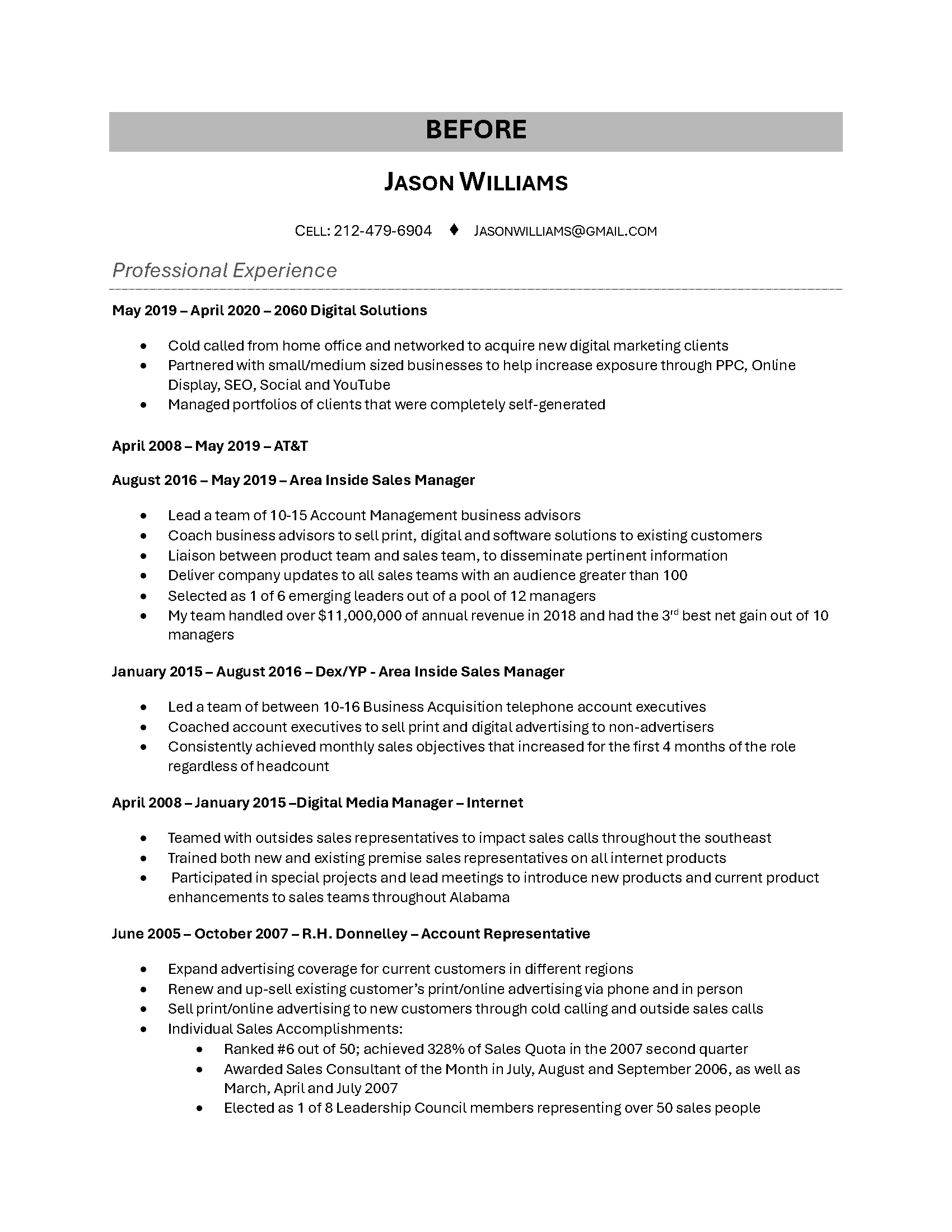
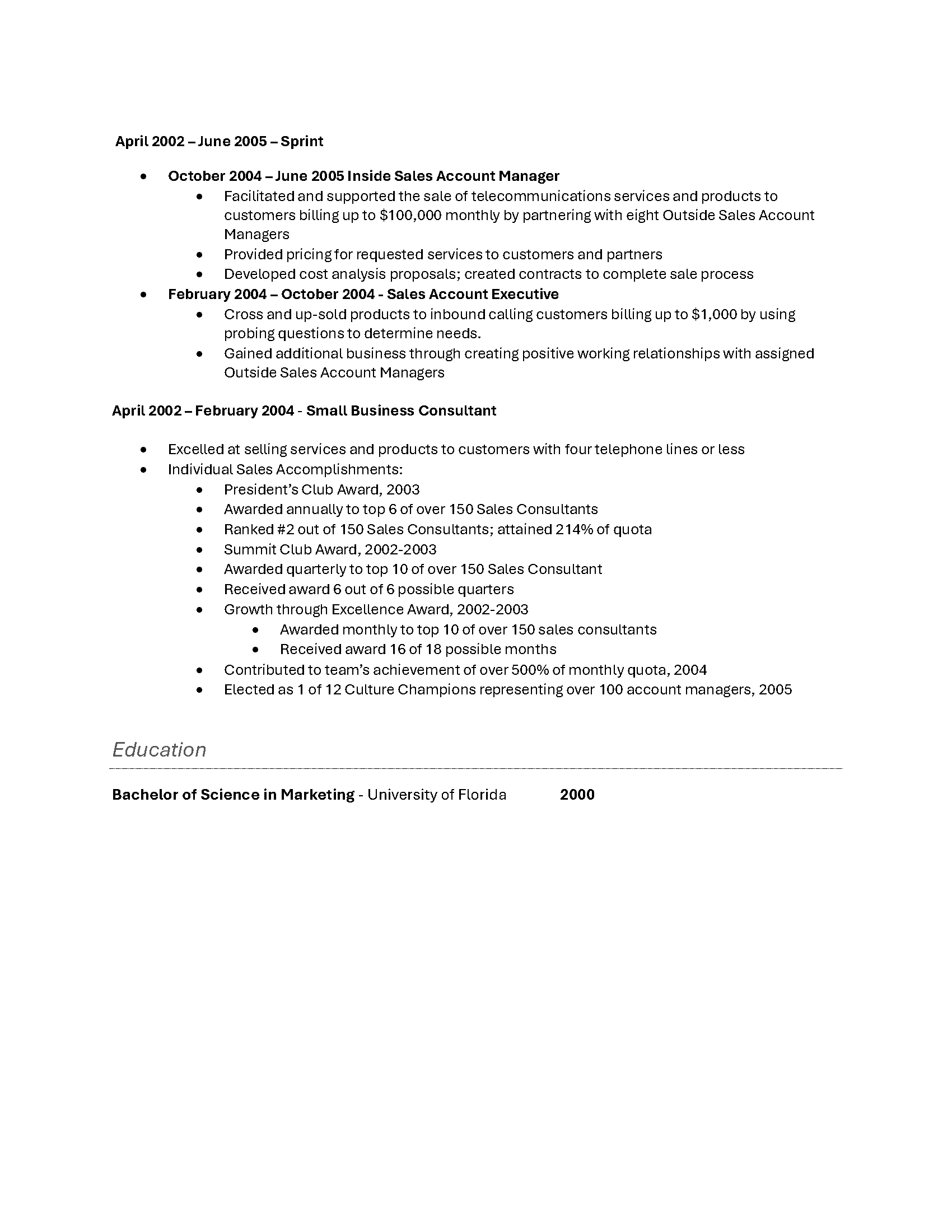
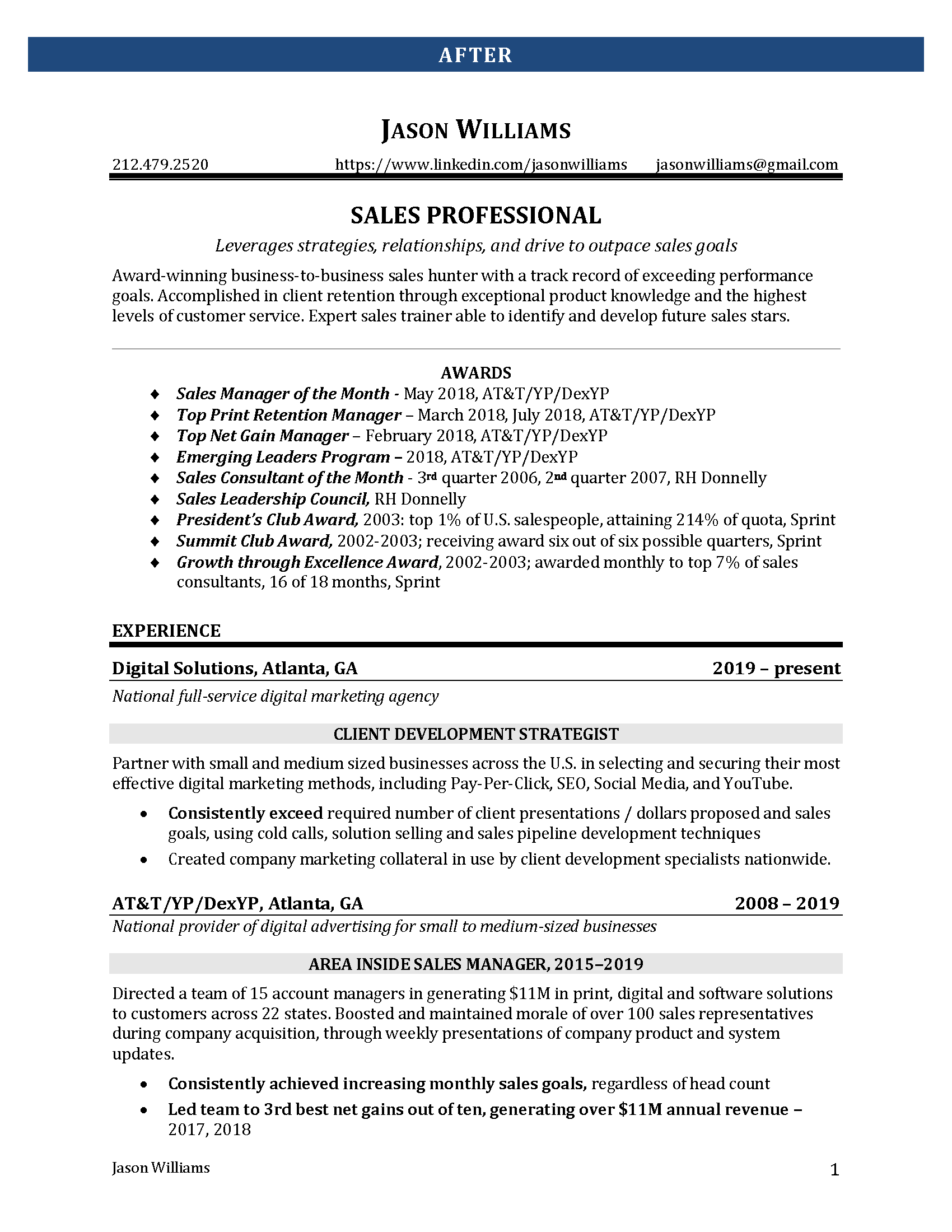
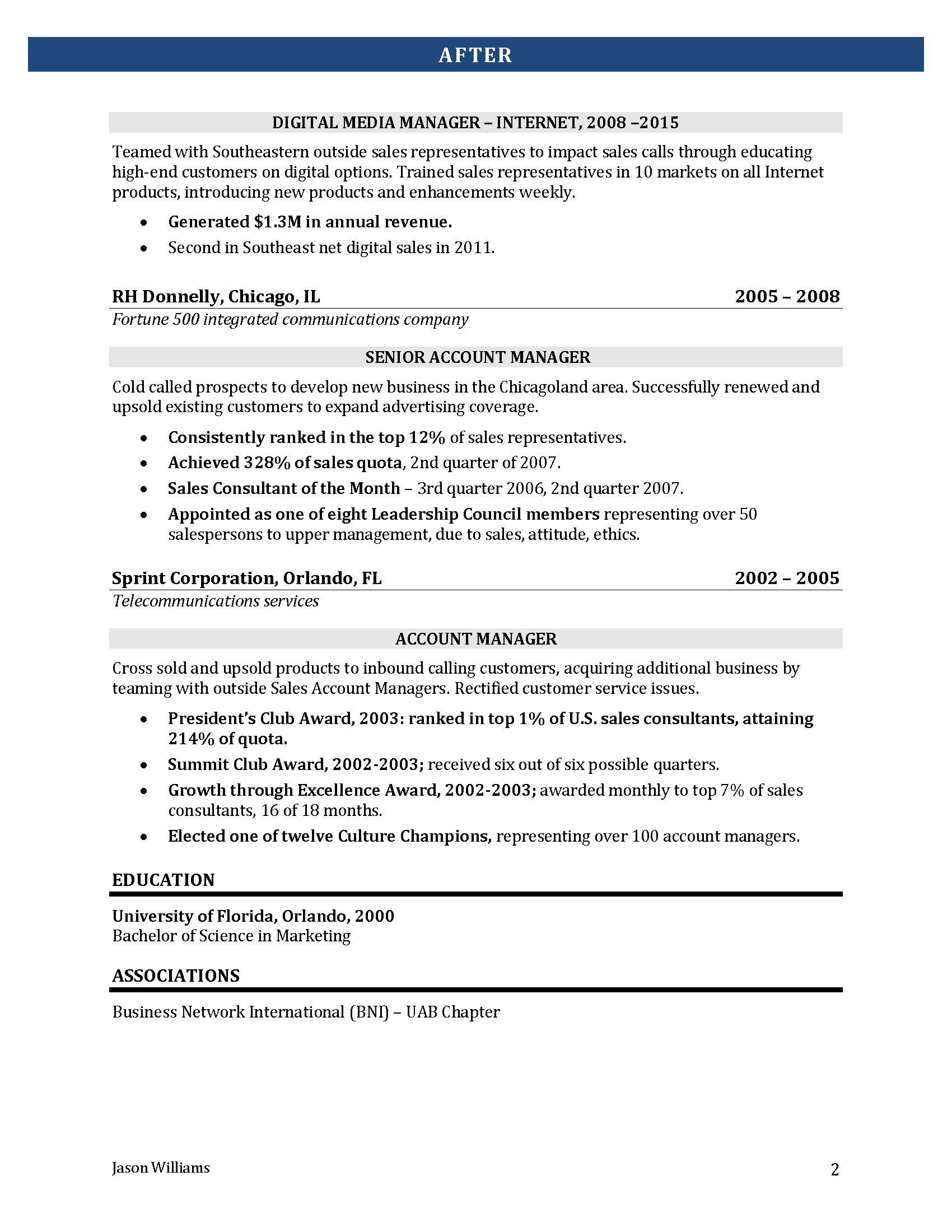
Let’s look at the difference a well-crafted two-page resume can make to a job search. The resume makeover below won my client, Jason, interviews for an upper-level sales management role. His original resume was already two pages, but it benefited from the following:
- An updated format, strategically placed bold font, pleasing graphics, and bullets to help recruiters quickly find the information they seek — the experience, accomplishments, and qualities would Jason bring to a sales executive role.
- Top half front-page placement of his many accolades immediately provided credibility.
- A short and impactful summary focusing on his most relevant qualifications for the job target.
- Containment of job descriptions began on the first page to the first page, supporting continuity and an easy-to-follow narrative.
Expert Opinions on Two-Page Resumes
In case you’re still wondering if the traditional one-page guideline is best, Career Thought Leaders, a think tank for career coaches and resume writers, promotes two-page resumes as the norm for experienced candidates. The caveat for the writer is to evaluate the content carefully to ensure it applies to the job target.
SEO and Keyword Optimization Tips for Your Resume
- Using keywords relevant to your industry and the skills required is crucial regardless of resume length. Doing so helps employer ATS find and sort your resume.
- Find relevant keywords by scouring job postings of interest and querying AI platforms (e.g. ChatGPT and Perplexity). When possible, incorporate them into your Summary, Experience, Skills, and other categories. A word of caution: make sure you’ve used the abilities or tools indicated and can speak intelligently about them.
What if my resume only covers 1.3 pages?
If you can only cover one-third of the second page, I suggest condensing some information to fit the resume on one page. However, one and a half to one- and three-quarter pages is acceptable.
Should I include personal information, such as hobbies, random awards, and community activities, to make my resume two pages long?
Only if they will enlighten your reader about your suitability for the targeted job. For example, if the role needs a strategic mindset and you were a college chess champion, include that honor. There is a connection between playing chess well and the ability to plan and think analytically.
Is a three-page resume okay?
A three-page resume is generally not recommended, especially early in your career. Most hiring managers spend less than 10 seconds reviewing a resume, so a concise one- or two-page document is ideal for showcasing your most important qualifications. However, if you have decades of experience, extensive publications, or military service, and the position explicitly requests detailed information, a longer resume may be acceptable. Always prioritize relevance: omit outdated or tangential roles to keep the focus on what matters most for the current job.
What jobs to take off your resume?
Remove jobs that are irrelevant to your target role with no transferable skills or connection. For example, any roles older than 10-15 years that no longer reflect your current expertise. Similarly, any short-term gigs or temp positions where you cannot demonstrate significant achievements.
Focus instead only on positions that showcase your relevant work experience, skills and measurable contributions.
Certified Master Coach and Academy Certified Resume Writer
Carolyn Couch is a Certified Master Coach, Academy Certified Resume Writer, and Certified Etiquette Consultant. Over the past 20 years, she has helped thousands of professionals start, reinvent, and advance their careers with confidence.