
21 Best Server Resume Examples and Templates for 2025



As a professional restaurant server, it’s easy to overlook your resume, especially if you’ve primarily advanced your career by leveraging the local connections you’ve built within the hospitality industry. That said, having a strong accomplishment-driven resume is still important, as it allows you to pursue lucrative opportunities when applying cold.
The other advantage is that providing an exceptional resume shows that you’re willing to go above and beyond what’s expected of you, which grabs the eye of restaurant owners. This guide will provide expert tips and insights to help you translate your serving experience into a powerful marketing document.
Key Takeaways:
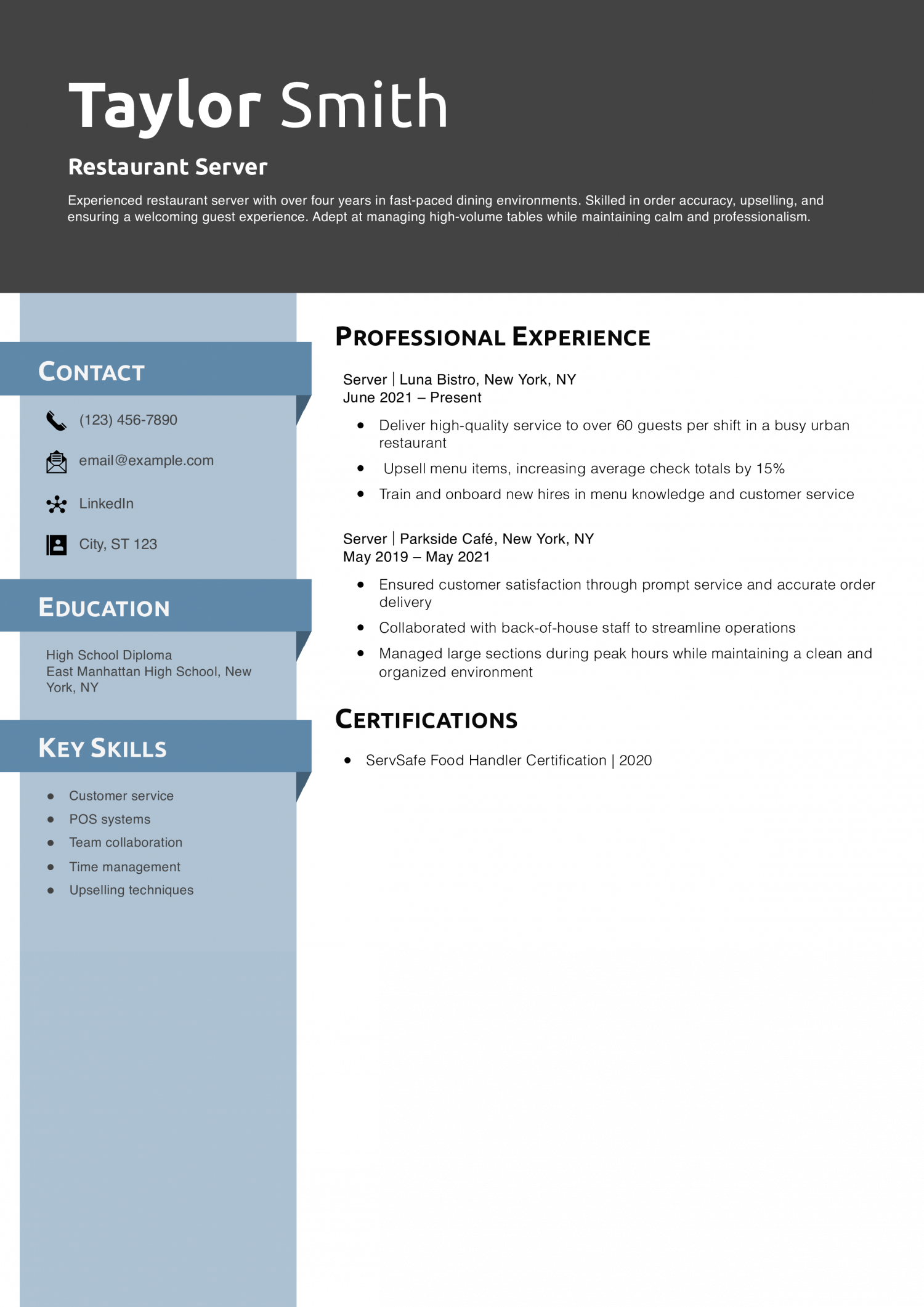
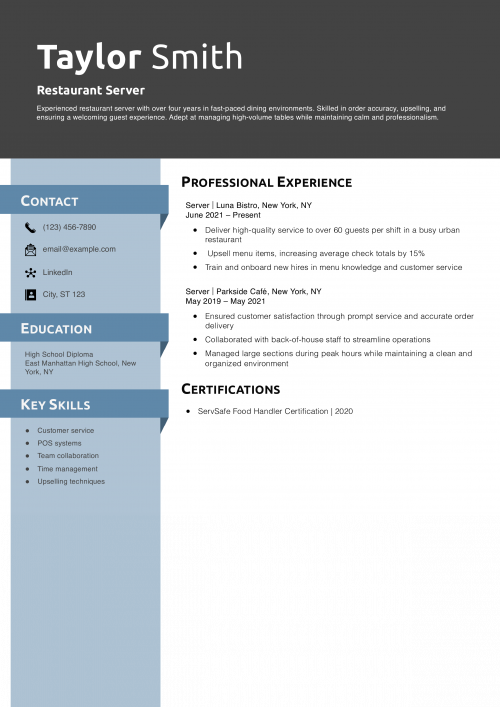
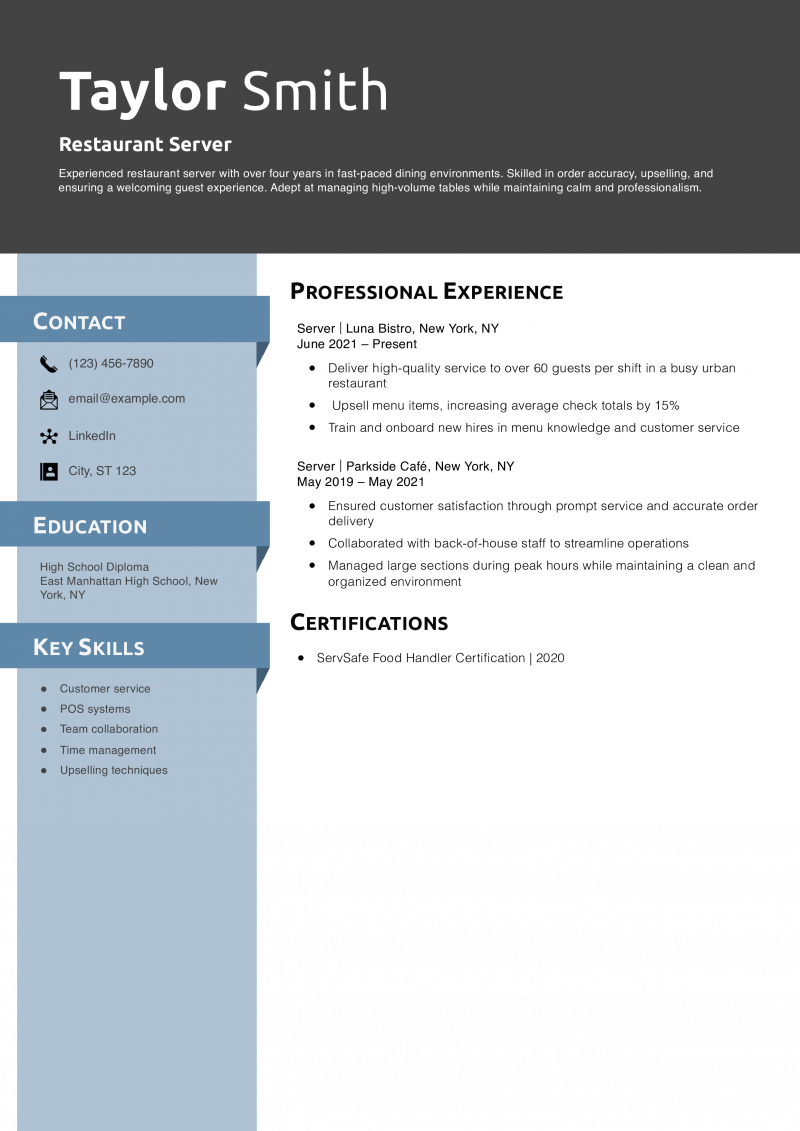
Taylor’s resume emphasizes core strengths such as guest satisfaction and efficiency. The focus on quantifiable achievements — like the 15% increase in sales — makes this resume results-driven and easy for hiring managers to evaluate. Learn how to write an effective resume in this guide.
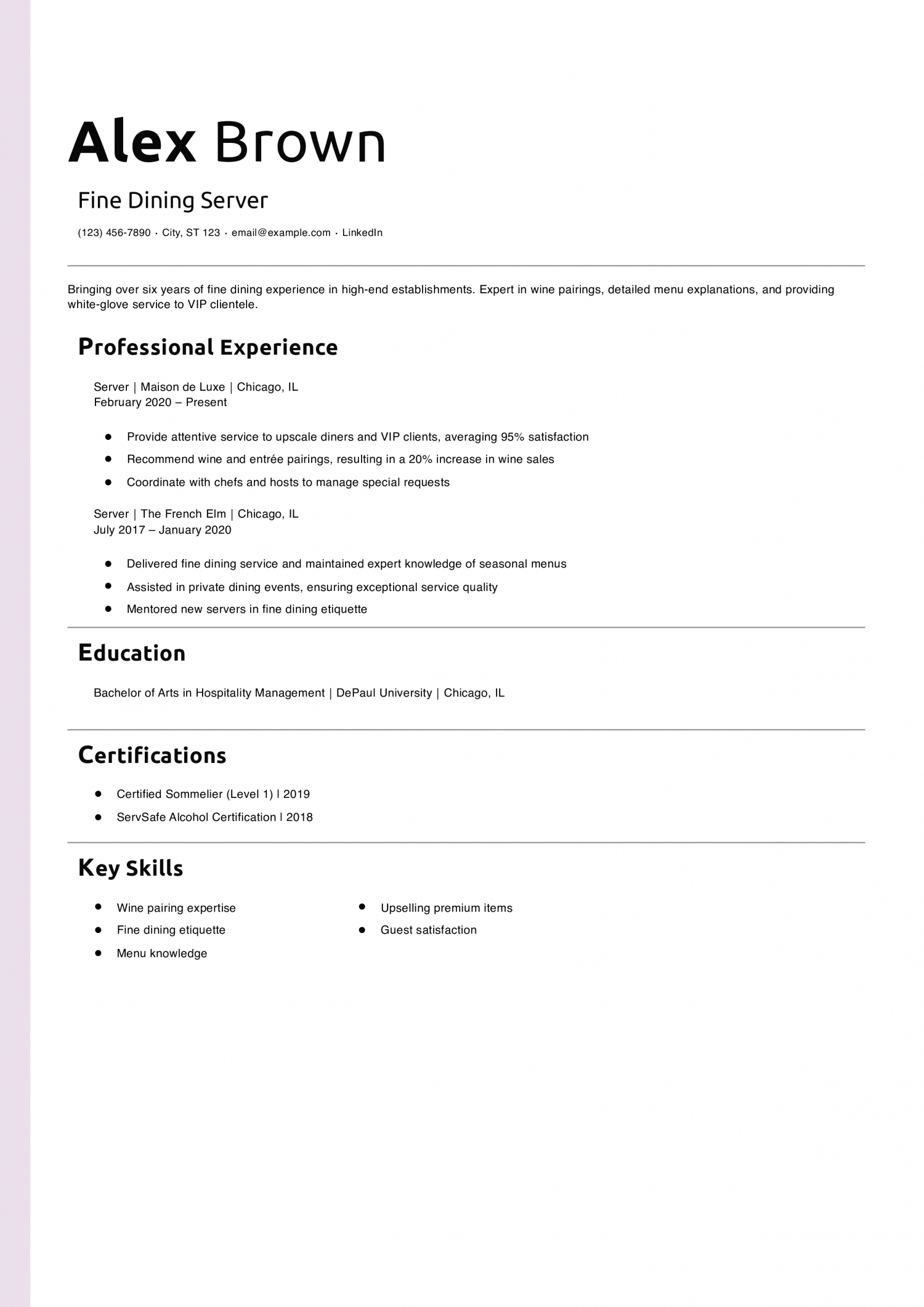
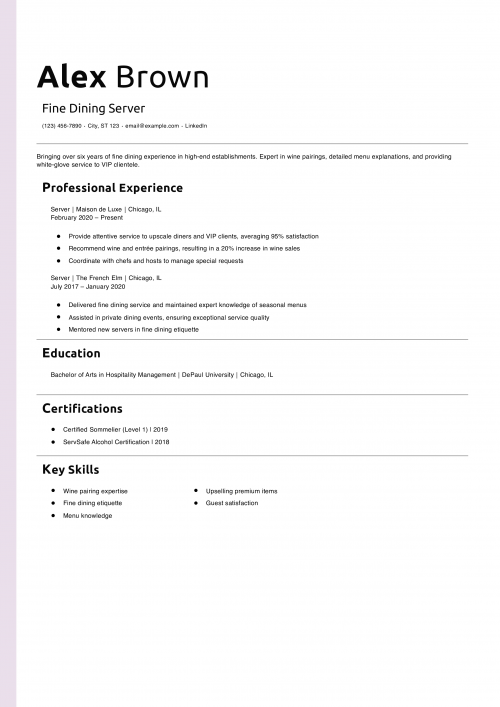
Alex’s resume demonstrates mastery of fine dining service, supported by certifications and measurable accomplishments. The 20% increase in wine sales shows a clear impact. Explore how to write a resume summary to craft your own strong profile.
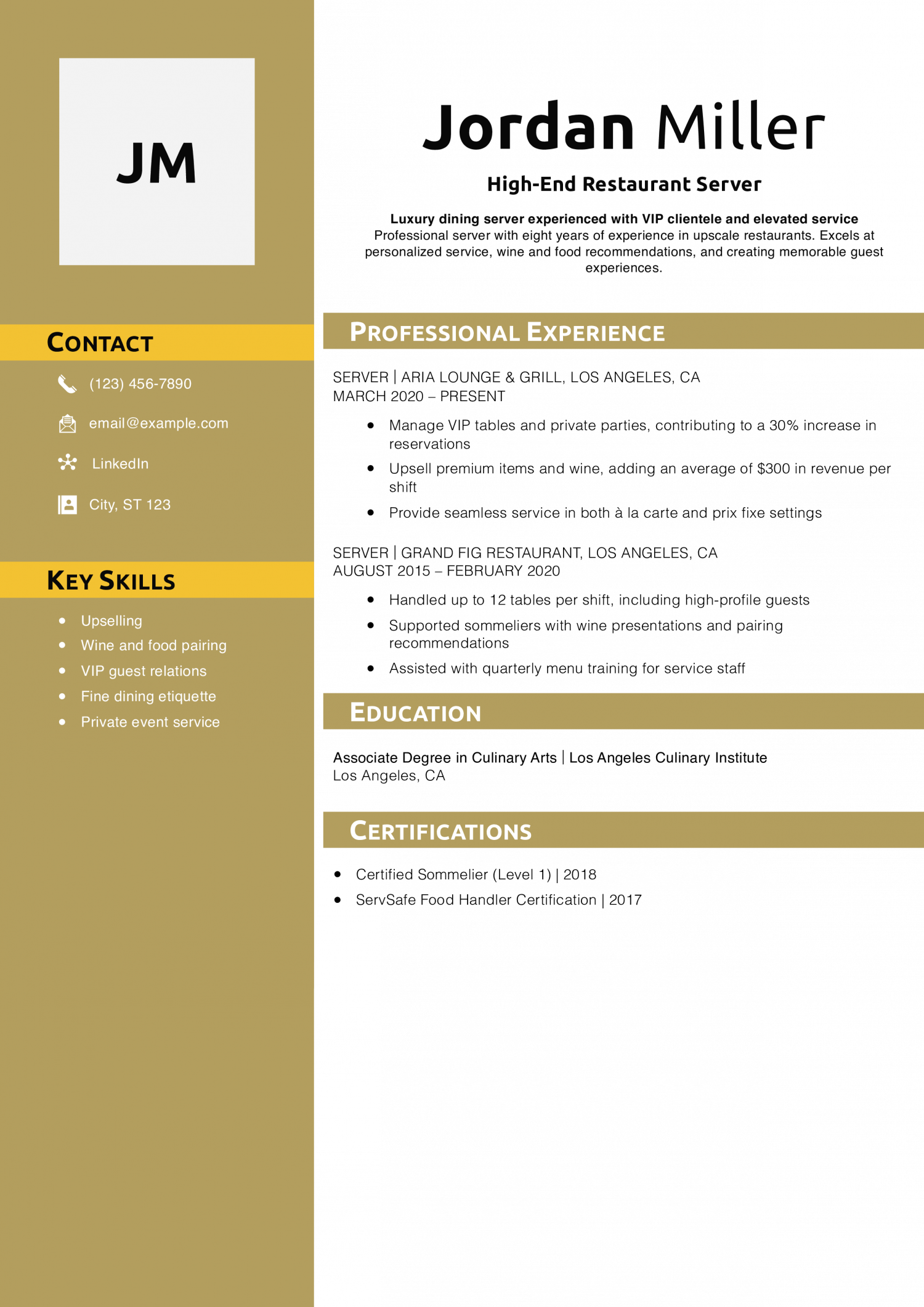
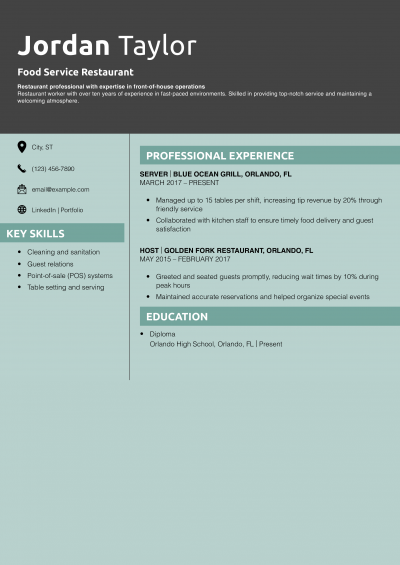
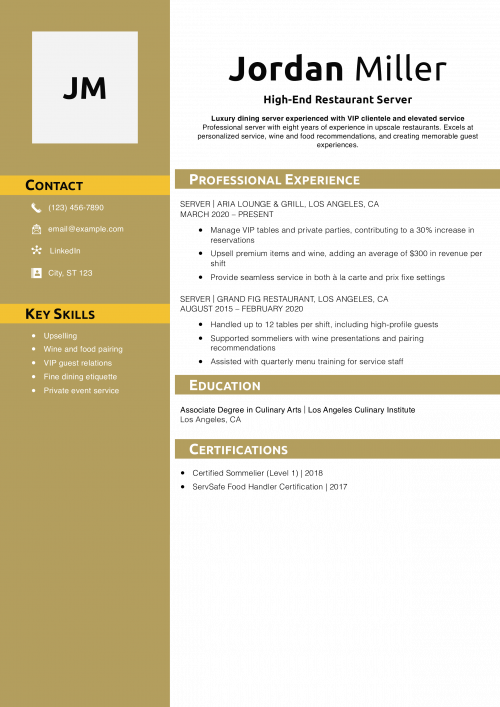
Jordan’s resume showcases his ability to provide exceptional service and boost revenue through upselling. The clear presentation of VIP experience makes him a top candidate for high-end venues. Learn how to put content on a resume.
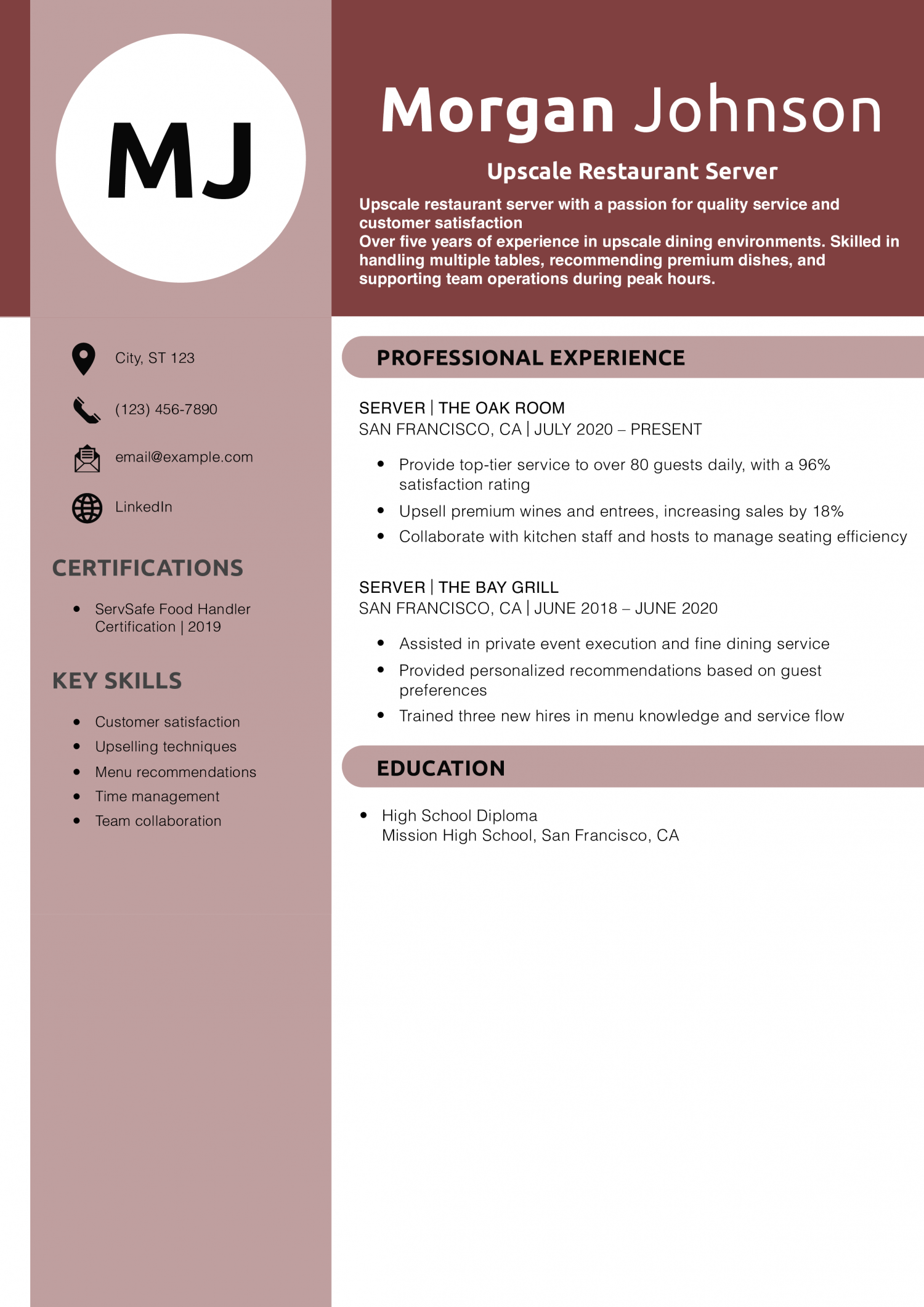
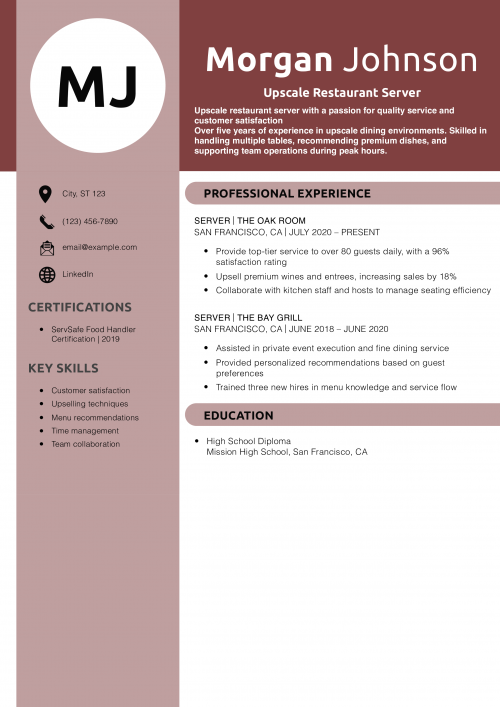
Morgan’s resume highlights sales growth through upselling and smooth coordination with the front and back of house teams. This is especially important in fast-paced upscale venues. Check out resume objective examples for guidance on your summary section.
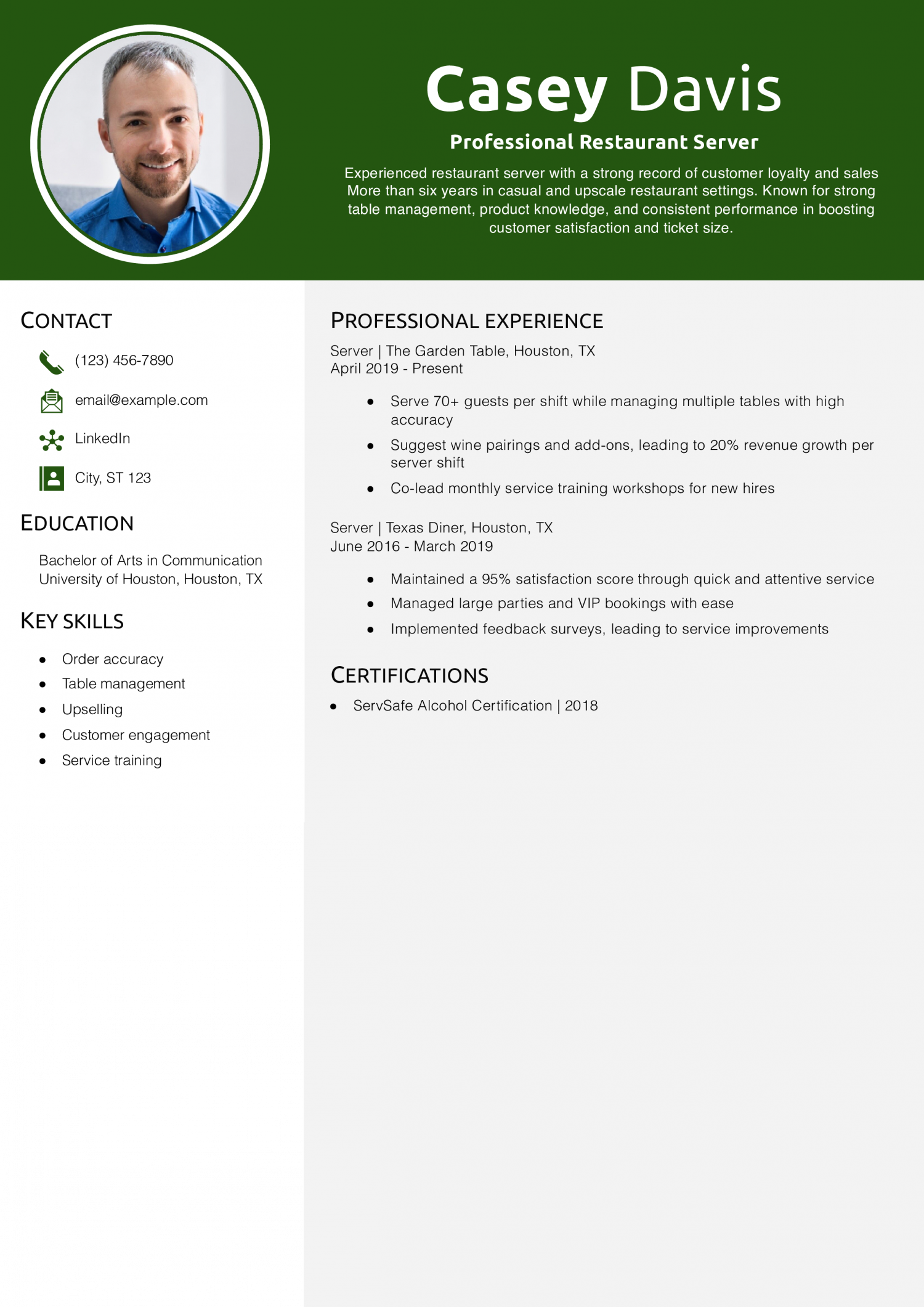
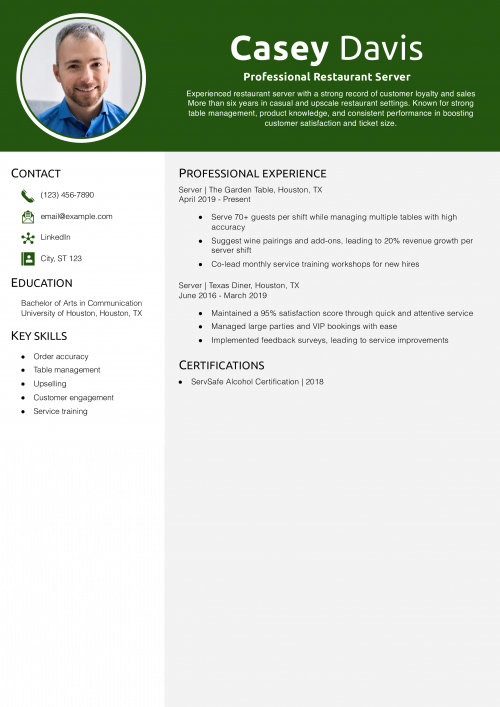
Casey’s resume communicates professionalism and measurable achievements, such as boosting per-shift revenue. The inclusion of service training also reflects leadership ability. Learn how to write a strong resume summary.

Jamie’s resume effectively showcases service readiness through volunteer and retail experience. The ServSafe certification adds credibility for entry-level applicants. Learn more about writing resumes with no experience.
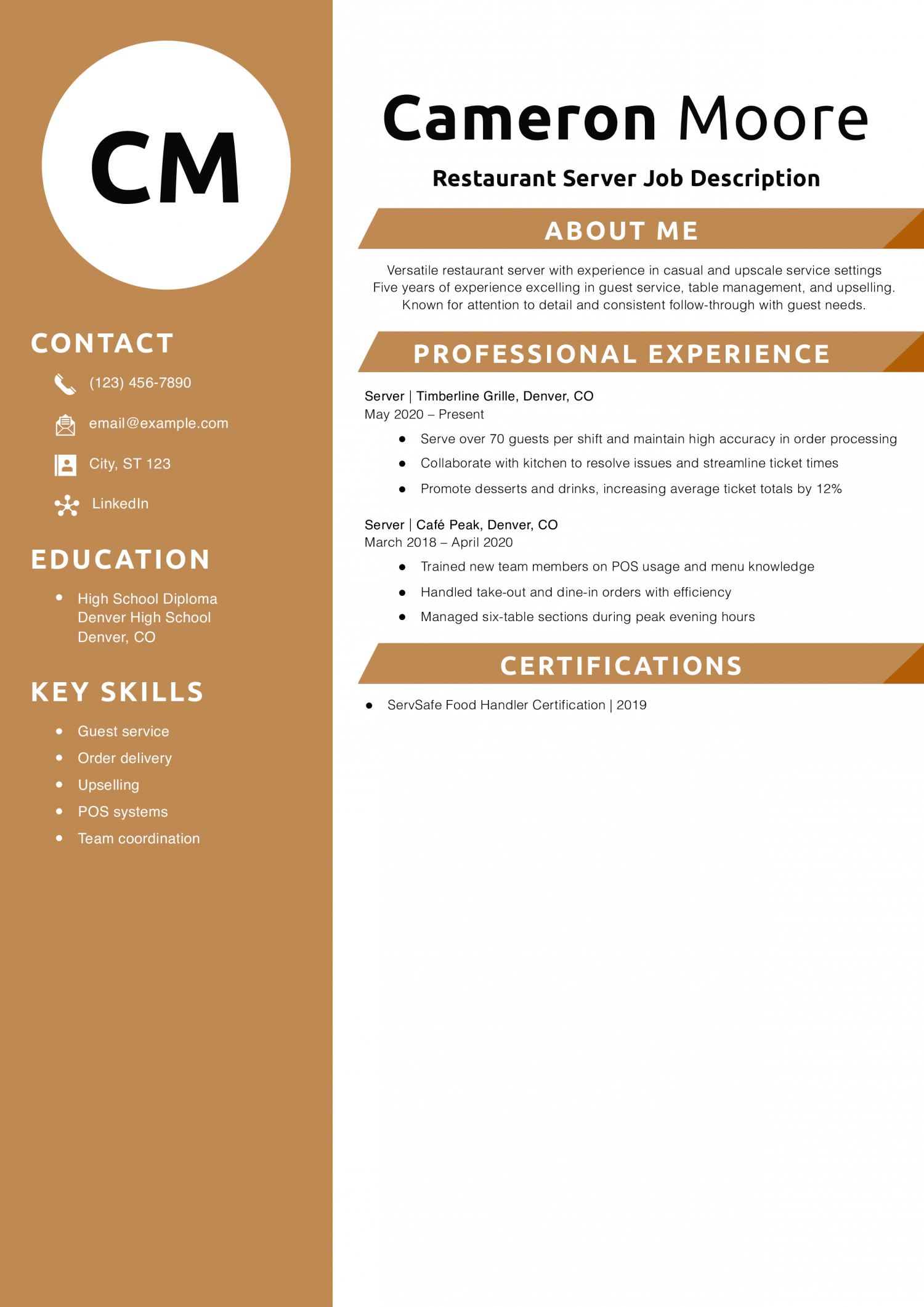
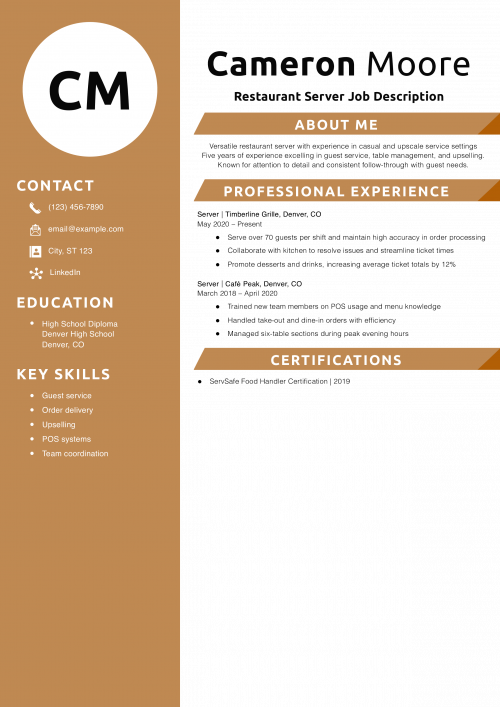
Cameron’s resume aligns closely with a standard job description, clearly mapping skills to daily tasks. It also includes action verbs and achievements. Learn how to use restaurant server job descriptions effectively.
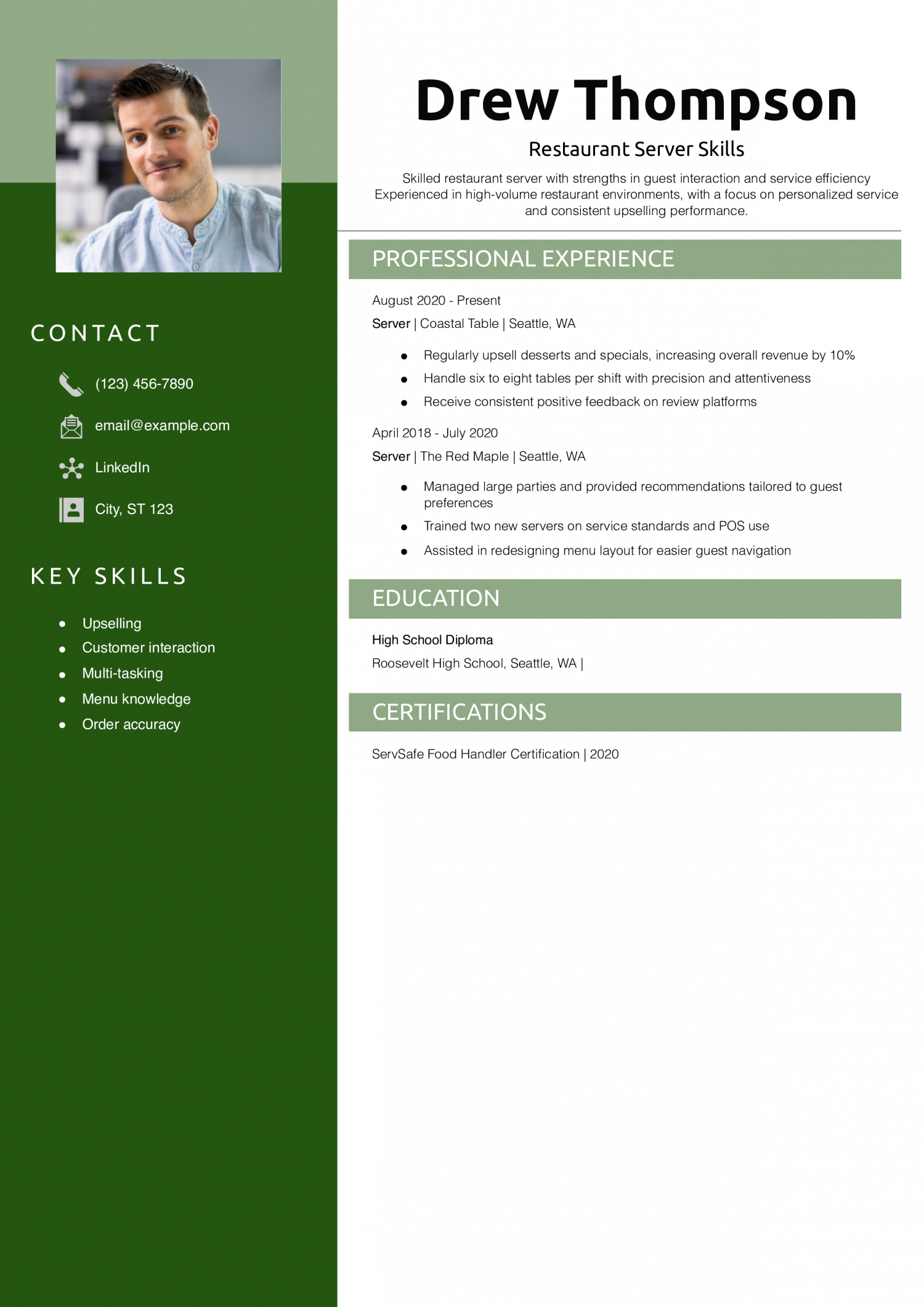
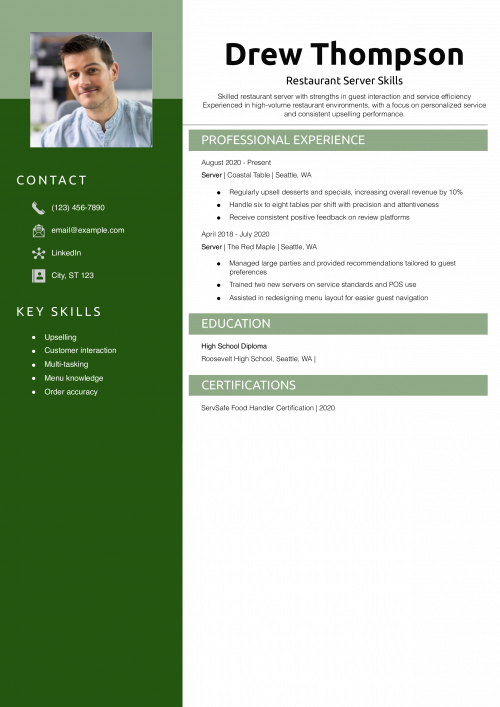
Drew’s resume highlights skill-specific achievements, like upselling and table management, with quantifiable results. For more tips on showcasing your abilities, explore skills to put on your resume.
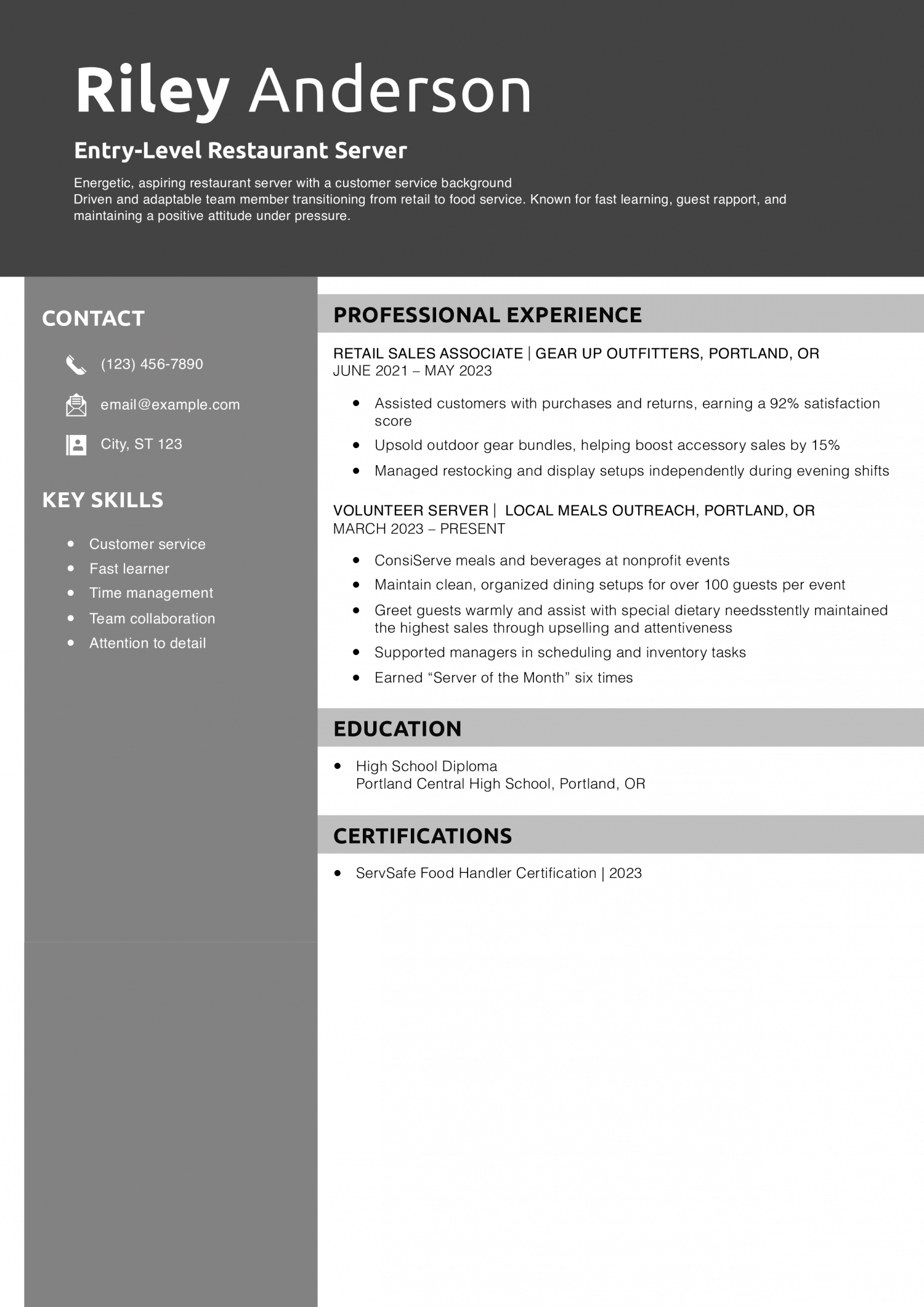
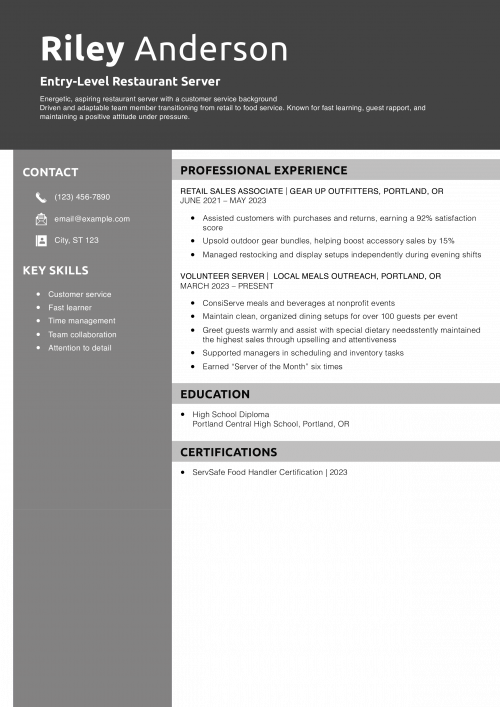
Riley’s resume focuses on transferable strengths from retail to restaurant service. Volunteering fills the experience gap and shows initiative. Learn how to write your first job resume.
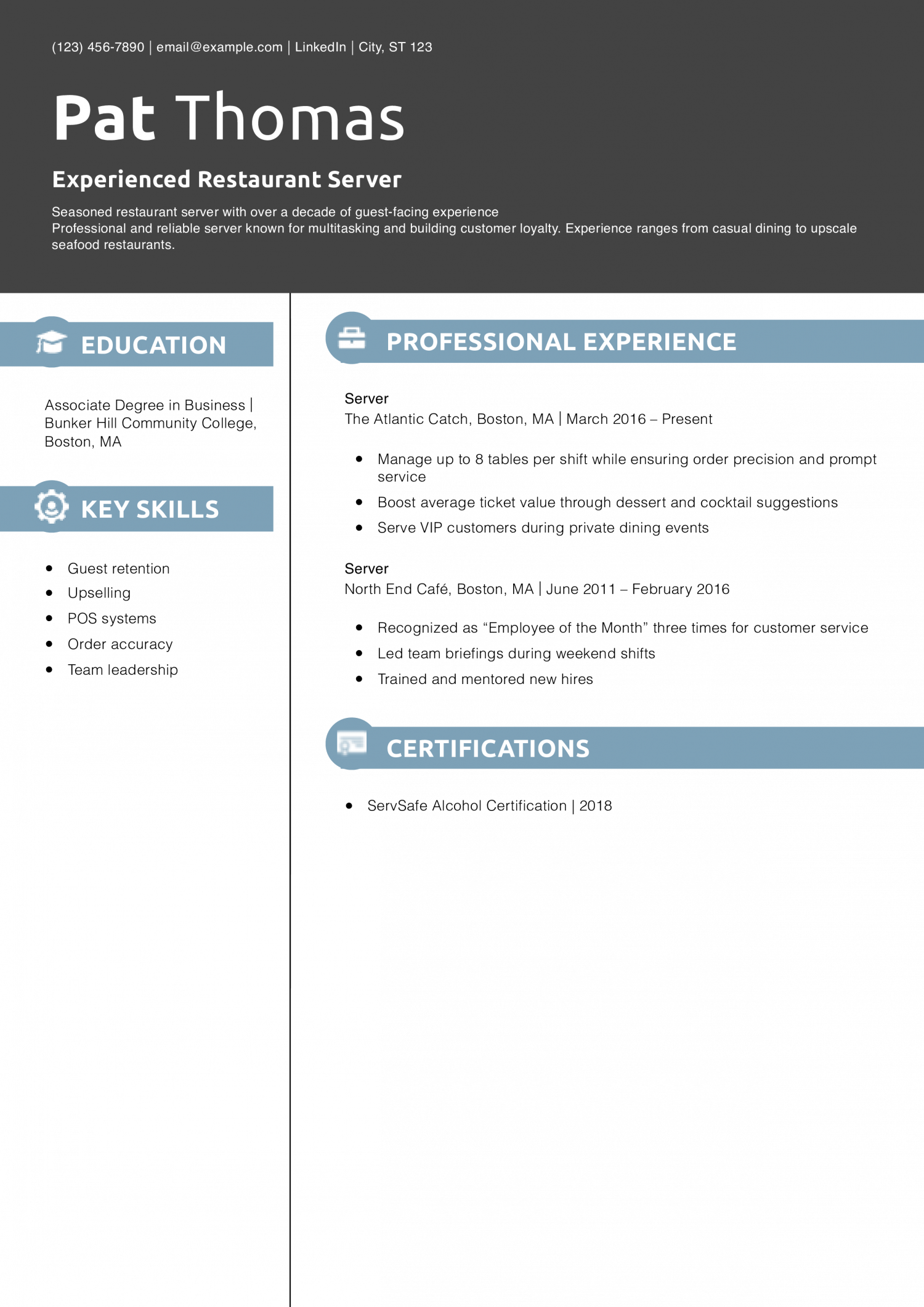
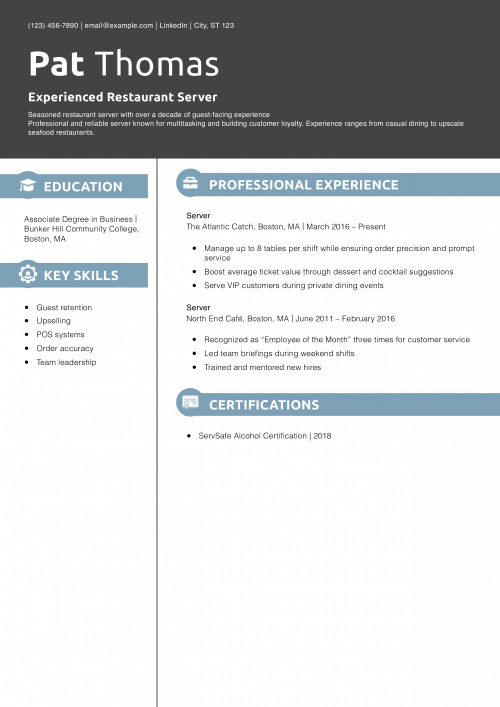
Pat’s resume reflects longevity, leadership, and strong performance. Hiring managers appreciate candidates with measurable impact and long-term commitment. Learn more about what to put on a resume.
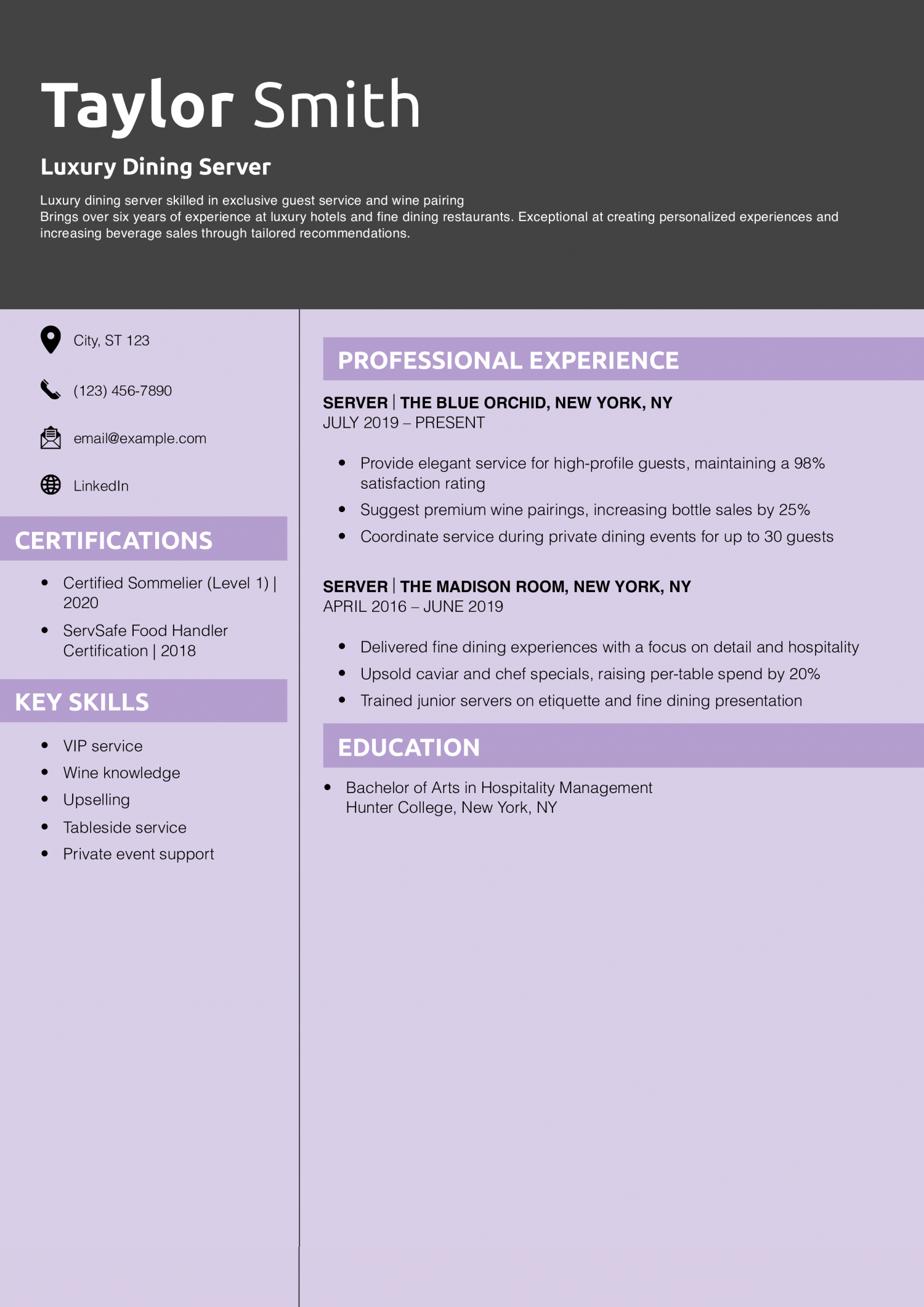
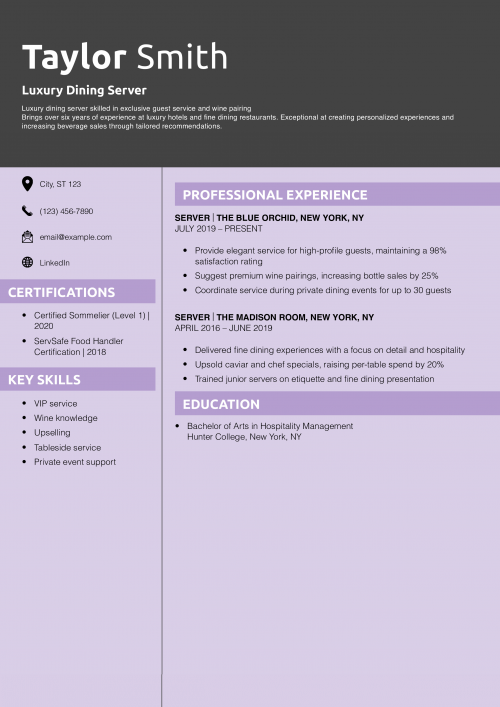
Taylor’s resume focuses on fine dining excellence and personalized guest care. Sales increases and advanced certifications strengthen their candidacy. Learn more about job title examples for your resume.
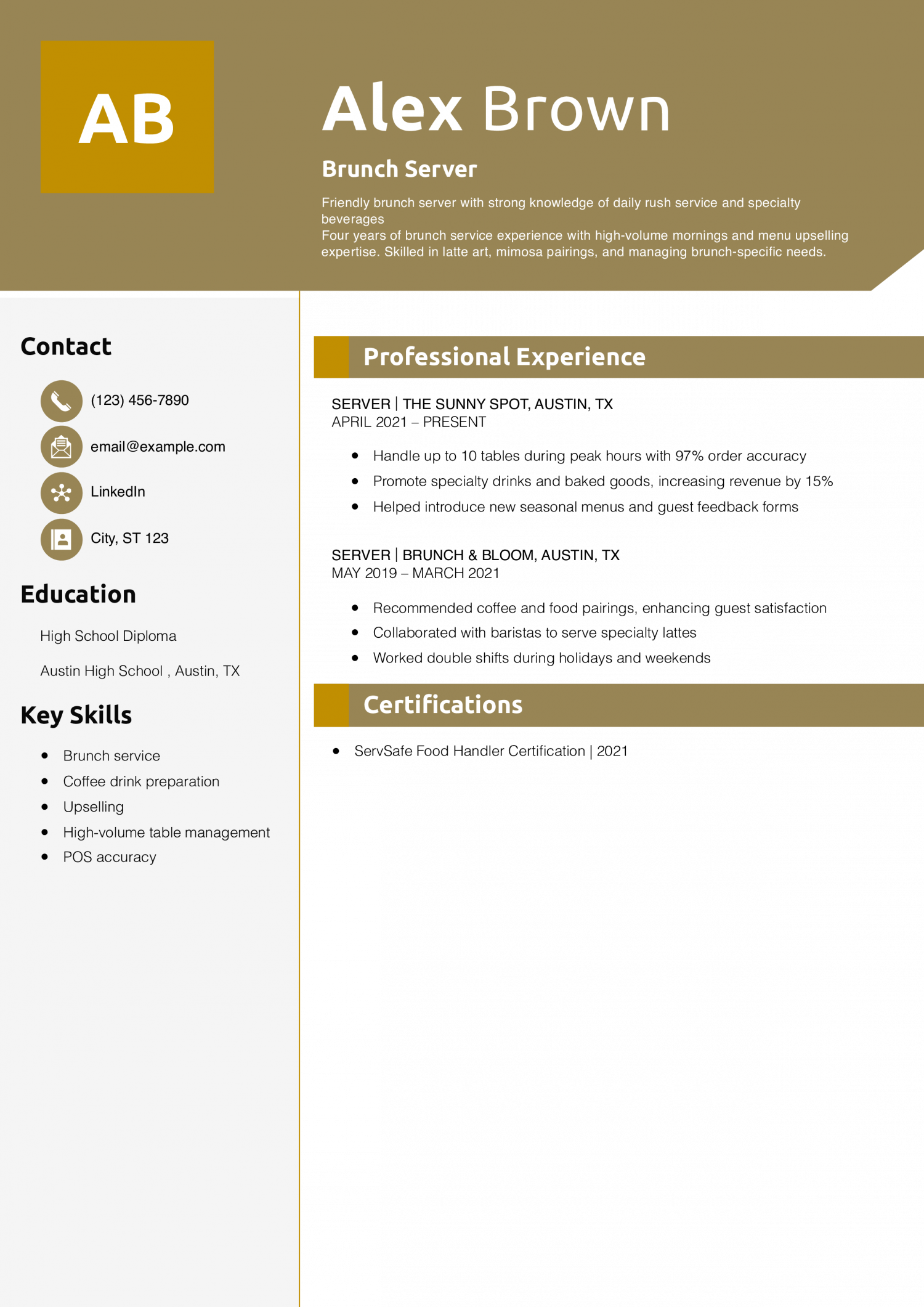
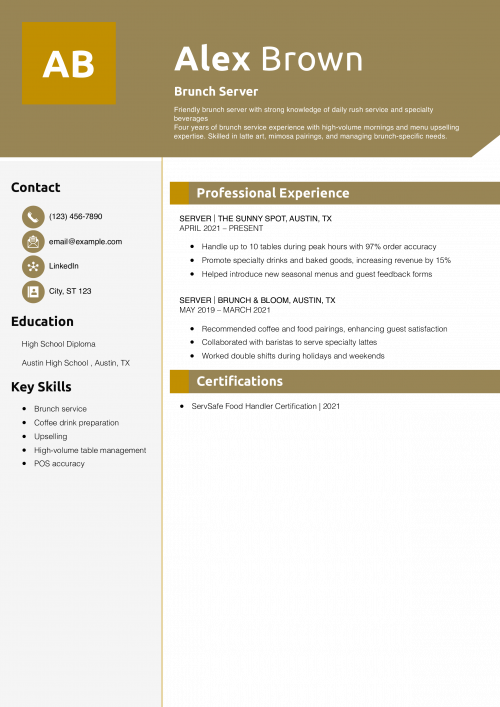
Alex’s resume is tailored for a brunch setting. It demonstrates beverage pairing and peak-time experience, a great example of how to specialize. Learn how to list skills on a resume.
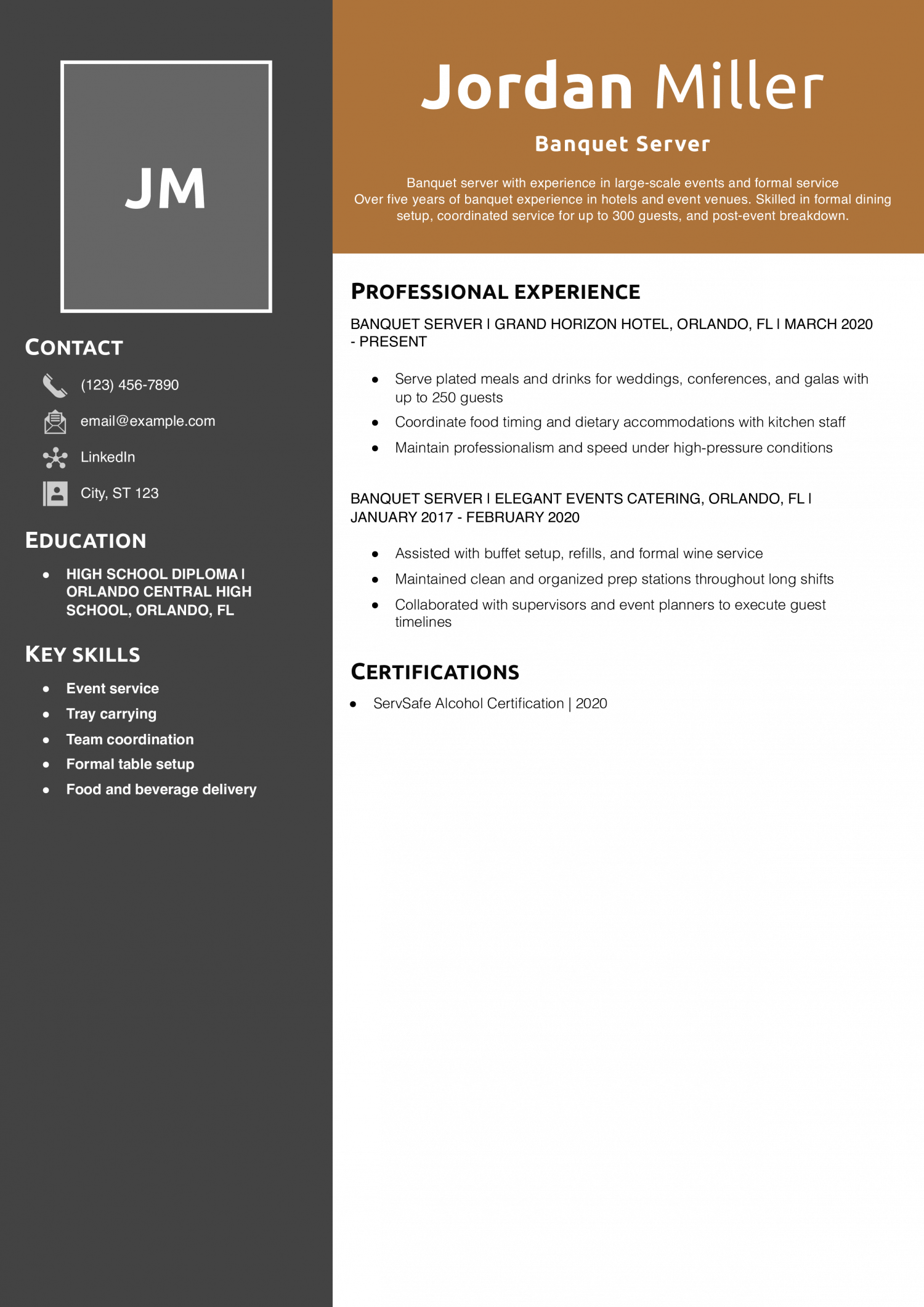
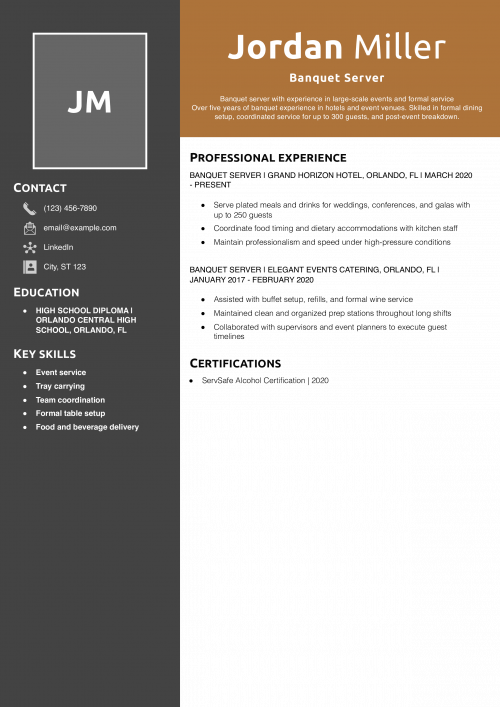
Jordan’s resume demonstrates adaptability and stamina, focusing on teamwork during large events. It highlights banquet-specific responsibilities. See more job titles for your resume.
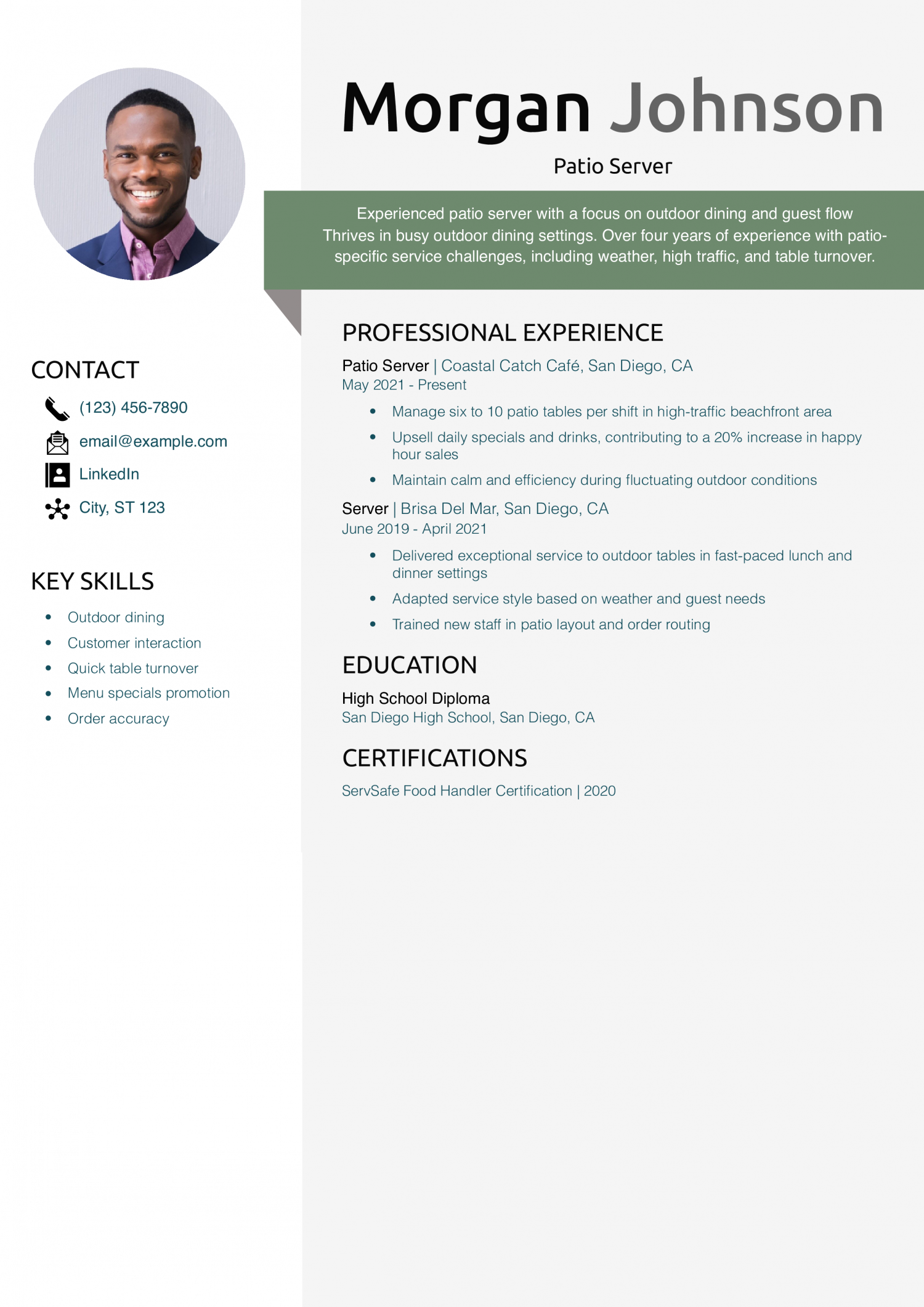
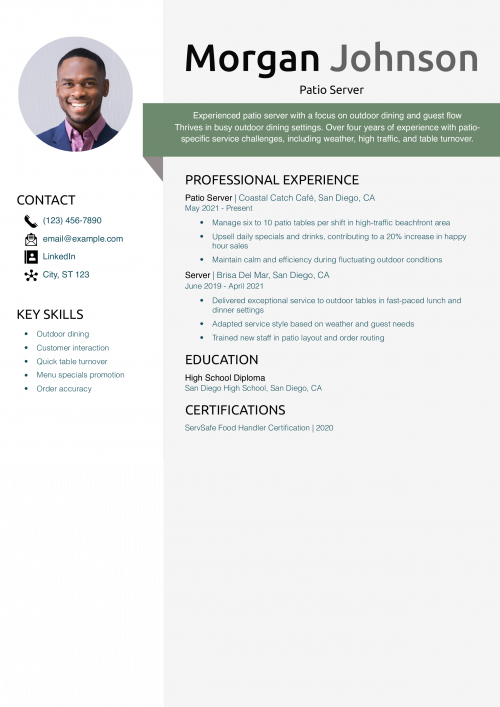
Morgan’s resume reflects patio service’s unique challenges and strengths — something hiring managers often overlook. Learn how to list your experience effectively.
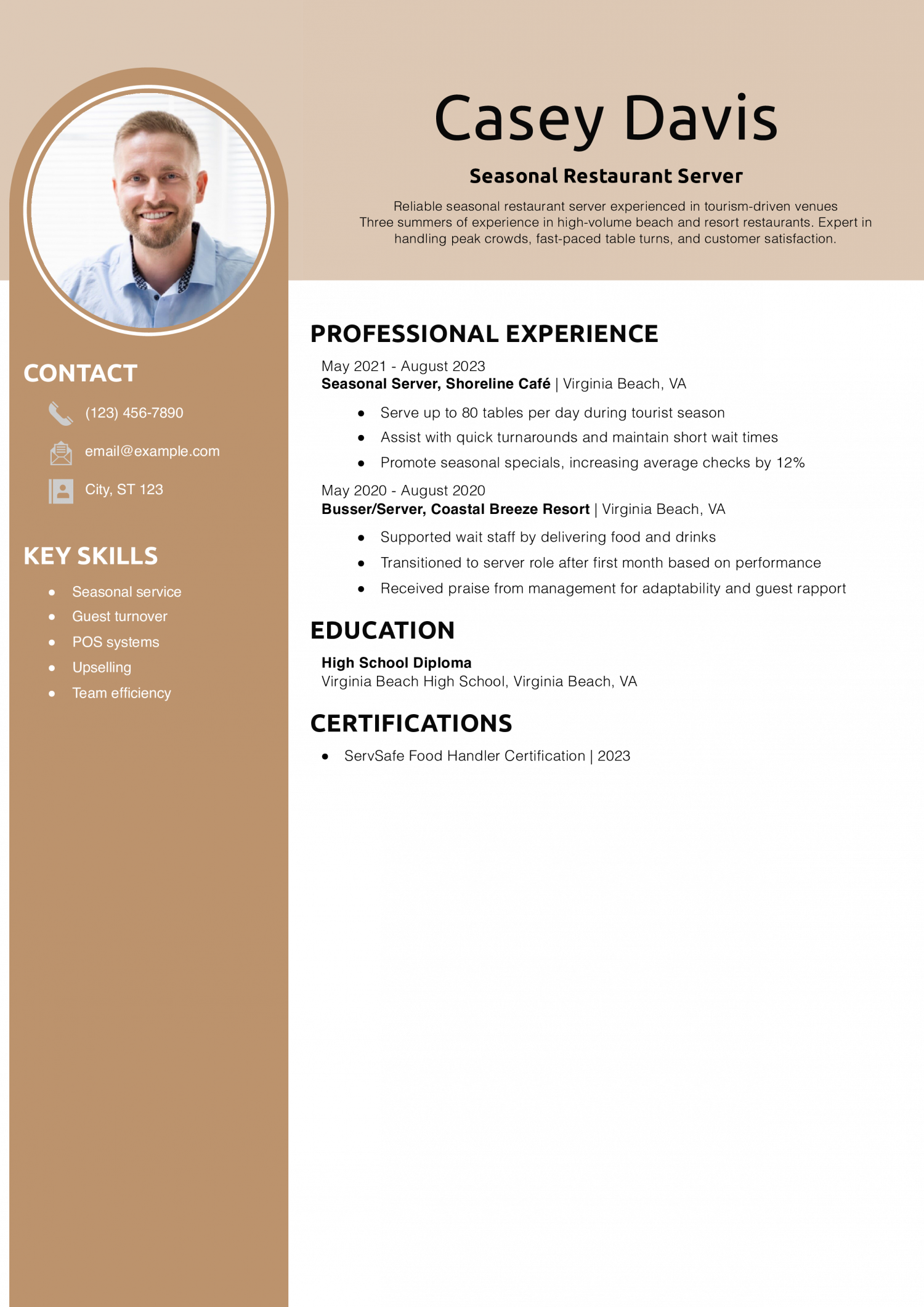
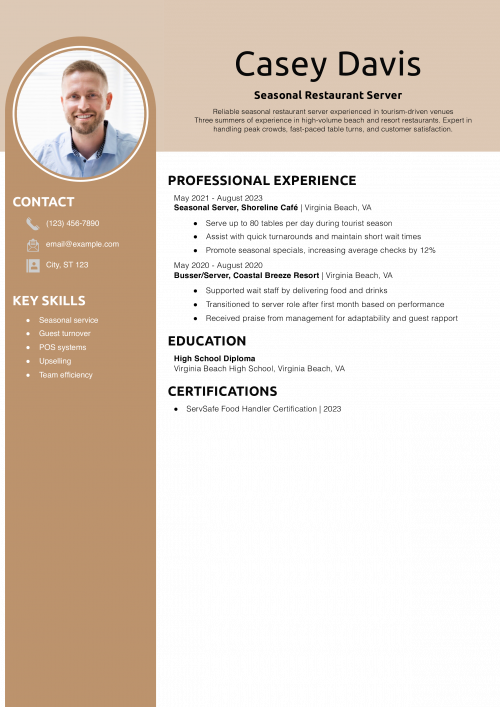
Casey’s resume shows resilience and effectiveness in peak-season pressure. Seasonal experience is a strong asset for many employers. Learn more about how far back your resume should go.
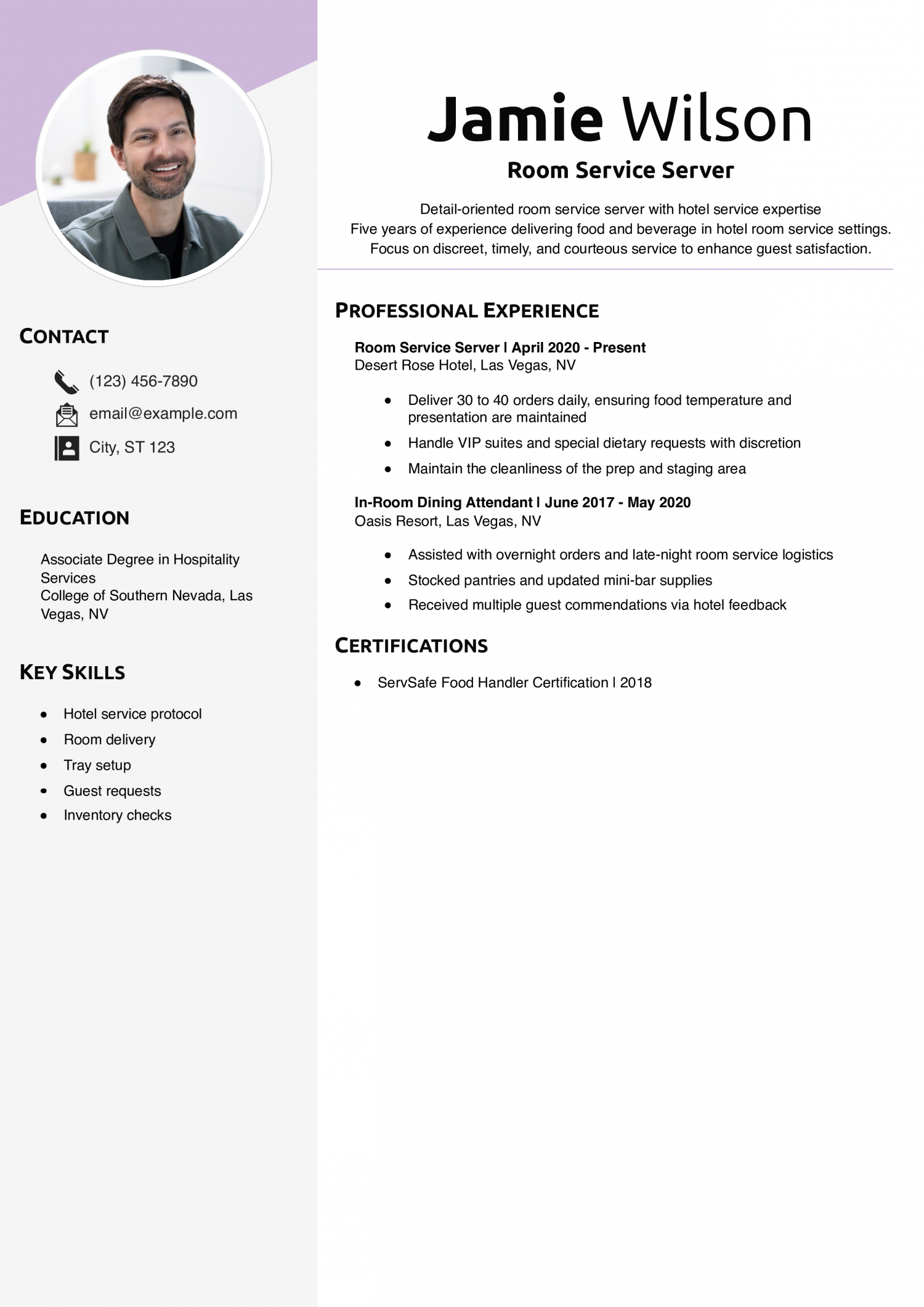
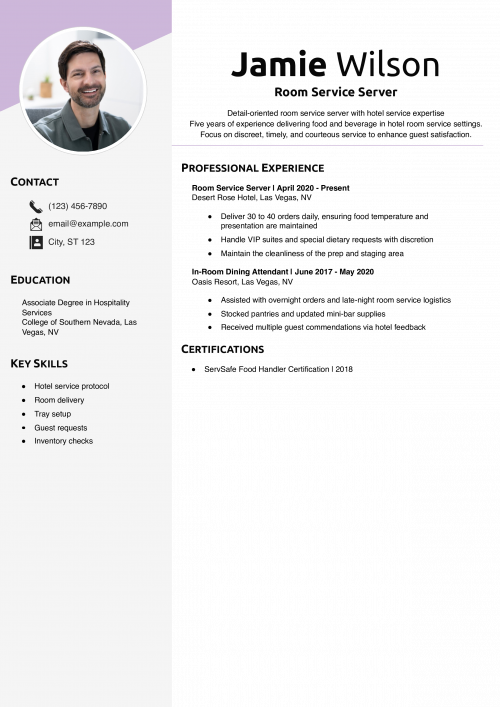
Jamie’s resume highlights hotel-specific knowledge and guest care — key to room service roles. For design inspiration, review what a professional resume should look like.
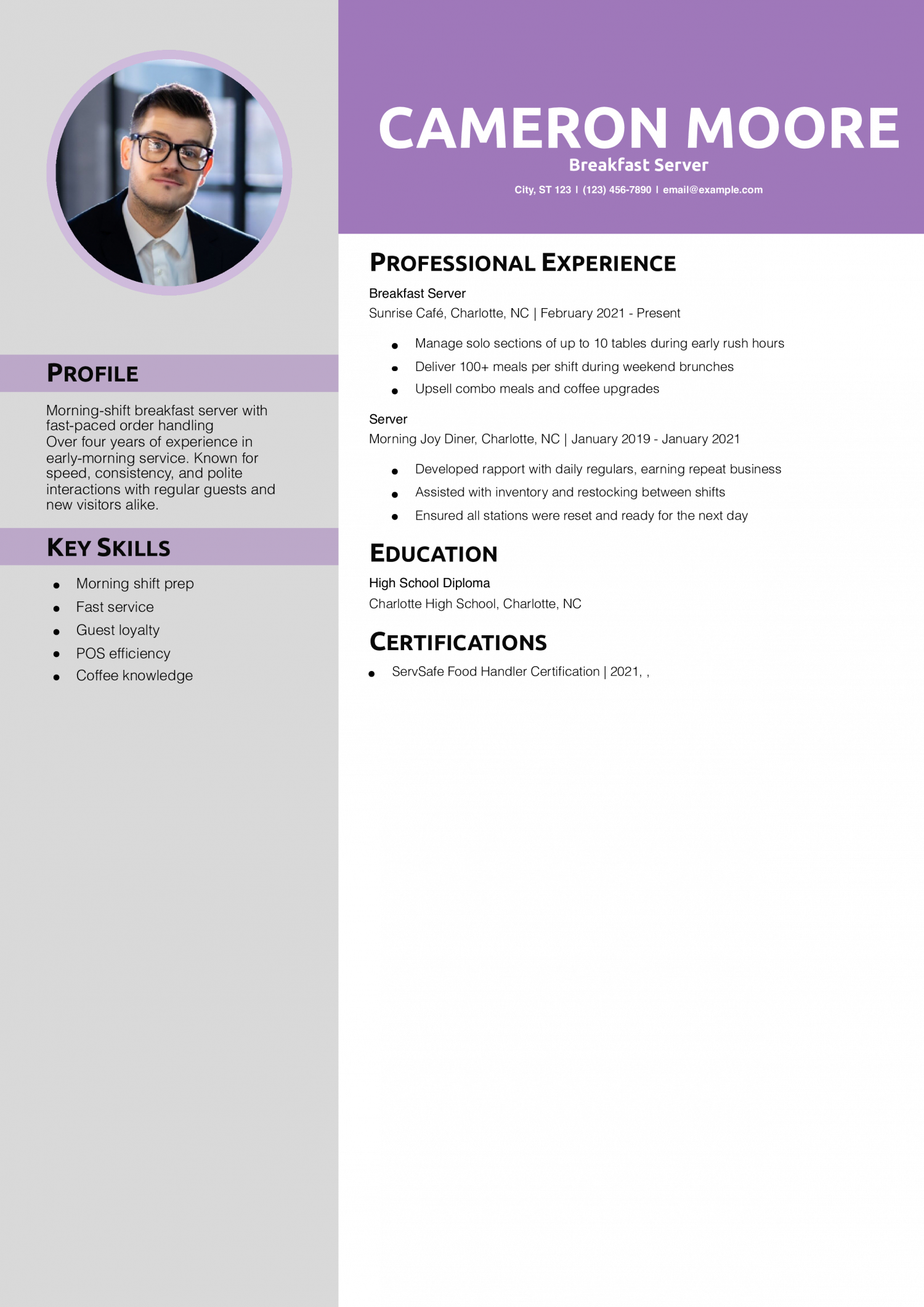
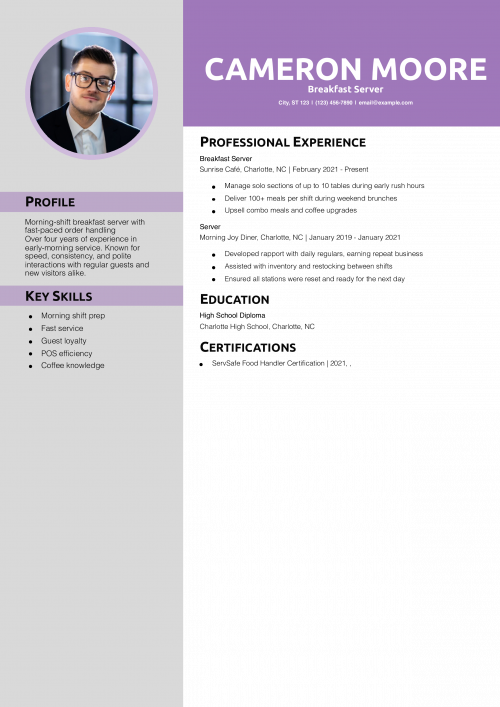
Cameron’s resume focuses on the rhythm of breakfast service. It’s ideal for employers seeking someone who can hit the ground running. Discover how to create a resume profile that stands out.
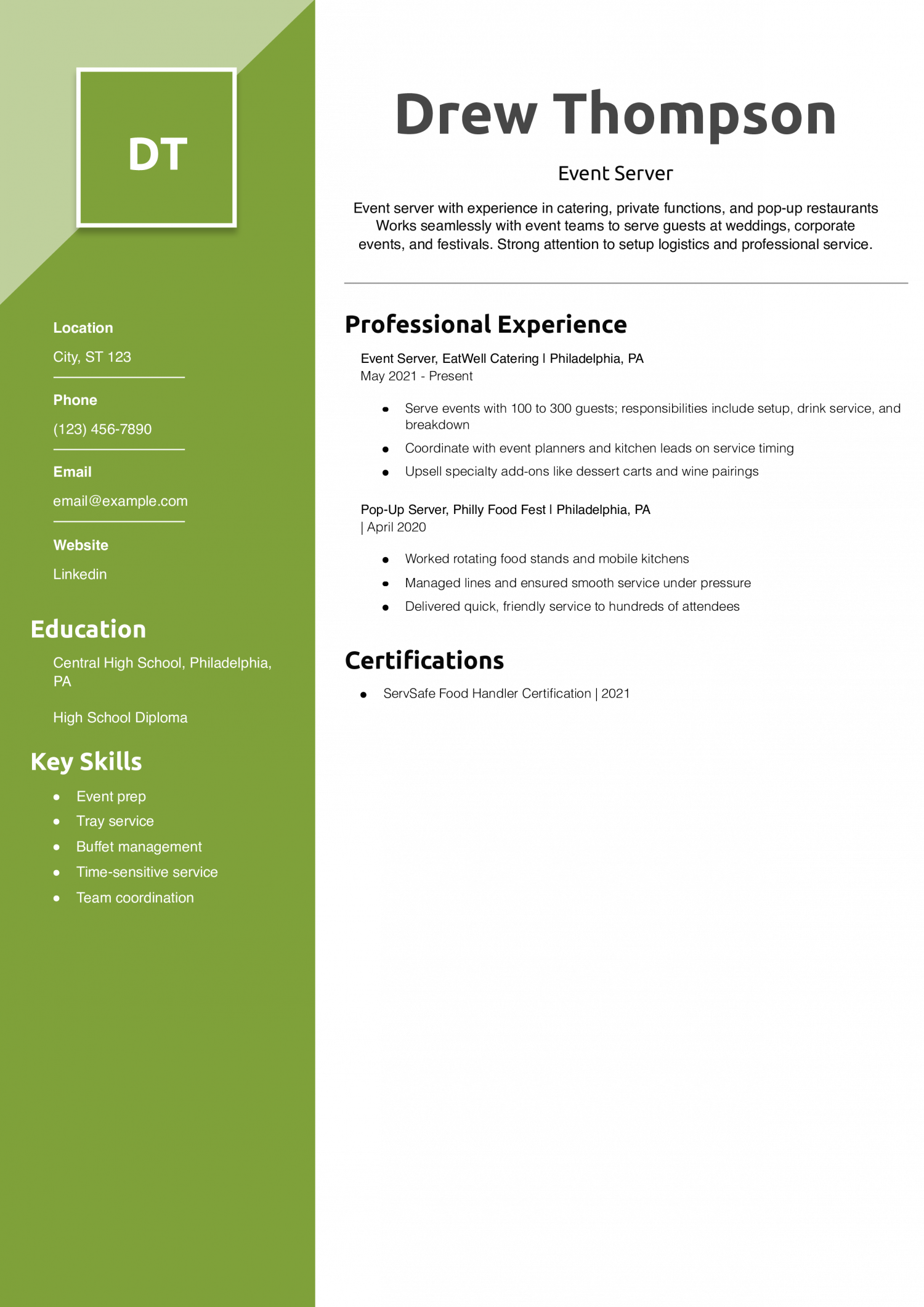
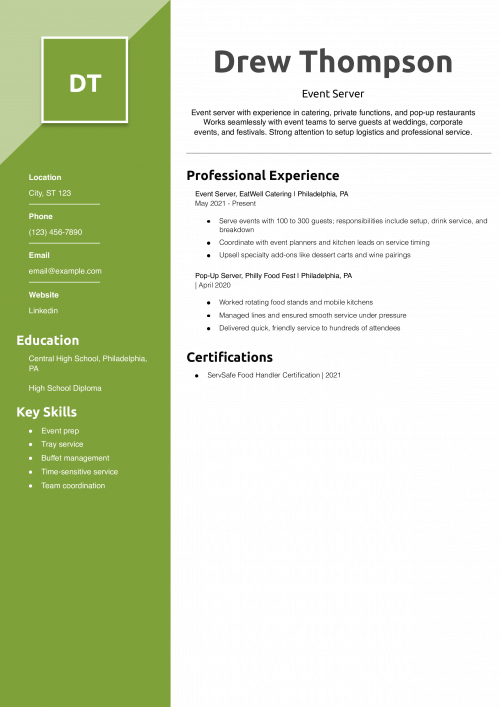
Drew’s resume proves readiness for on-the-go, time-sensitive events. It showcases organization and professionalism. For similar roles, check out resume keywords that matter.
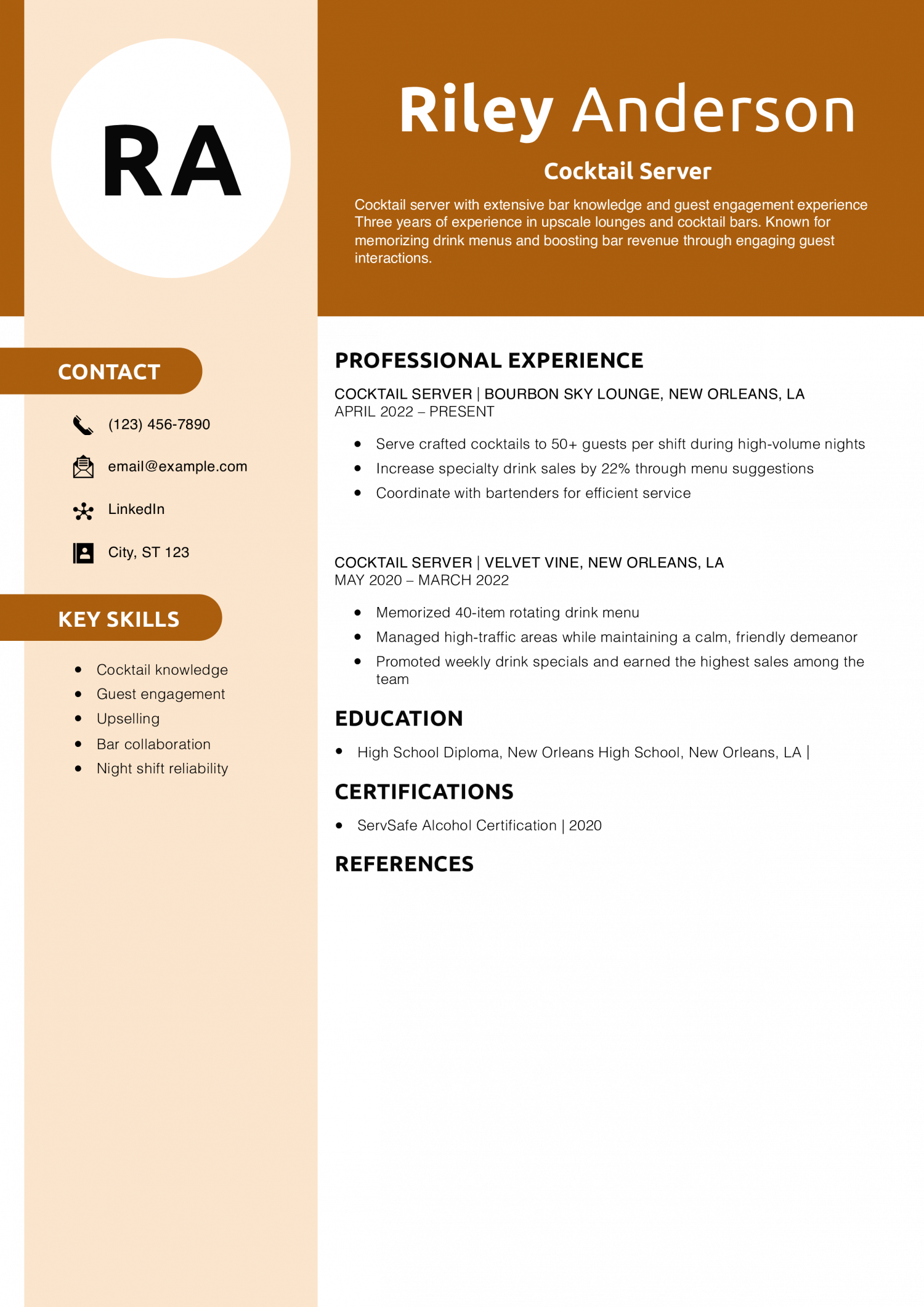
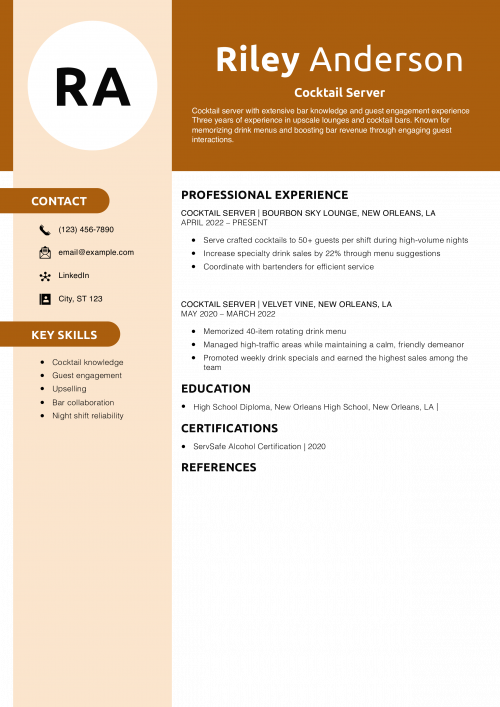
Riley’s resume targets cocktail service with clear metrics and bar collaboration experience. Use action words to enhance your resume like in this resume action words guide.
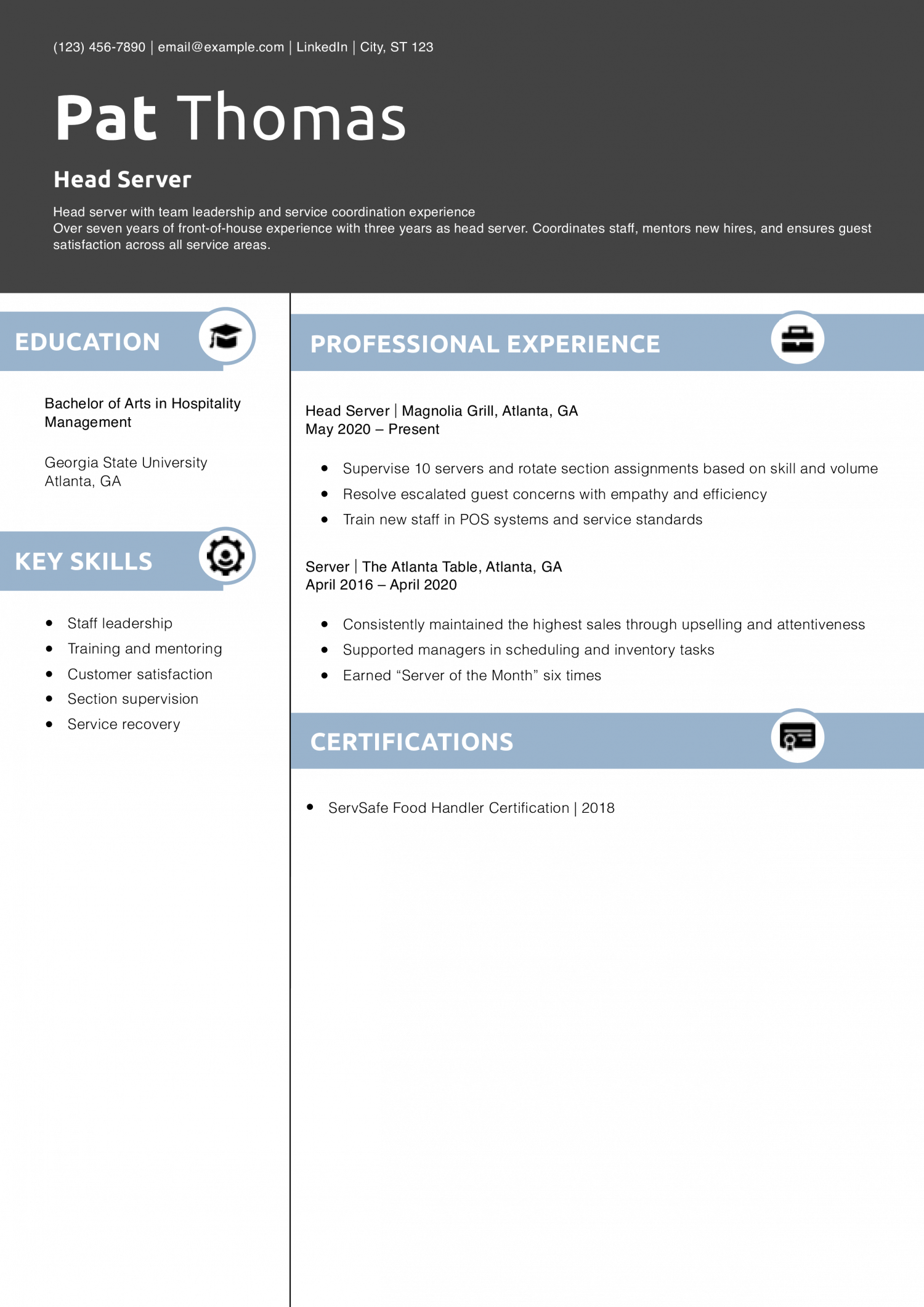
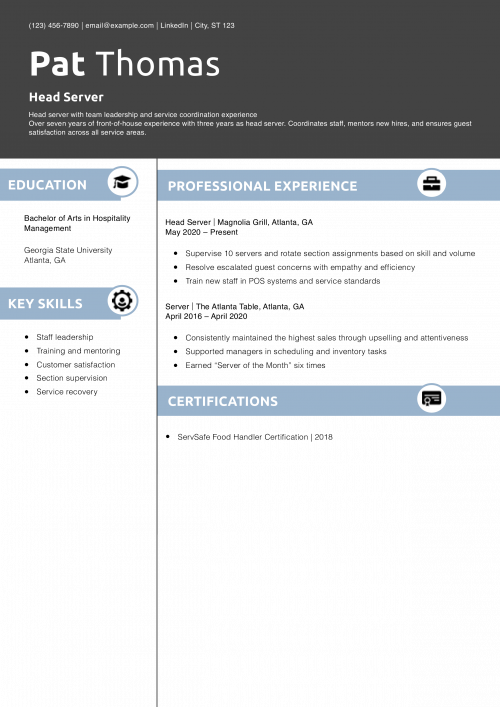
Pat’s resume shows clear career progression into leadership. The structure and content emphasize mentoring and ownership. For more, see how to show promotions on a resume.
Before crafting your content, you need to select a suitable format to properly display your experience and achievements within the hospitality industry. Your restaurant server resume should include these sections:
Provide your full name, phone number, email address, city, state, and any professional links. Keep the details current to ensure potential employers can reach you easily.
Jane Doe
[email protected] | (555) 123-4567 | Denver, CO | LinkedIn
Lead with an engaging opening summary to immediately grab the hiring manager’s attention. Start with a sentence that captures your years of experience in the hospitality industry and key skills the restaurant seeks. Emphasize your ability to deliver a personalized guest experience that sets you apart from other servers.
Restaurant server with over five years of experience delivering exceptional customer service in high-volume dining establishments. Skilled in upselling menu items, managing large parties, and maintaining a 95% customer satisfaction score. Adept at fostering team collaboration to streamline service operations.
Enthusiastic server with experience in customer service and a passion for providing memorable dining experiences. Skilled in multitasking, resolving guest concerns, and maintaining composure in high-pressure environments.
Your professional experience section must emphasize your most engaging achievements as a server. Consider how you’ve successfully utilized upselling strategies to exceed sales goals. Demonstrate your ability to communicate with diverse clientele and coordinate effectively with kitchen staff, hostesses, and servers to enhance service delivery during stressful, high-volume periods.
Lead server
The Bistro at Main, Boulder, CO | March 2018 to present
Server
Tasty Eats, Denver, CO | June 2015 to February 2018
Incorporating numbers and metrics is a great way to highlight further your impact on previous establishments within the hospitality industry. In particular, highlight your expertise in upselling menu items and achieving outstanding guest satisfaction ratings, as both speak to your talents as a professional restaurant server.
Do: “Increased beverage sales by 20% through suggestive selling techniques.”
Don’t: “Responsible for taking drink orders.”
The Bistro at Main, Boulder, CO | March 2018 to present
Tasty Eats, Denver, CO | June 2015 to February 2018
If you lack hands-on experience in the hospitality industry, you can still position yourself effectively for these types of roles. Include any previous customer service-related roles at the top of your resume. And if you’re entering the workforce for the first time, focus on extracurricular activities or volunteerism that show you can excel in team-based environments.
Formal education is often secondary to experience in restaurant roles. That said, certifications in food safety and customer service can set you apart, especially if you’re pursuing a leadership position. For instance, a Certified Restaurant Manager (CRM) designation shows that you’ve taken the steps to fully prepare yourself as a management professional within the hospitality industry.
Template:
[Degree Name], [School Name], [City, State Abbreviation] | [Graduation Year]
[Relevant coursework or honors]
Example:
Bachelor of Arts (B.A.) Hospitality Management | 2020
Community College of Denver | Denver, CO
Template:
[Certification Name] | [Awarding Organization] | [Completion Date]
Examples:
Although not every restaurant will have an ATS, featuring the right skills on your resume is still helpful in showing hiring managers that you have the knowledge and expertise of the hospitality industry to succeed in the position. Below, you’ll find a list of potential keywords you may encounter while pursuing server jobs at high-end restaurants:
| Key Skills | |
|---|---|
| Client relations | Communication |
| Conflict resolution | Customer service |
| Food and beverage knowledge | Food safety |
| Guest relations | Hospitality management |
| Inventory management | Operations management |
| Point-of-sale (POS) system operation | Sales strategy |
| Staff training | Team collaboration |
| Upselling techniques | |
Incorporating action verbs is an excellent way to bolster the strength of your bullet points. They allow you to frame seemingly mundane job responsibilities proactively, showing how you’ve positively contributed to the restaurant’s reputation and satisfaction ratings. We’ve compiled a list of verbs you can use to build the professional experience section of your restaurant server resume:
| Action Verbs | |
|---|---|
| Achieved | Collaborated |
| Communicated | Conducted |
| Delivered | Drove |
| Enhanced | Exceeded |
| Implemented | Improved |
| Led | Managed |
| Oversaw | Resolved |
| Trained | Upsold |
Select a clean and professional layout that emphasizes readability. Avoid overly elaborate designs, as they can detract from your qualifications. Instead, use a format that logically organizes your experience and skills, showcasing your professionalism.
To effectively tailor your Restaurant Server CV, start by highlighting key skills and experiences that match the job description. Look for keywords from the job posting, such as specific tools, certifications, or industry terms, and integrate them naturally into your CV. This customization will make your CV more relevant and increase your chances of passing ATS scans.
According to the Bureau of Labor Statistics, restaurant server jobs are expected to grow by 1% between 2023 and 2033. Although this is slower than the national average, this increase amounts to over 410,000 new openings yearly. That said, the most lucrative restaurants are selective in who they hire, so it's essential to tailor your resume to each individual job application. For example, if an establishment is looking for a server with a strong leadership background, emphasize how you helped mentor new servers, especially those struggling to succeed in fast-paced hospitality environments. If a restaurant targets a candidate with exceptional sales skills, illustrate how you upsold menu items or educate guests on signature specials.
The reverse chronological format is ideal for restaurant servers because it allows you to display your work history below your qualifications summary. This immediately shows the hiring manager that you have a proven history of delivering outstanding service and supporting restaurant operations during the most demanding and challenging times.
Although a cover letter typically isn’t required or expected for a restaurant server position, building one can help set you apart from other candidates. This allows you to add a personal touch to your application, conveying your genuine passion for the hospitality industry, which will make a lasting impression on the hiring manager.
Executive Resume Writer and Career Coach
Andrew Stoner is an executive career coach and resume writer with 17 years of experience as a hiring manager and operations leader at two Fortune 500 Financial Services companies, and as the career services director at two major university business schools.
Resume Templates offers free, HR approved resume templates to help you create a professional resume in minutes. Choose from several template options and even pre-populate a resume from your profile.