
17 Best Legal Assistant Resume Examples and Templates for 2025



If you’re looking for work as a paralegal, showcase your skills, credentials, and experience in legal roles. The best way to do that is with a well-crafted resume that highlights your qualifications, such as legal research, case file management, and drafting legal documents. This guide provides a step-by-step process for creating your paralegal resume and making the case for yourself as a top-notch candidate.
Key takeaways:
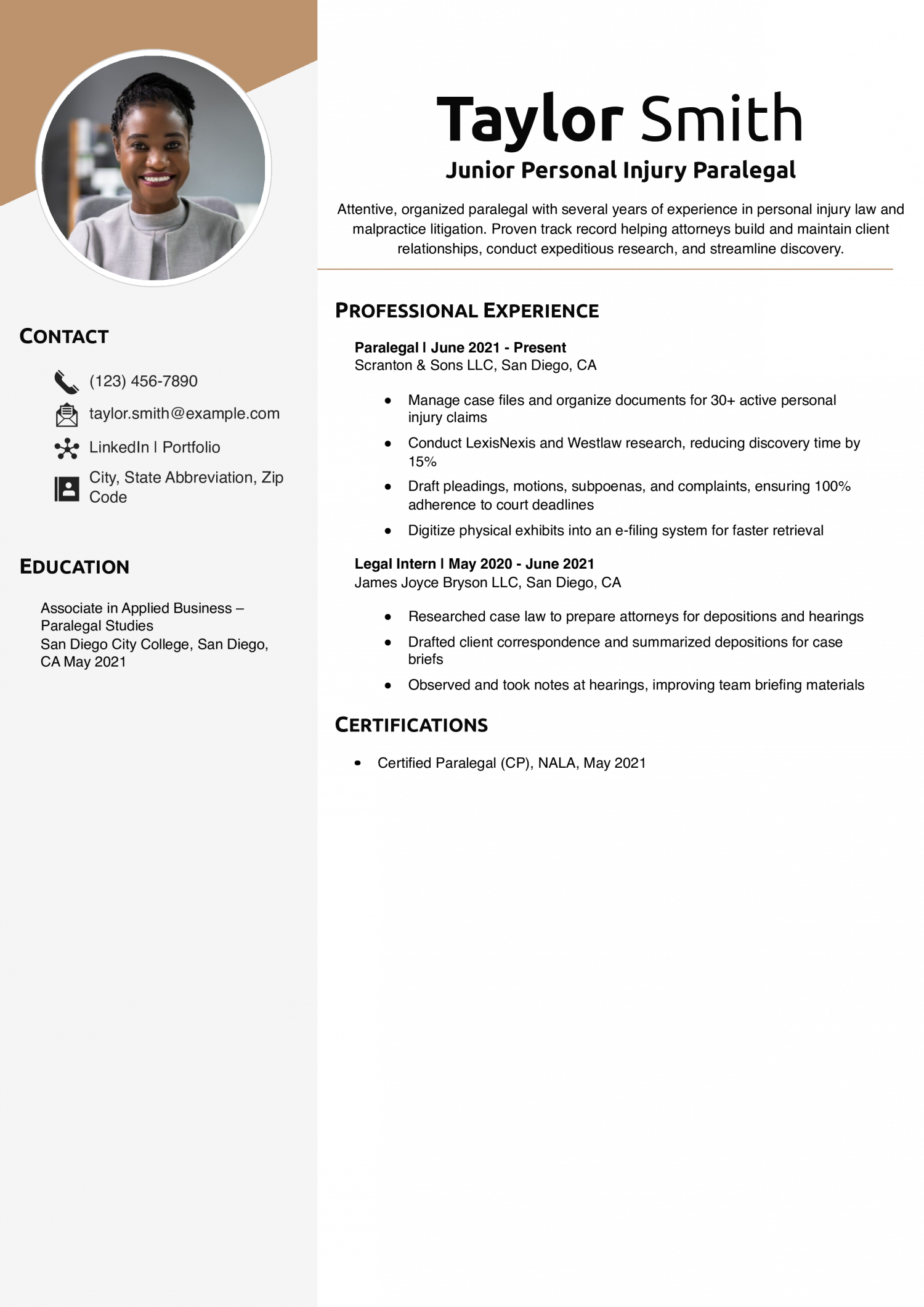
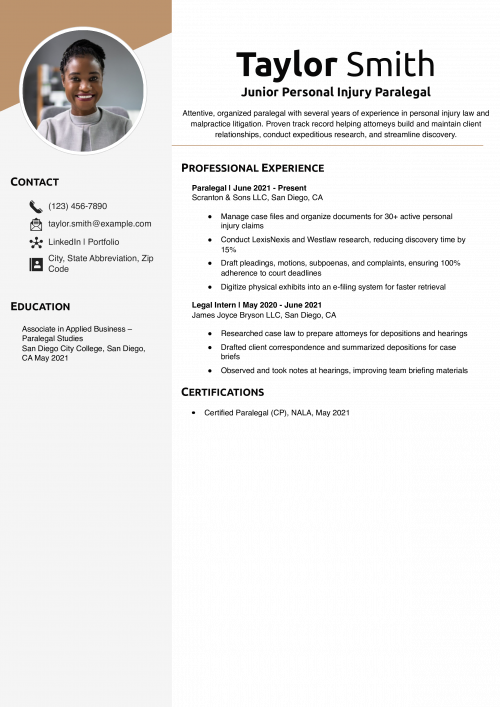
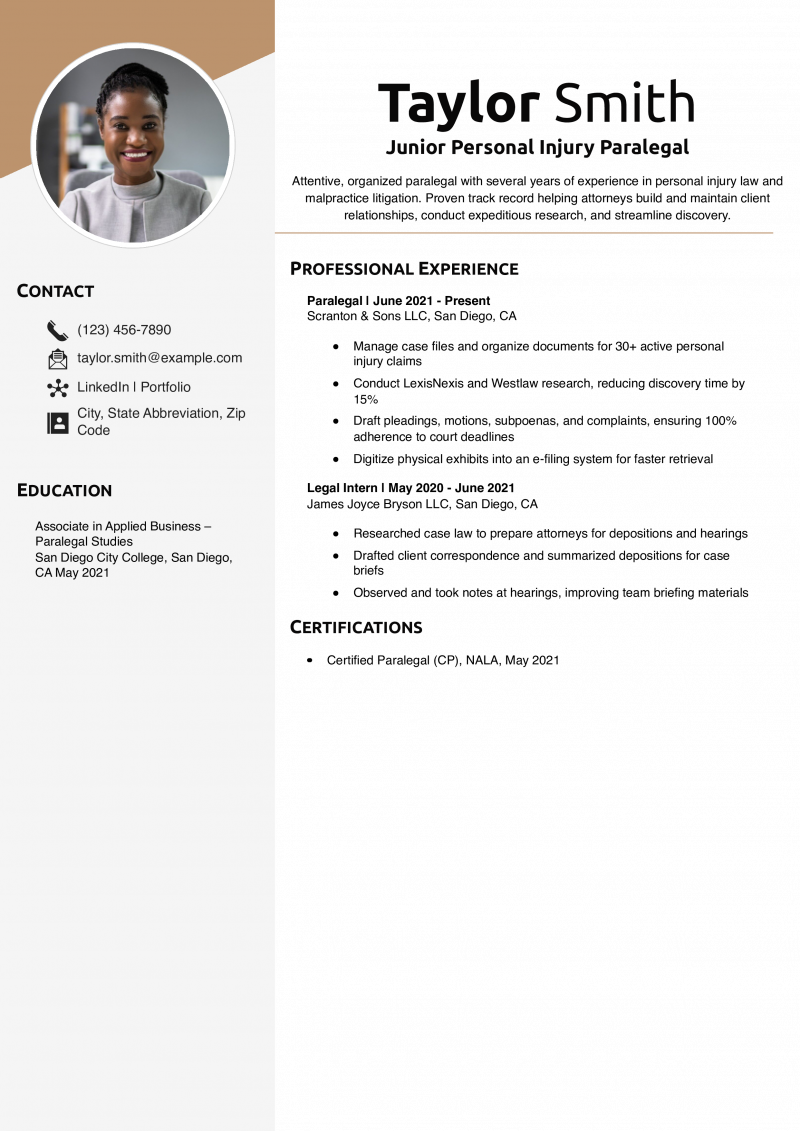
Taylor’s resume emphasizes efficiency in case management — “reducing discovery time by 15%” — and highlights concrete drafting skills with a perfect deadline record. These metrics immediately demonstrate value to hiring firms.
Focus on quantifiable research efficiencies to showcase impact. For more on highlighting paralegal skills, check out How to List Volunteer Work Experience on a Resume.
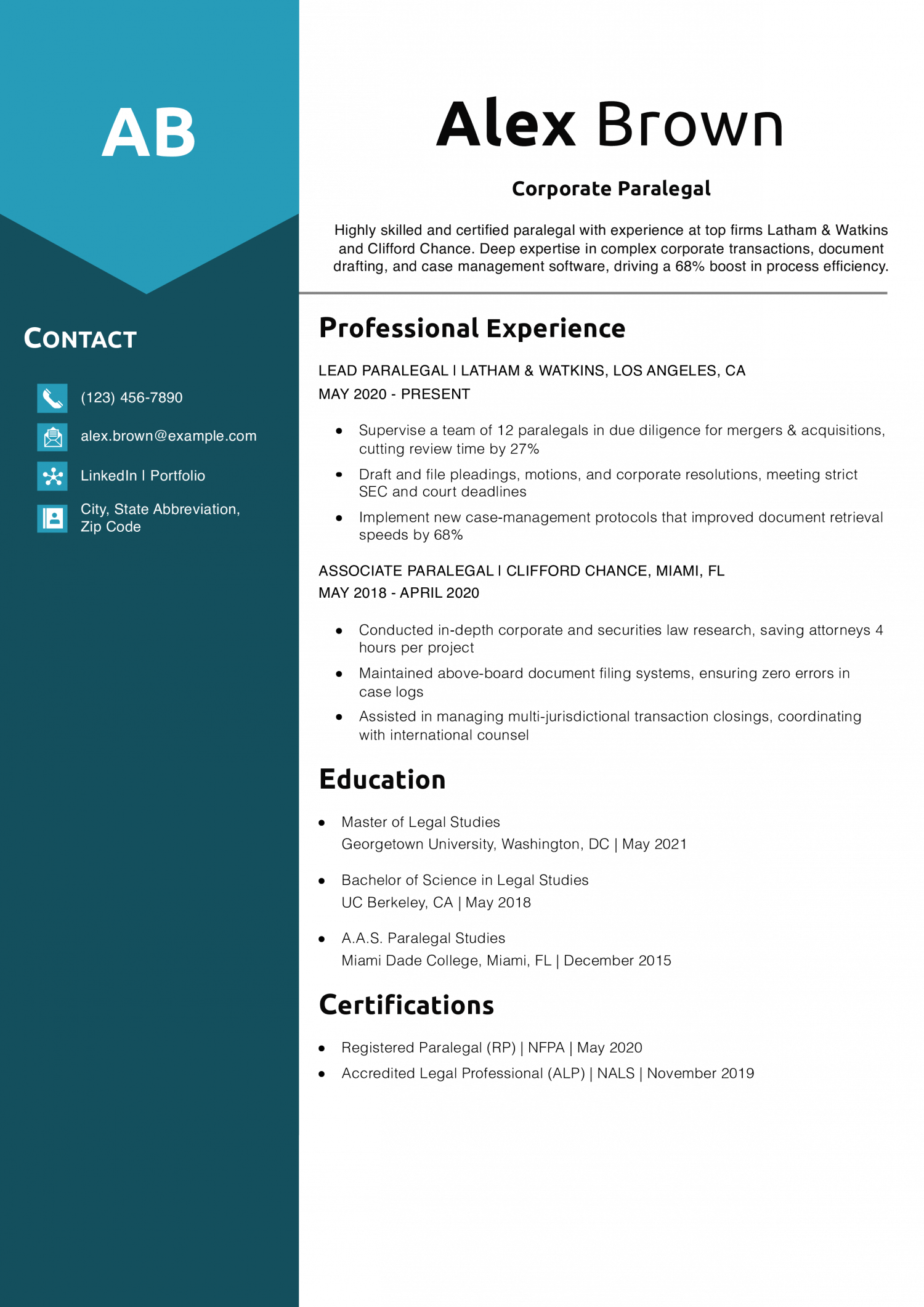
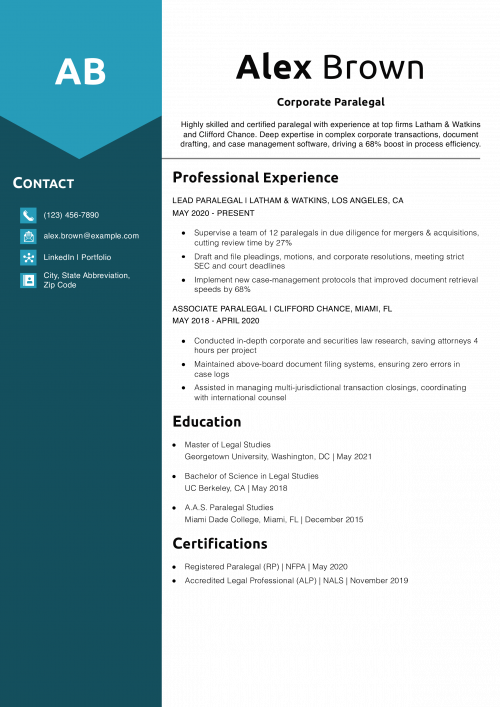
Alex’s resume quantifies leadership impact (“27% faster due diligence”) and highlights tech-driven process improvements (“68% faster retrieval”), showing both managerial and technical prowess.
Highlight team leadership metrics to showcase supervisory ability. For more on structuring process improvements, visit Best Resume Formats.
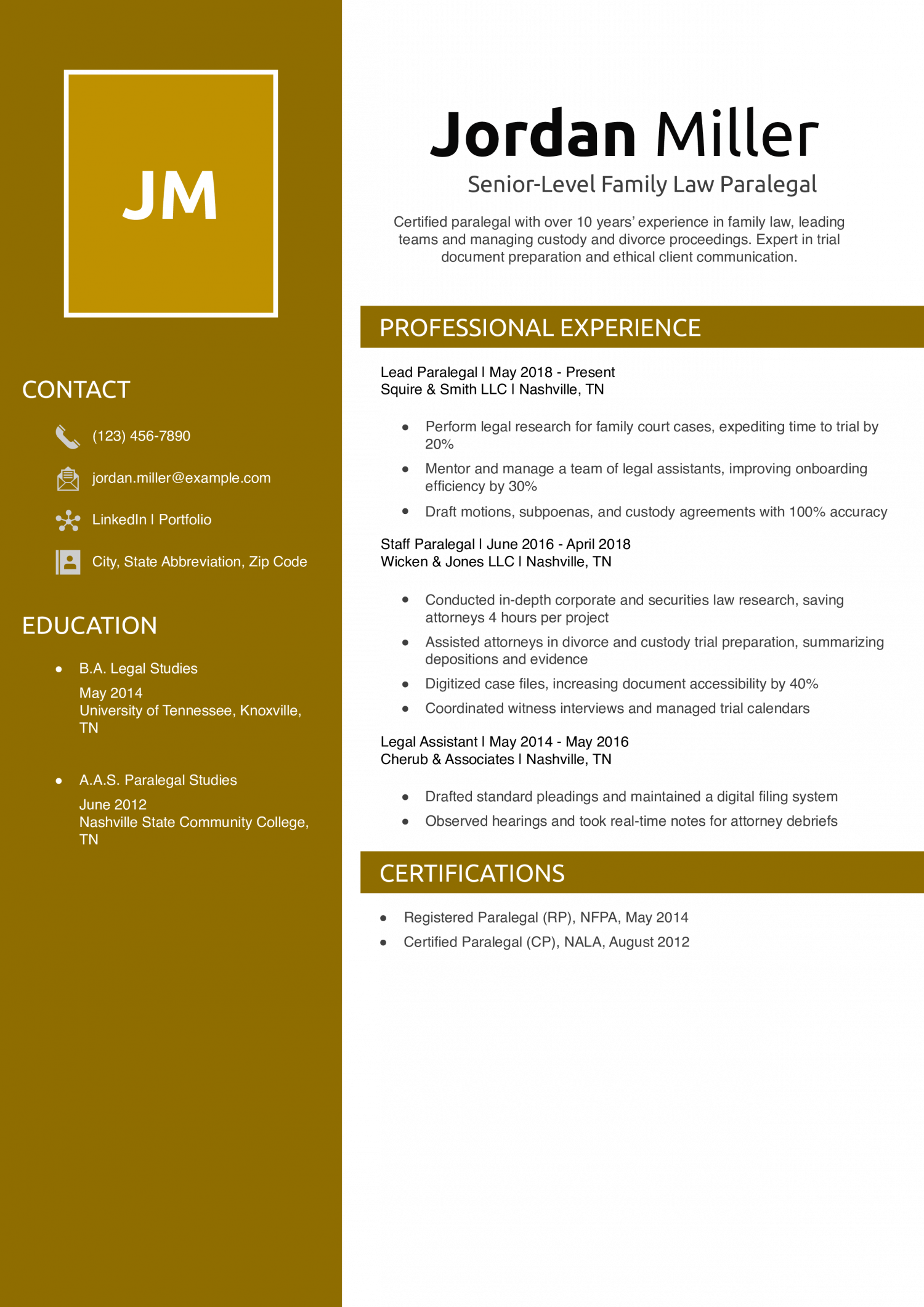
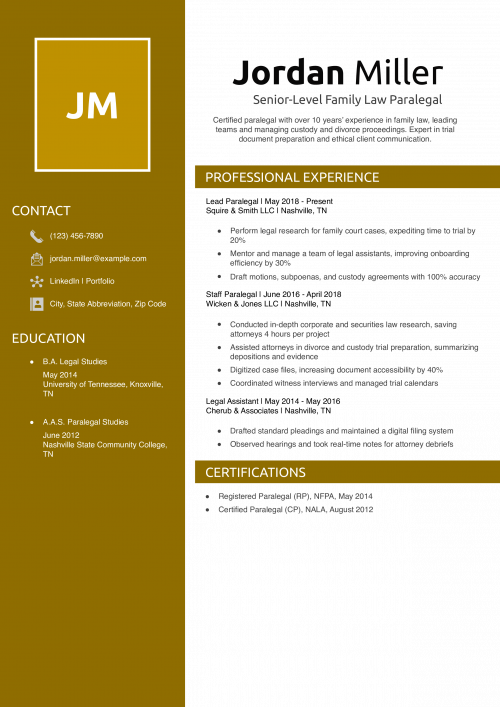
Jordan’s resume highlights trial readiness — “20% faster time to trial” — and leadership in mentoring, illustrating both hands-on and supervisory skills essential for high-pressure family law teams.
Emphasize speed and accuracy in trial prep to demonstrate reliability. For tips on legal research, see Work Experience on a Resume.
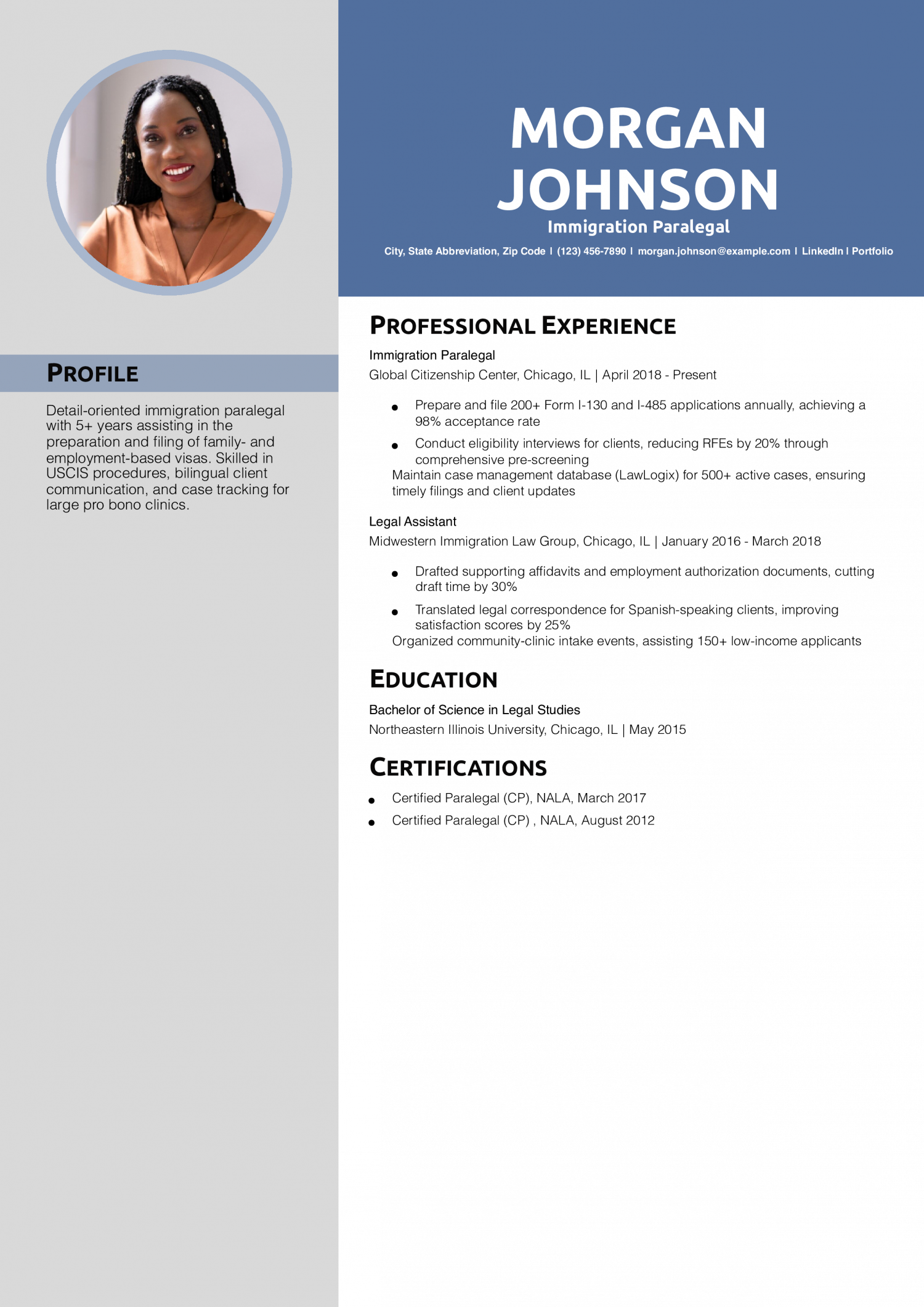
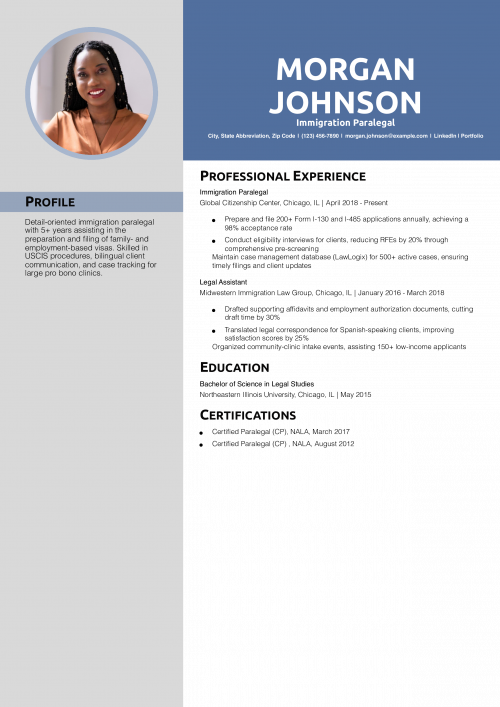
Morgan’s resume highlights measurable improvements — “98% acceptance rate” and “20% fewer RFEs” — demonstrating both accuracy and client impact.
Focus on USCIS filing metrics to show expertise. For more on structuring volunteer or clinic experience, check out How to List Volunteer Work Experience on a Resume.
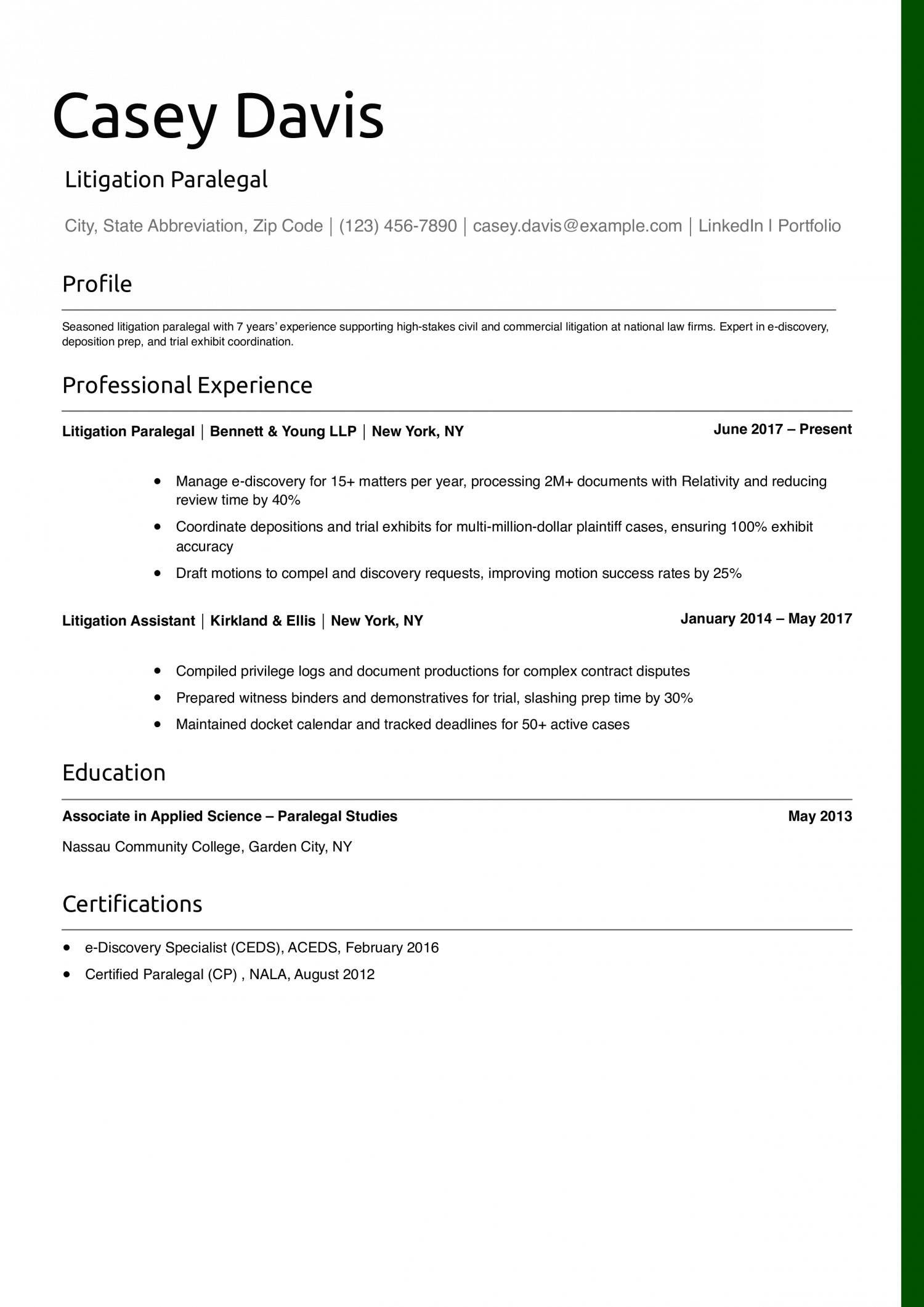
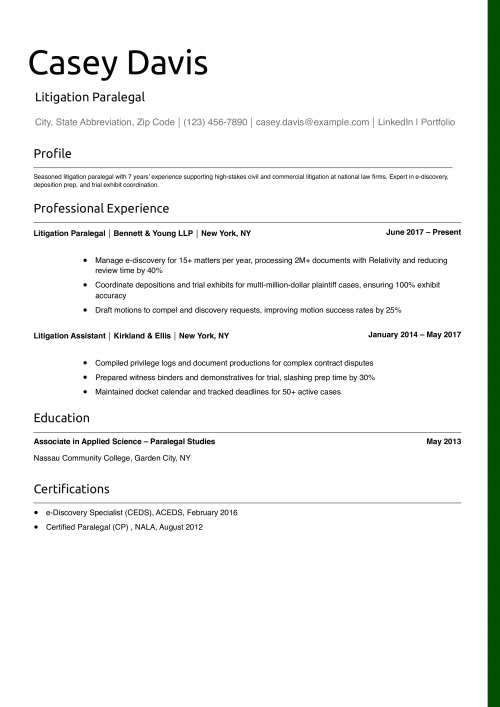
Casey’s metrics — “40% faster e-discovery” and “25% higher motion success,” for example — show both technical skill and strategic impact.
Emphasize e-discovery efficiencies to demonstrate value. For guidance on presenting litigation achievements, see Work Experience on a Resume.
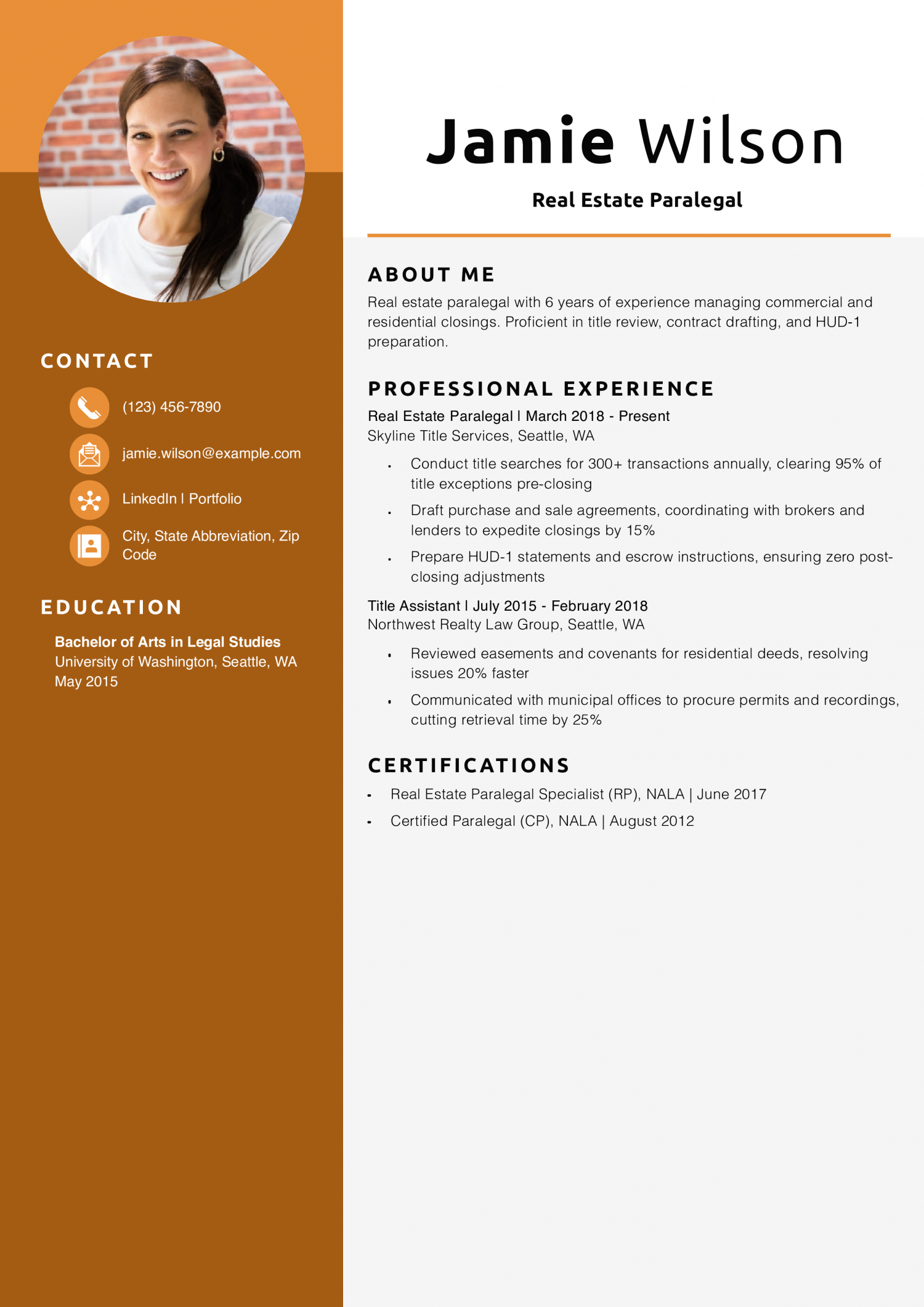
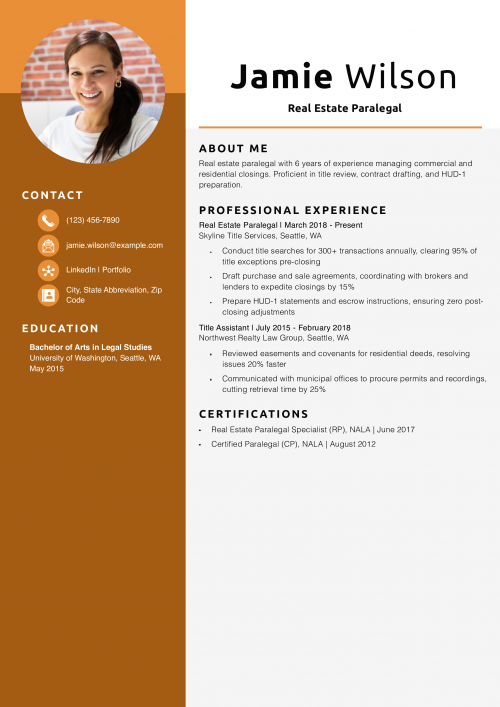
Jamie quantifies both volume (“300+ transactions”) and efficiency improvements (“15% faster closings”), underscoring real‐world impact.
Highlight title‐search metrics to demonstrate accuracy. For more on listing specialized credentials, see How to List Certifications on a Resume.
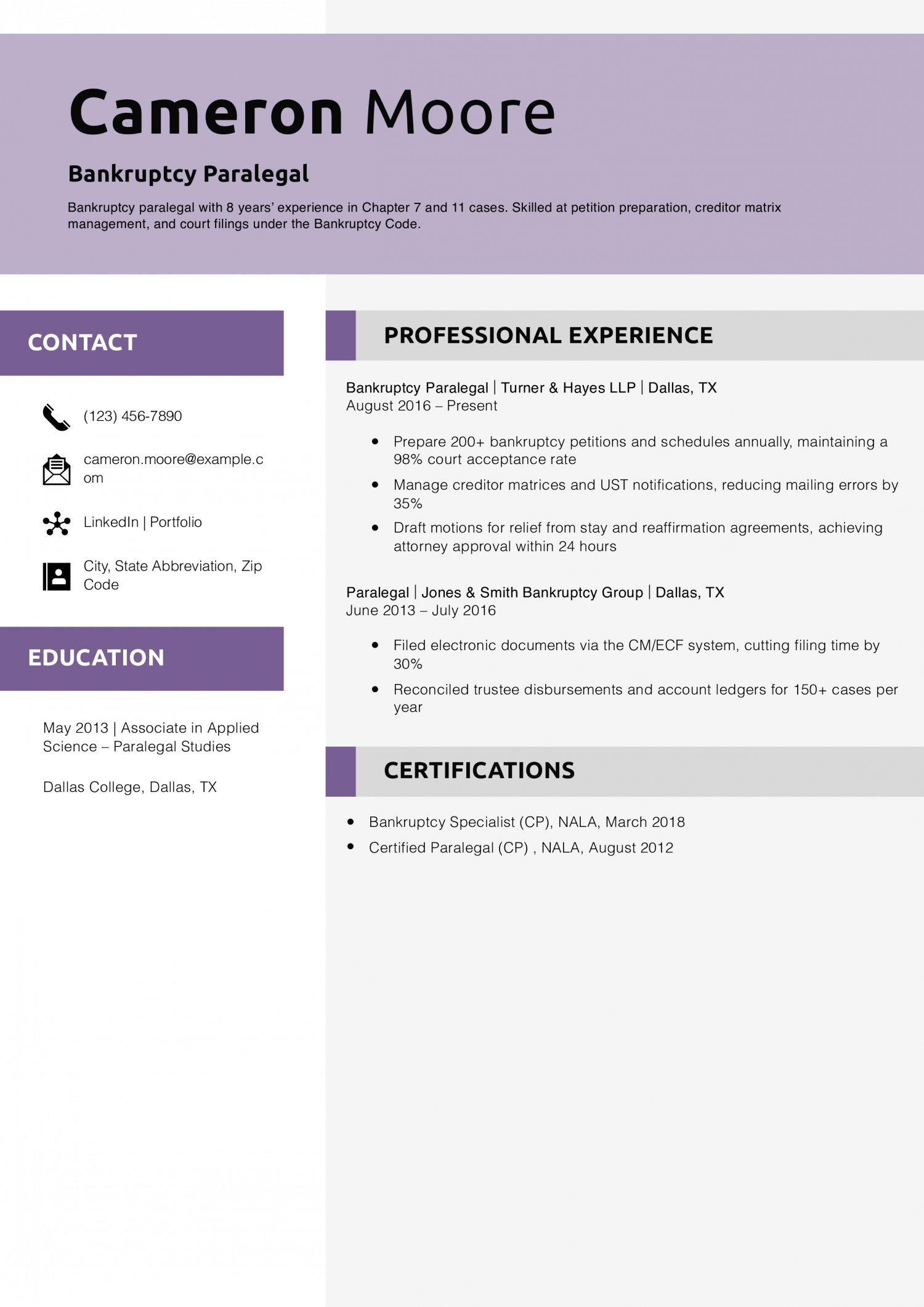
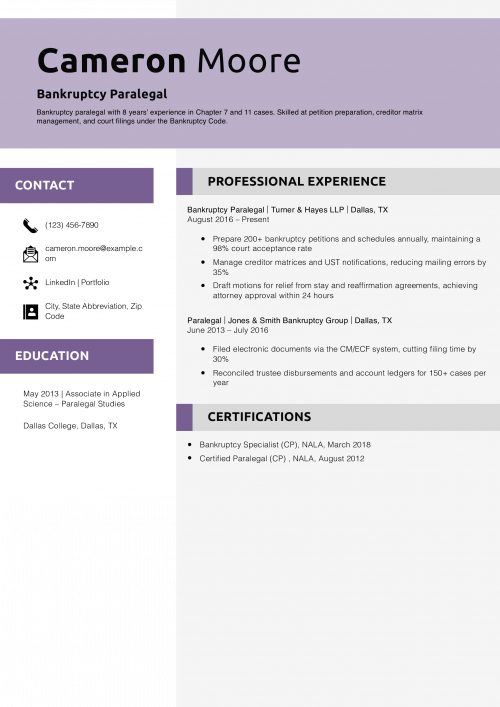
Cameron’s resume highlights both volume (“200+ petitions”) and precision (“98% acceptance”), showing mastery of complex bankruptcy procedures.
Quantify filing accuracy and speed to underscore reliability. For more on highlighting legal software skills, check out Computer Skills for a Resume.
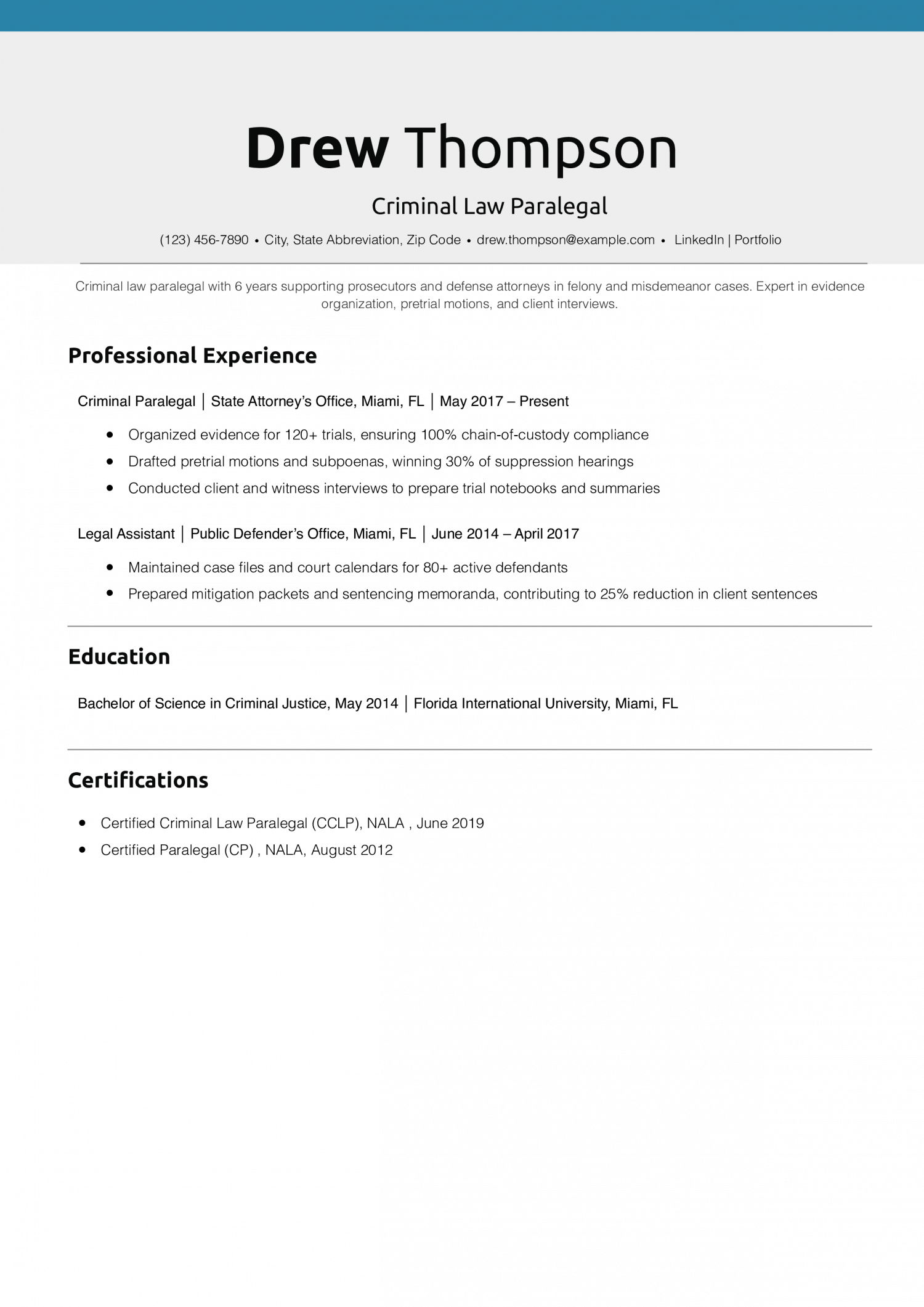
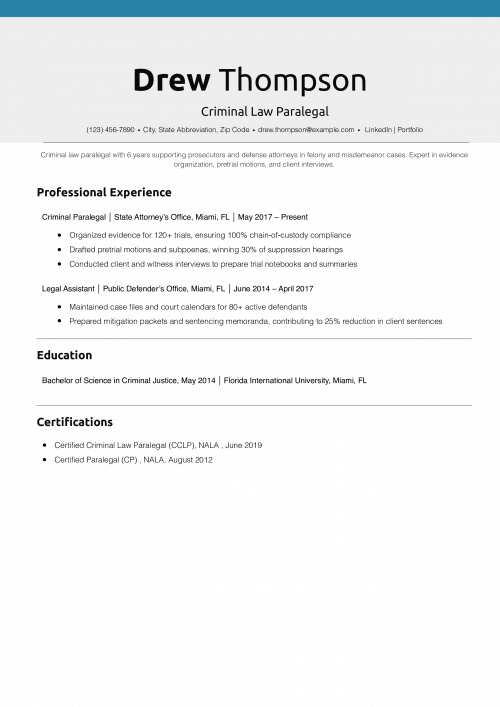
Drew’s chain‐of‐custody record (“100% compliance”) and success rate in motions (“30% wins”) highlight both attention to detail and litigation impact.
Emphasize evidence management metrics to showcase precision. For guidance on organizing trial experience, see How to Use Bullet Points on a Resume Effectively.
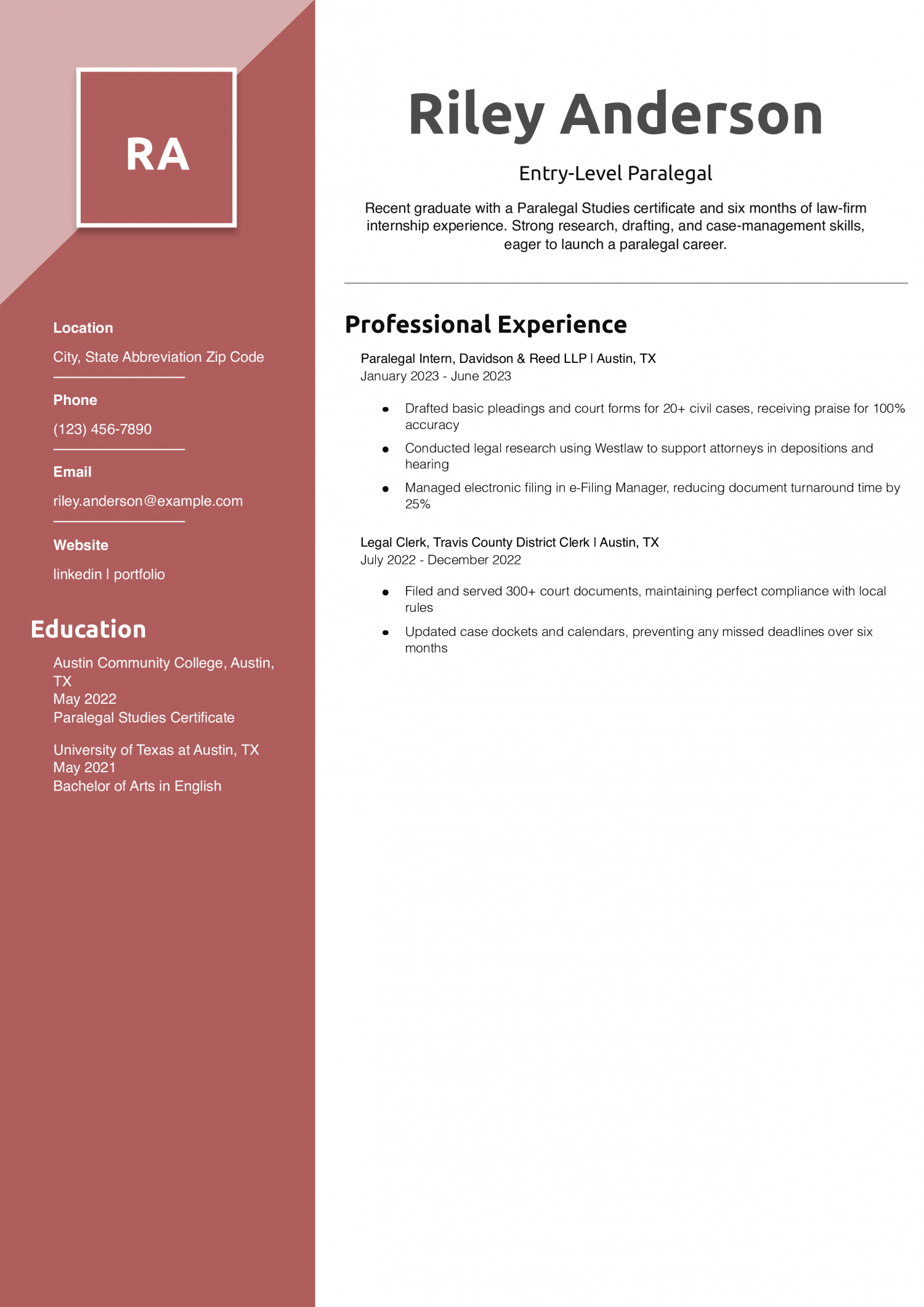
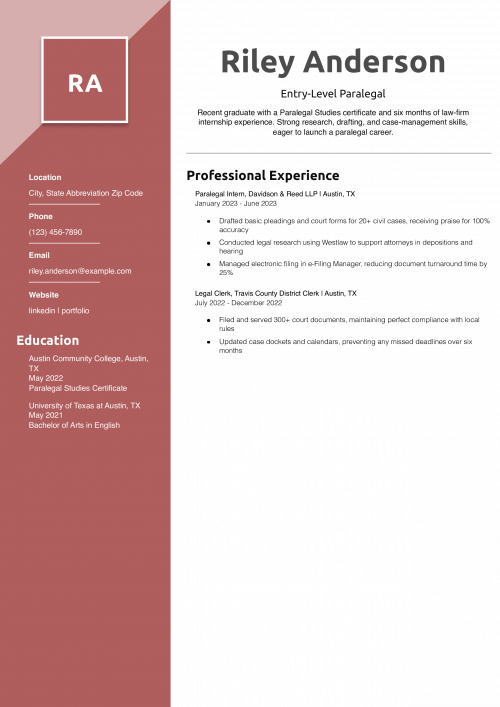
Riley’s internship metrics — “100% accuracy” and “25% faster turnaround” — demonstrate readiness and attention to detail, critical for entry-level roles.
Highlight flawless compliance and speed improvements to stand out. For advice on crafting an entry-level profile, see How to Write a Resume with No Experience.
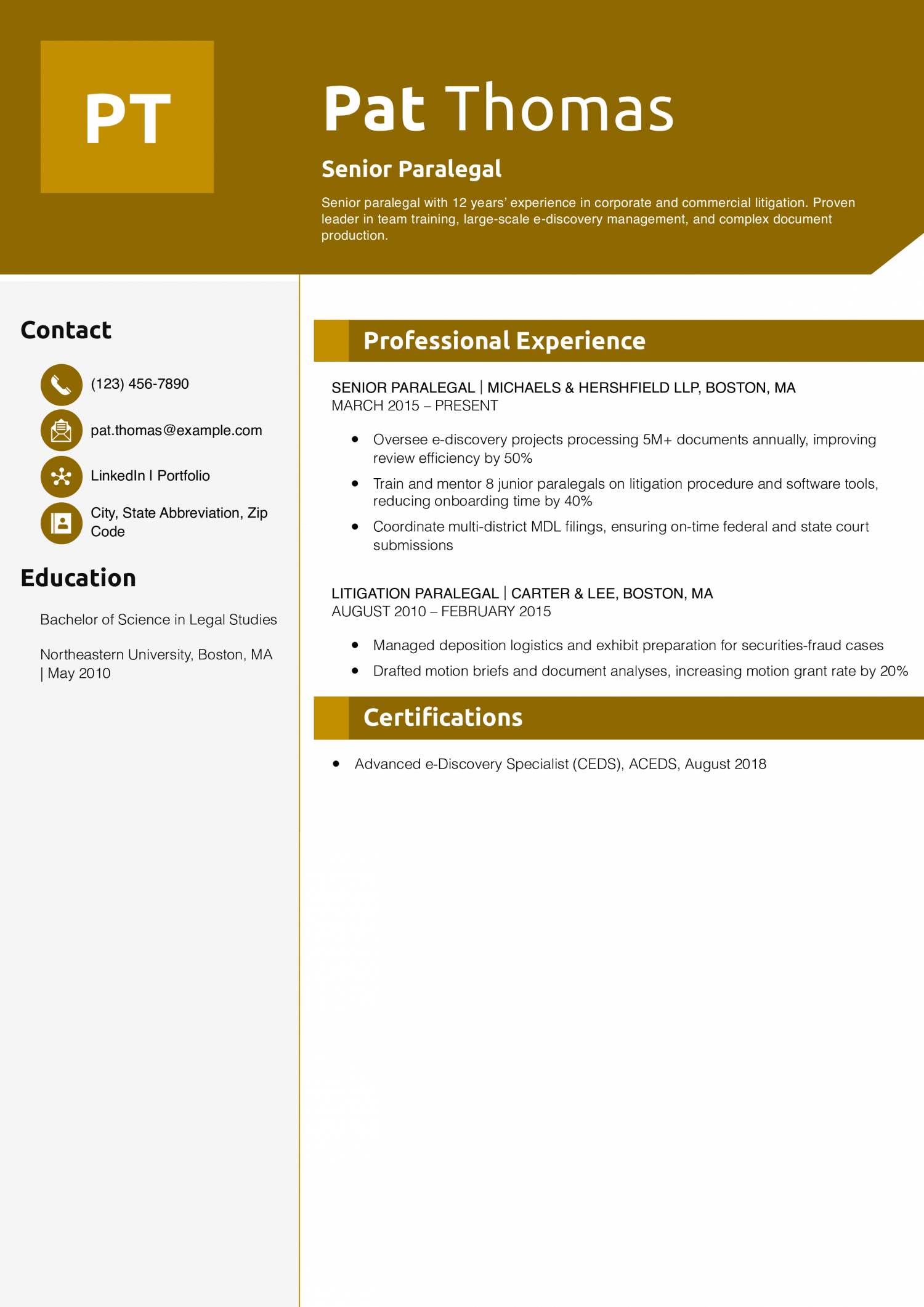
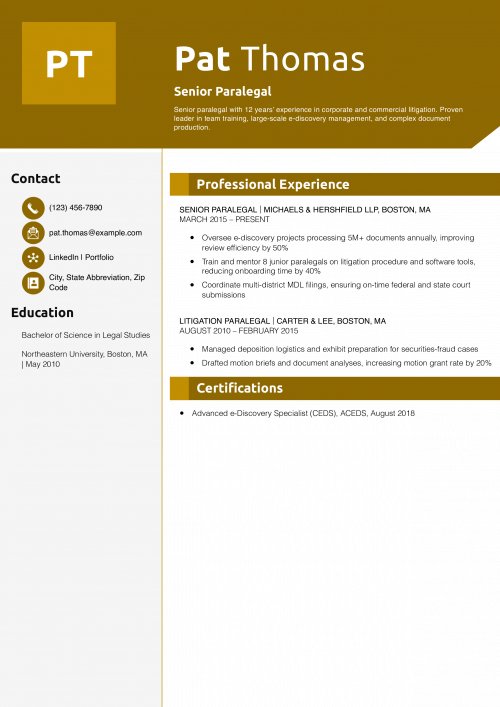
Pat’s leadership metrics — “50% faster reviews” and “40% faster onboarding” — demonstrate both technical mastery and team-development skills.
Quantify process and training improvements to showcase leadership. For more on leadership paralegal skills, visit Leadership Skills for a Resume.
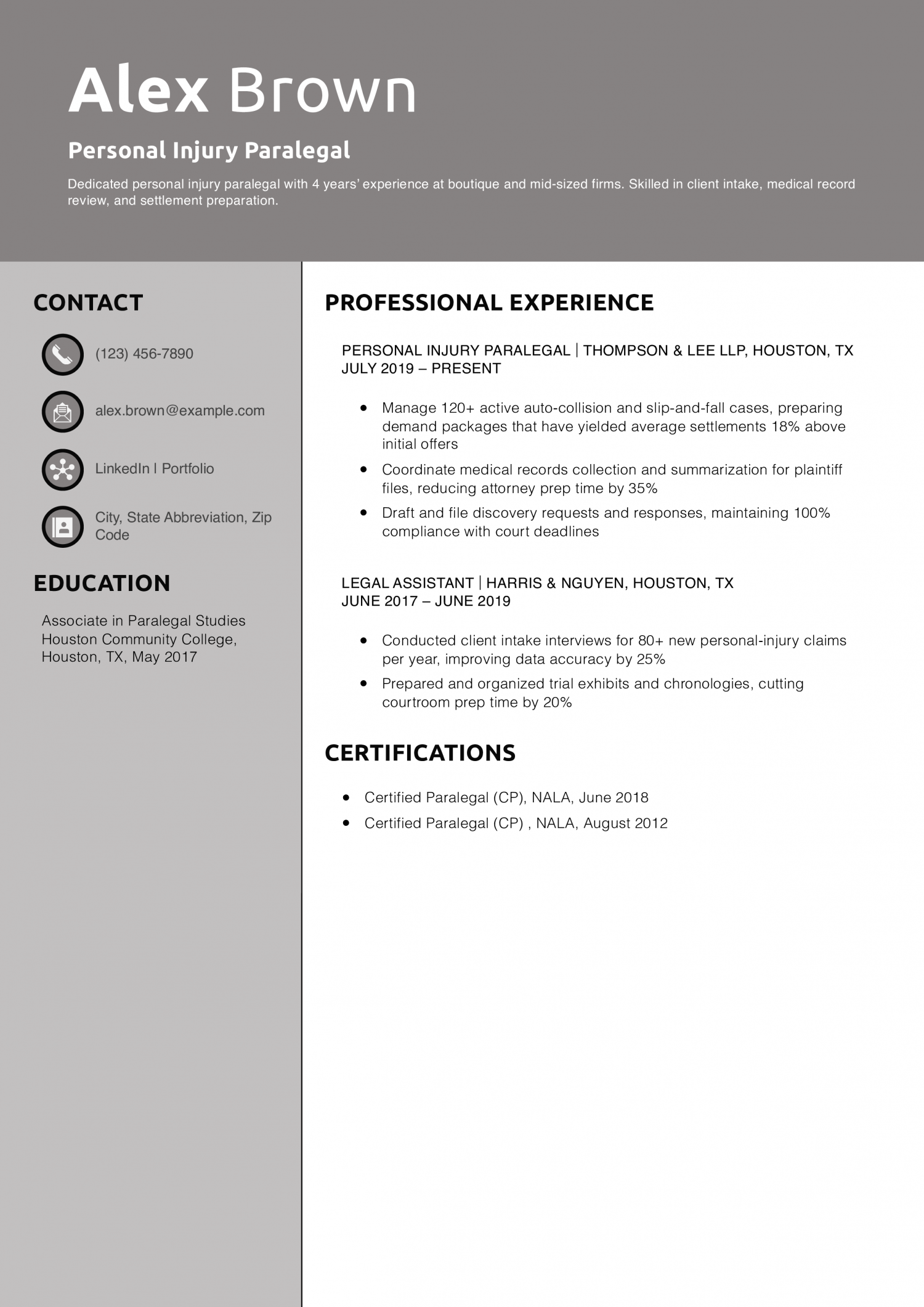
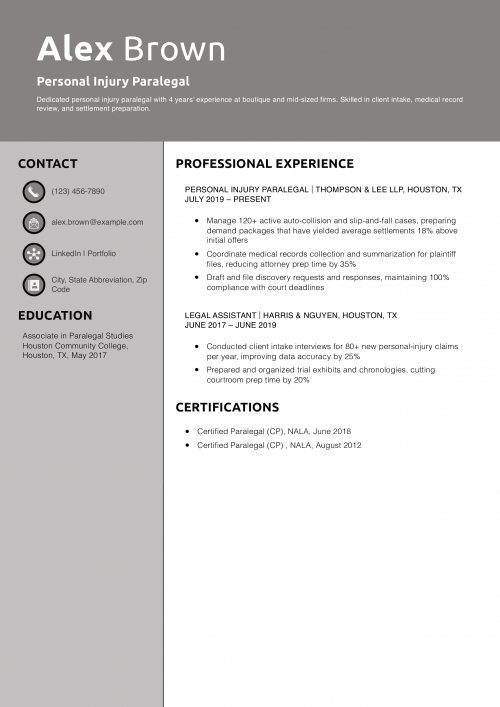
Alex quantifies both settlement outcomes (“18% above initial offers”) and efficiency gains (“35% less prep time”), demonstrating a clear impact on both client value and firm productivity.
Focus on case volume and outcome percentages to illustrate expertise. For more on framing achievements, see Best Resume Formats.
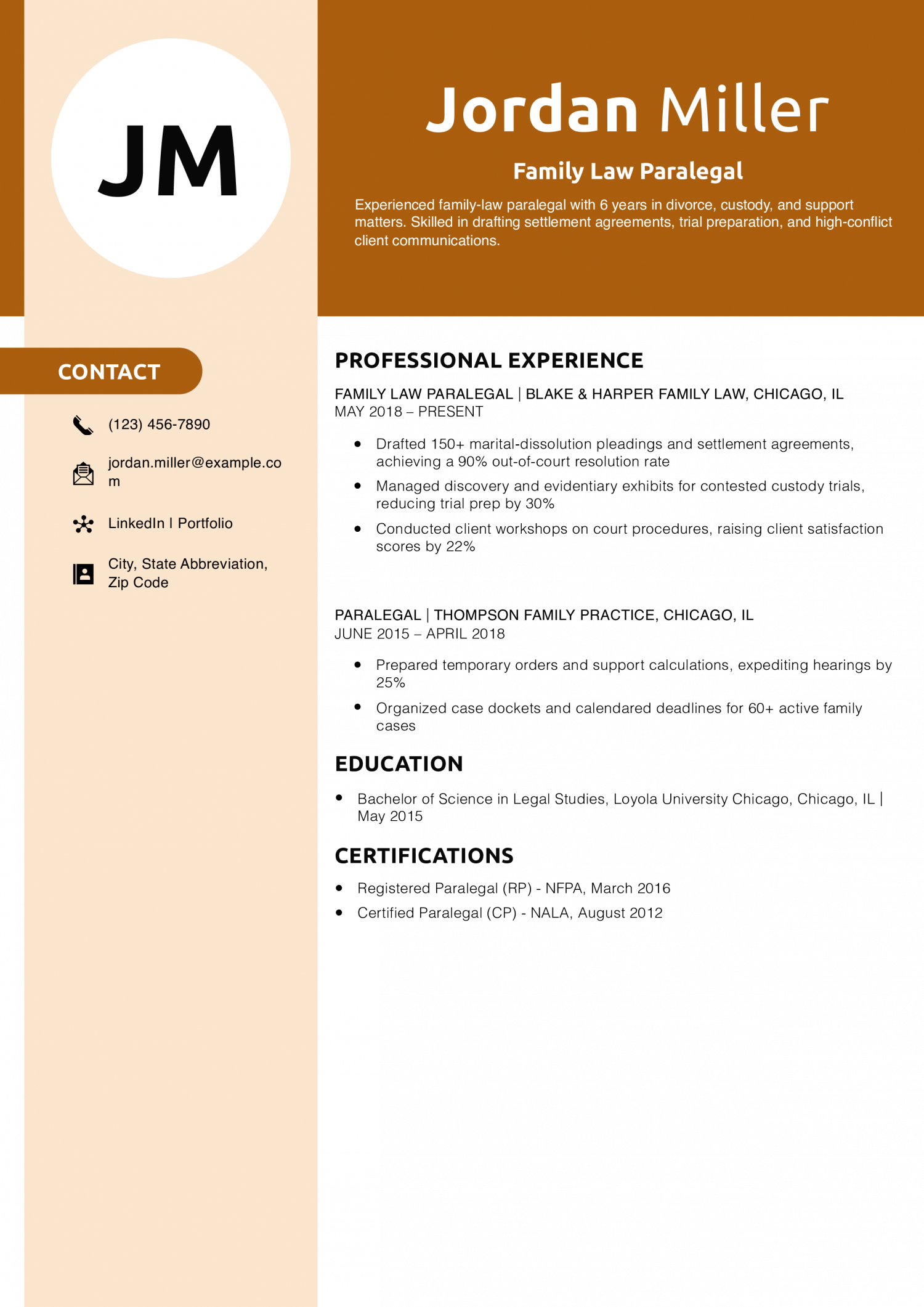
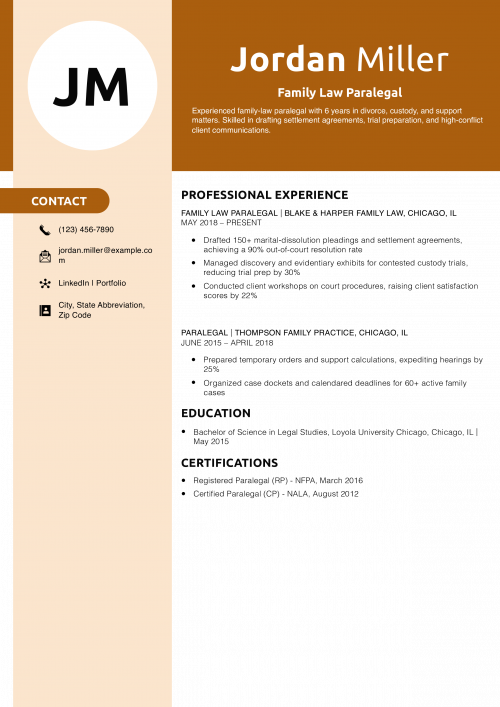
Jordan highlights resolution metrics (“90% out-of-court”) and efficiency gains (“30% less prep”), showing both legal skill and client care.
Emphasize dispute-resolution rates to showcase negotiation strength. For guidance on objective statements, see Resume Objective Examples.
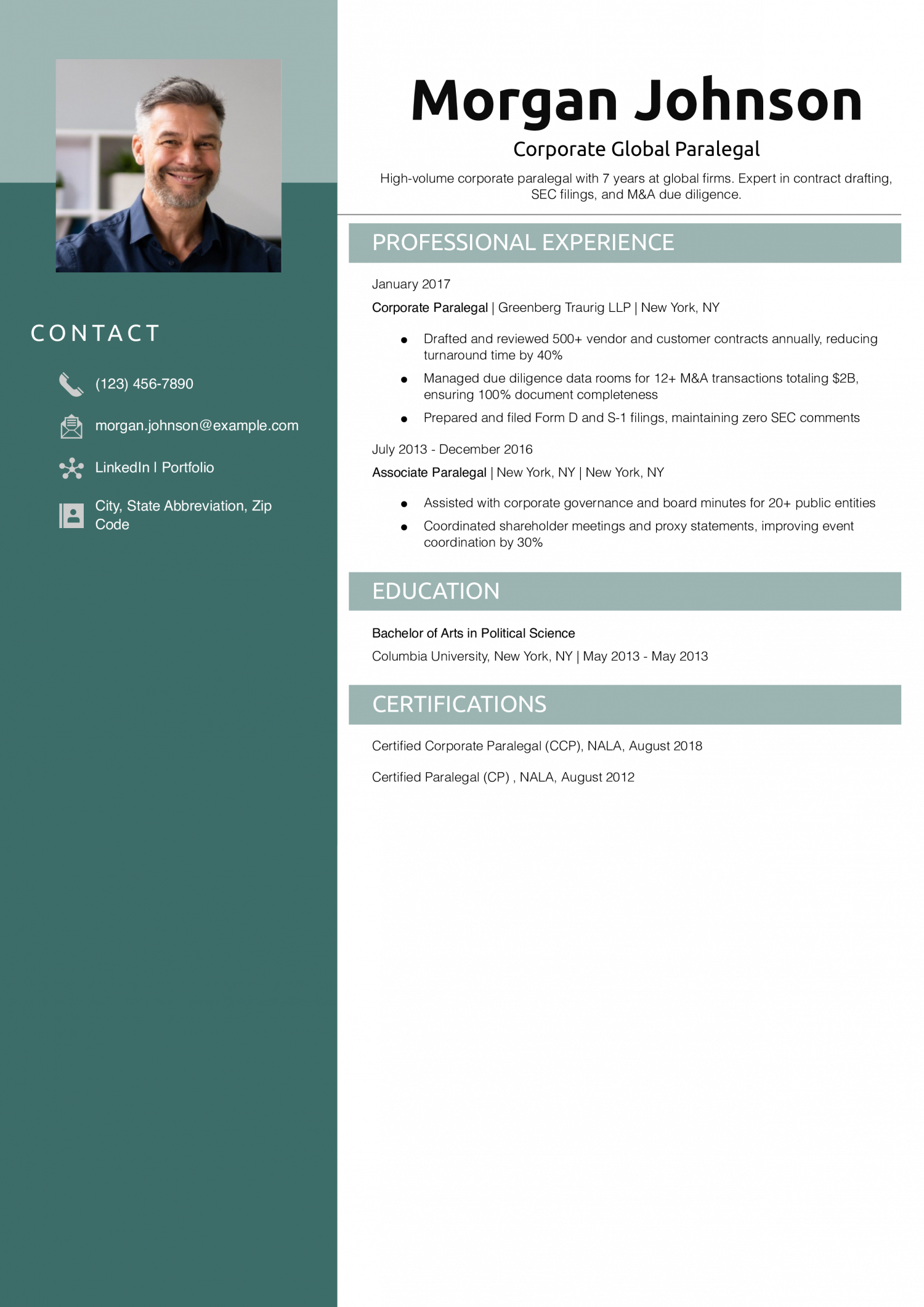
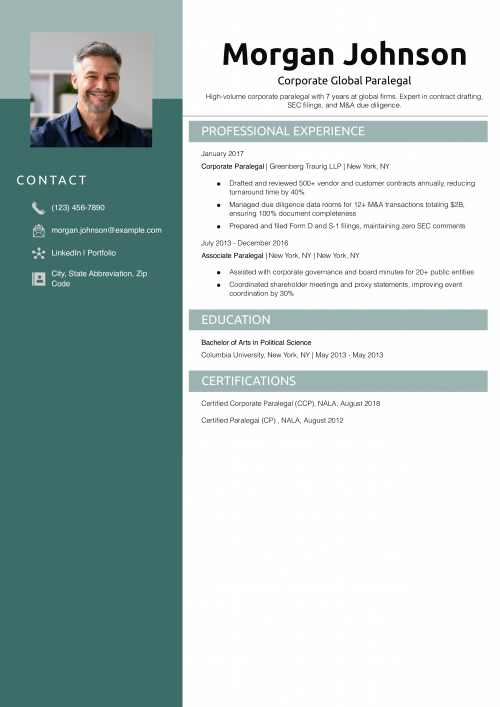
Morgan’s metrics (“40% faster contract turnaround,” “100% completeness”) demonstrate precision and high-stakes proficiency.
Highlight document-volume metrics to illustrate reliability. For more on listing core competencies, see Core Competencies for a Resume.

Casey quantifies deadline accuracy (“zero misses”) and error reduction (“25% fewer errors”), underscoring strong support skills.
Emphasize calendar and docket metrics to show reliability. For advice on support roles, see Administrative Skills for a Resume.
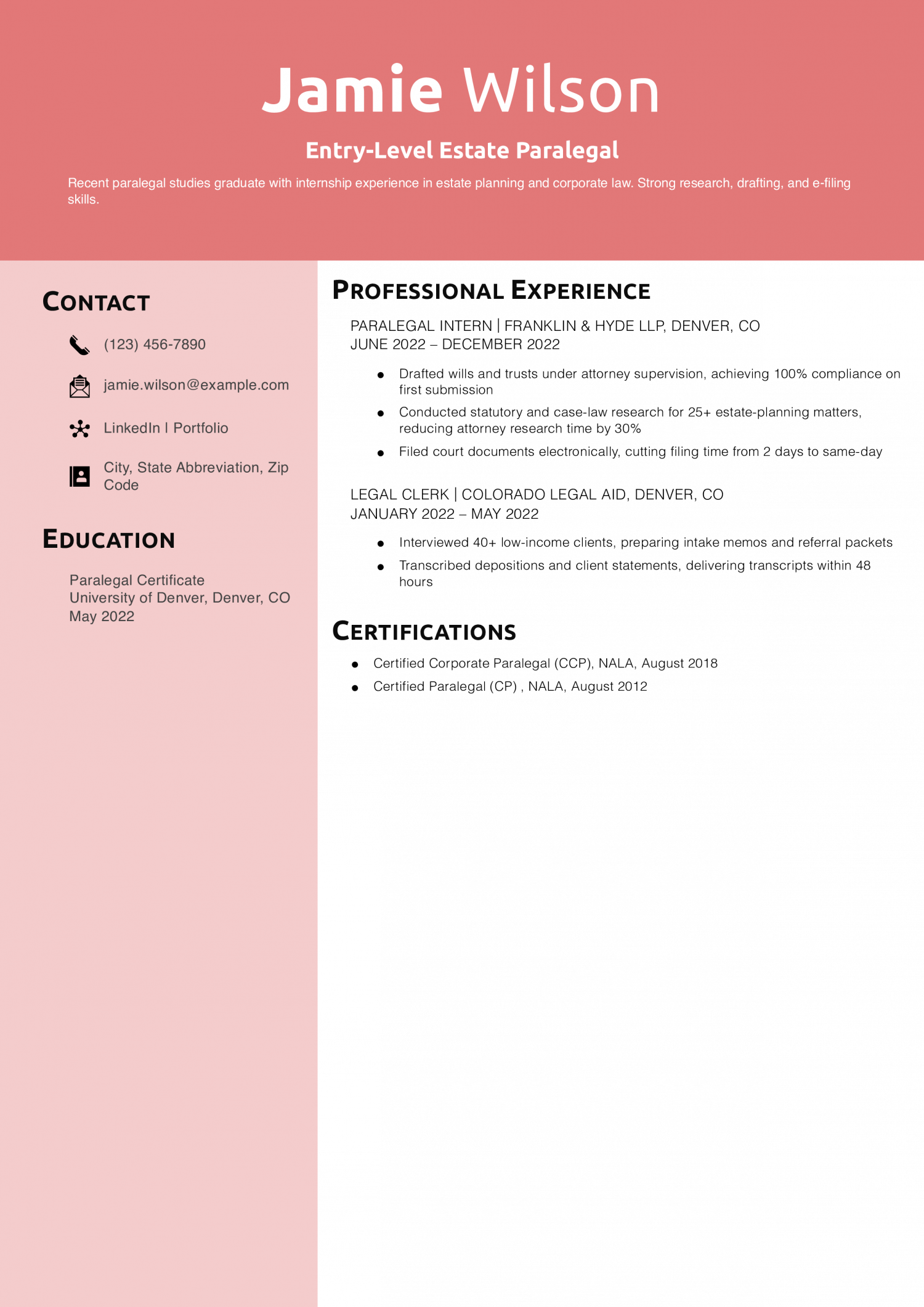
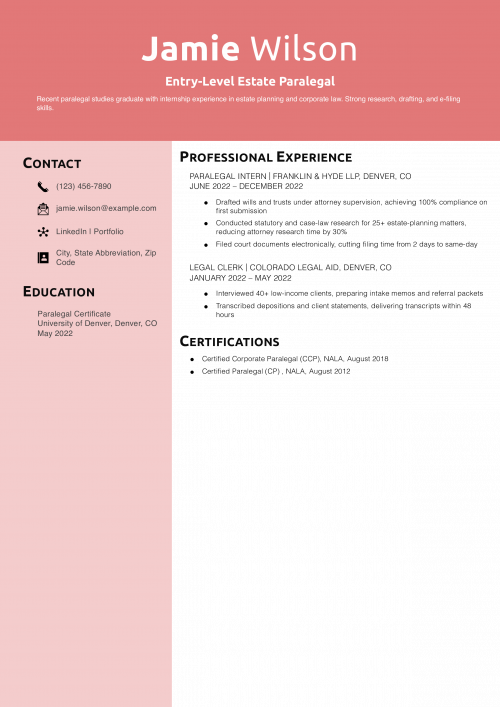
Jamie’s metrics — “100% first-pass compliance” and “30% less attorney time” — demonstrate readiness and a quick learning curve.
Highlight research and filing speed to show entry-level impact. For student-focused guidance, see How a Resume Should Look for a College Student.
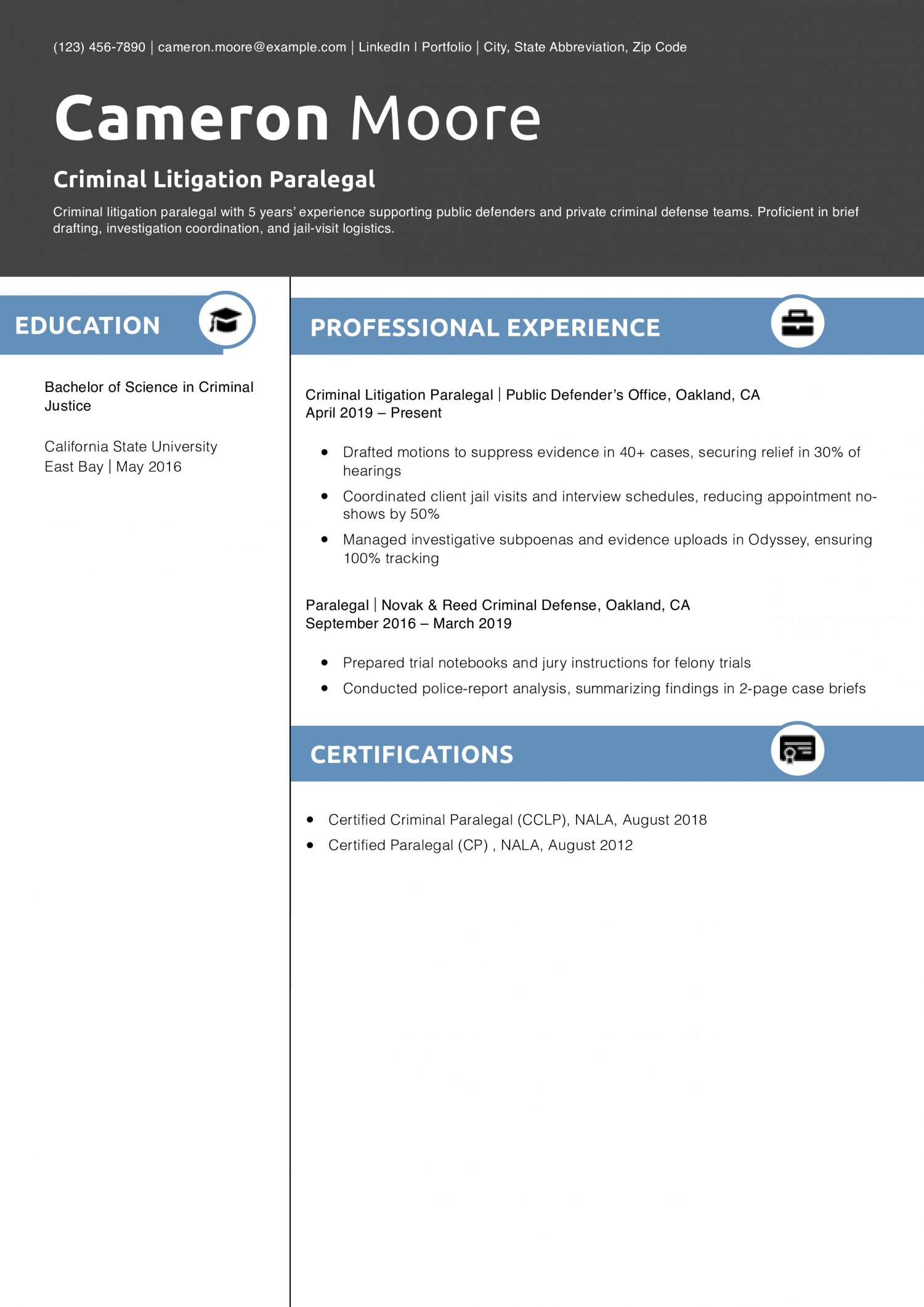
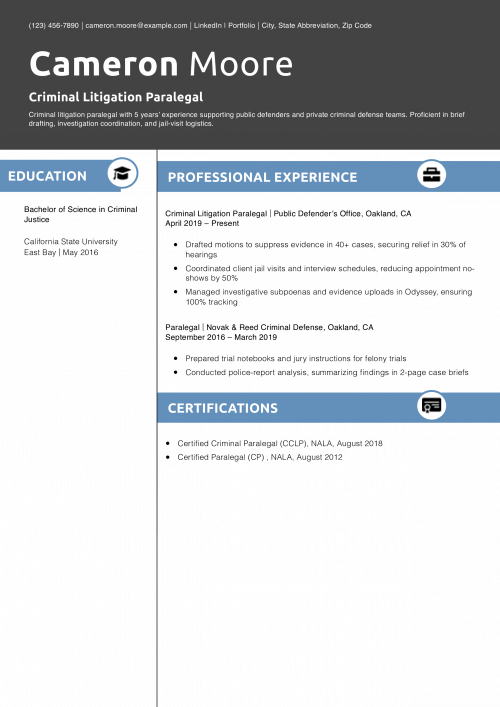
Cameron’s success rate in suppression hearings (“30% wins”) and reduced no-shows (“50% fewer”) highlight both legal acumen and client coordination prowess.
Emphasize hearing outcomes and client-coordination metrics. For more on presenting litigation results, see Server Job Descriptions for a Resume.
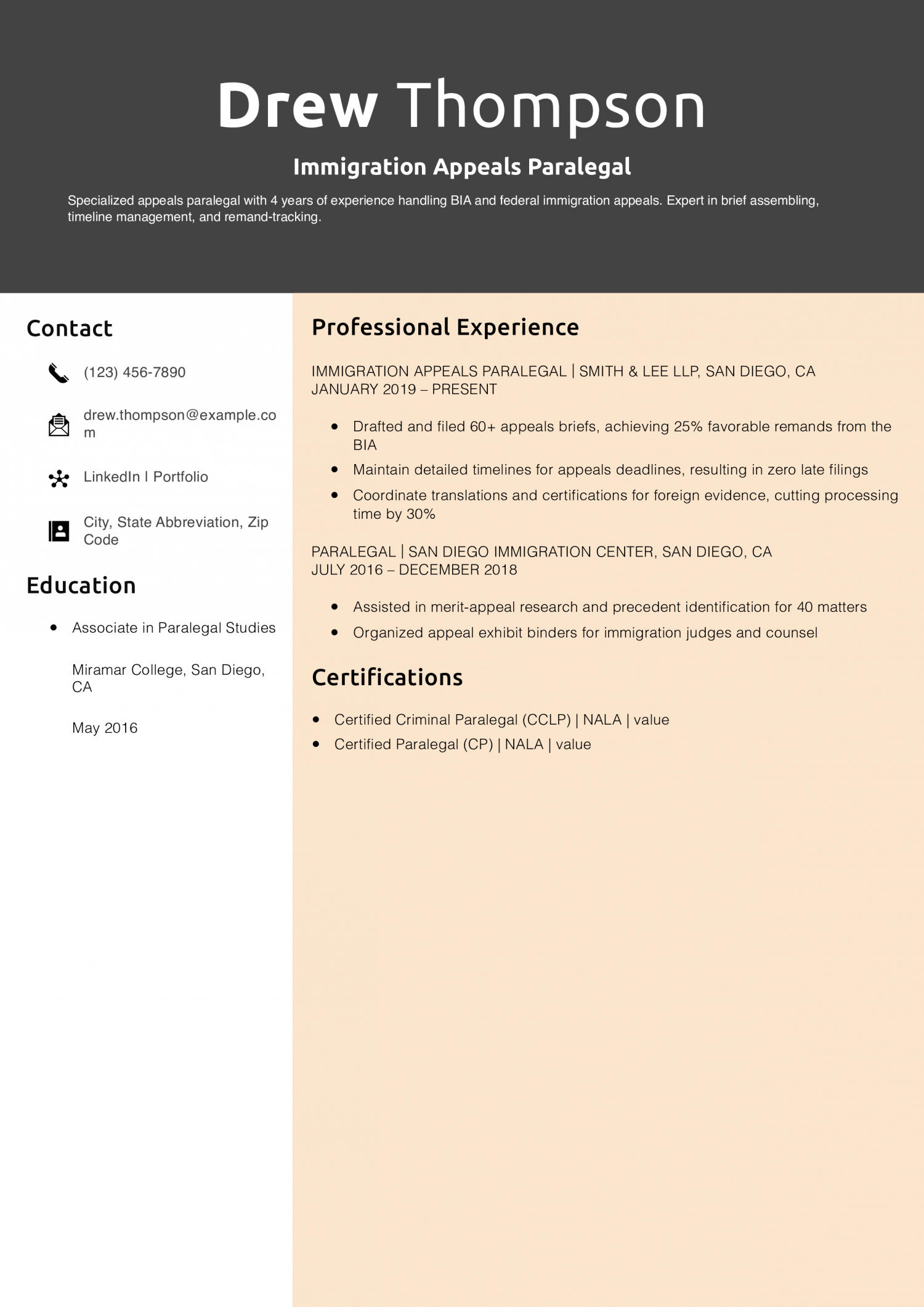
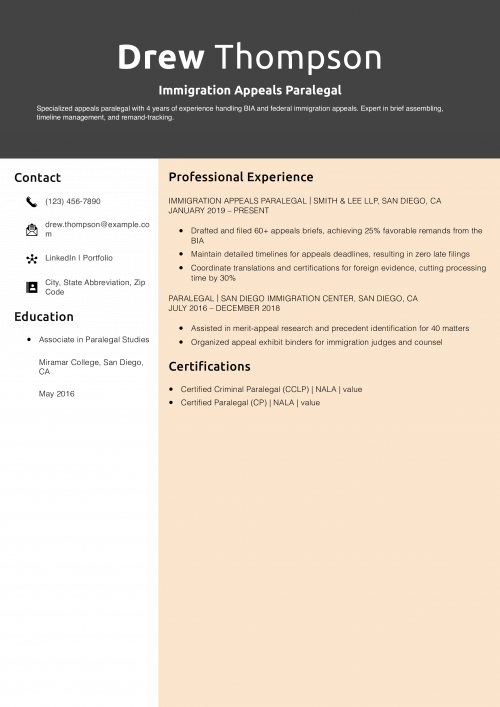
Drew’s appeals metrics — “25% remand rate” and “zero late filings” — demonstrate both legal research strength and meticulous deadline management.
Highlight appeal success rates and on-time performance. For tips on detailing specialized paralegal work, see Server Job Description for a Resume
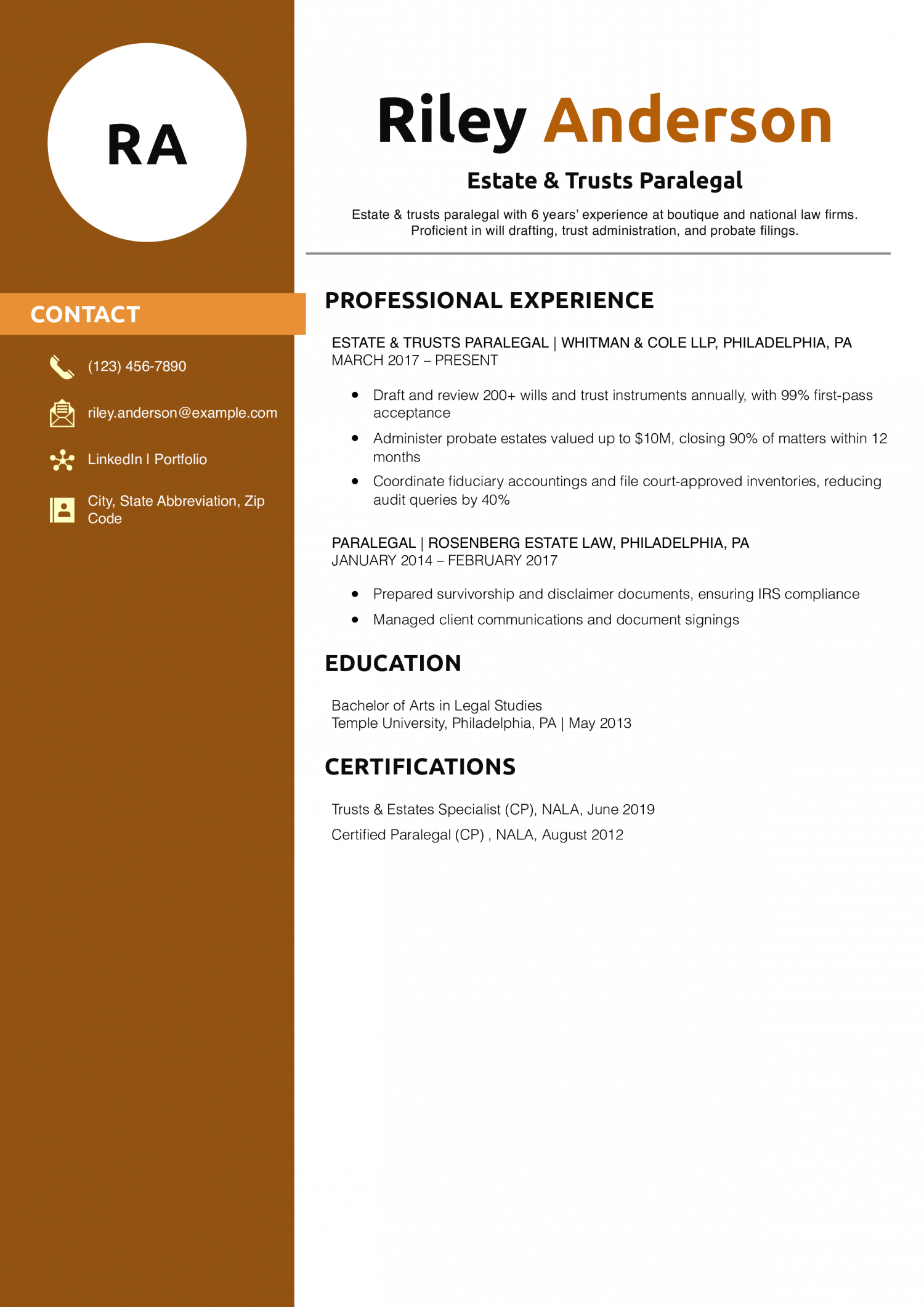
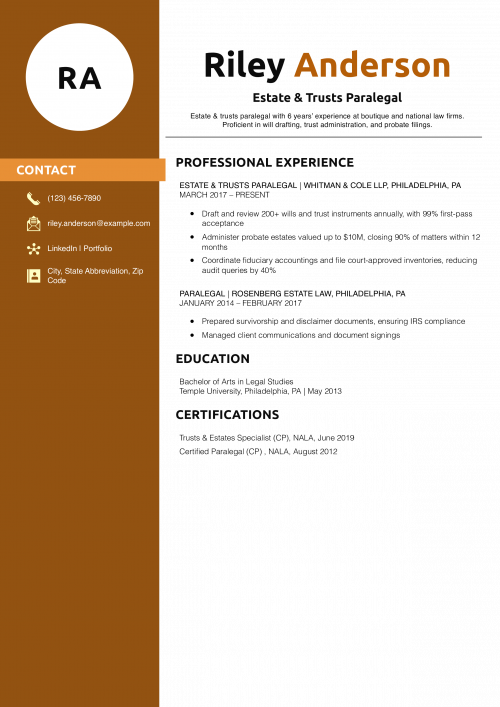
Riley’s near-perfect instrument acceptance (“99%”) and swift estate closings (“90% within a year”) underscore both technical drafting skill and process efficiency.
Quantify document acceptance and matter‐closing rates. For guidance on wills and trusts drafting, see Work Experience on a Resume.
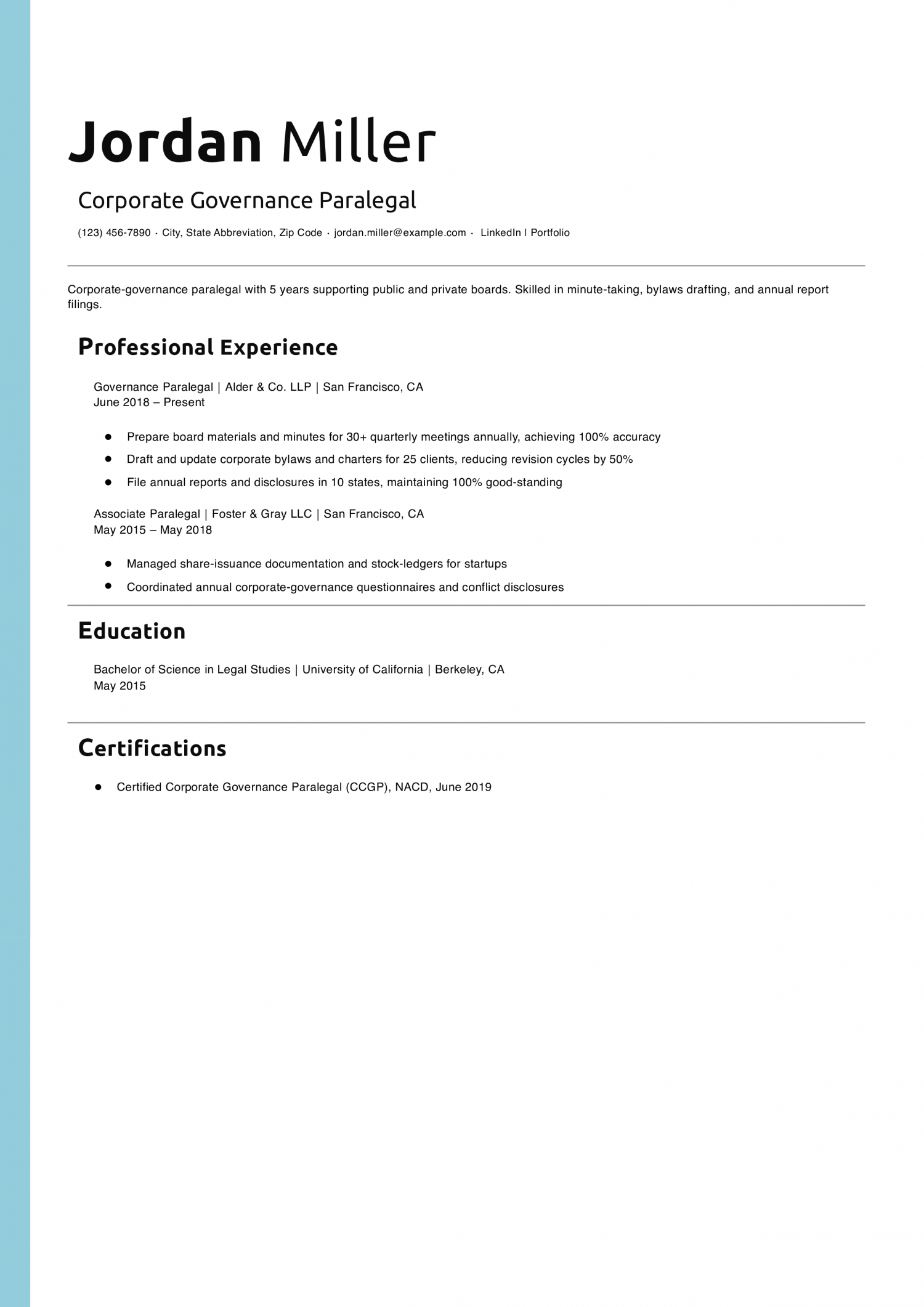
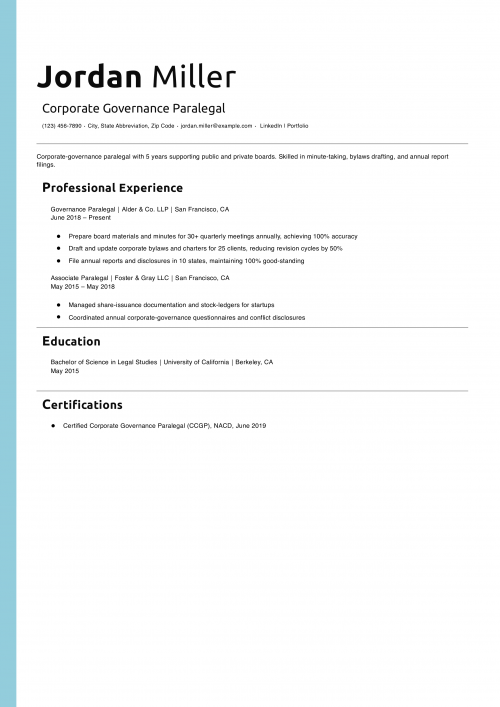
Jordan’s perfect accuracy rates and 50% faster drafting cycles show attention to detail and process improvements.
Highlight meeting and filing metrics to underscore governance expertise. For more on drafting corporate documents, see How to Write a Resume Summary.
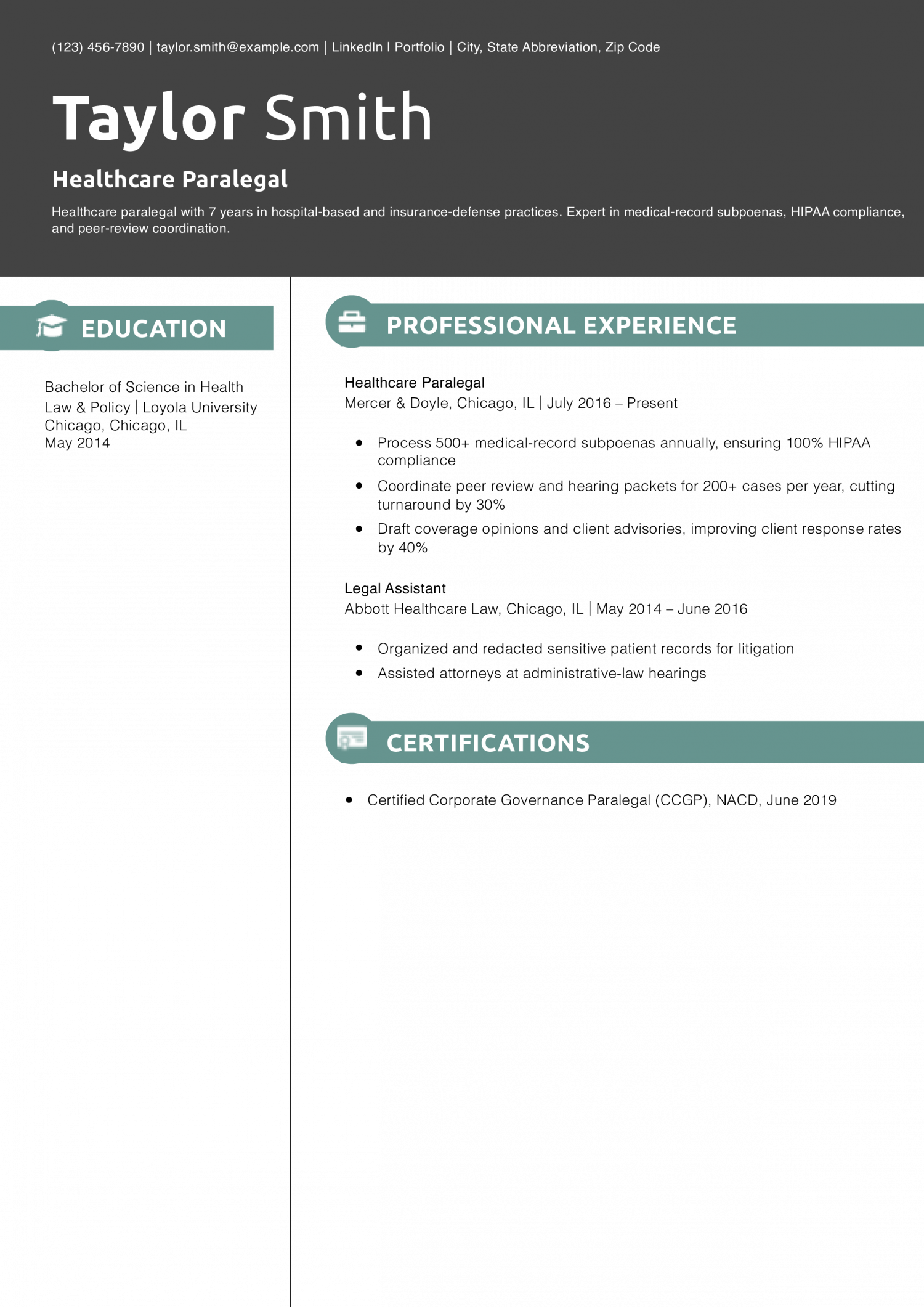
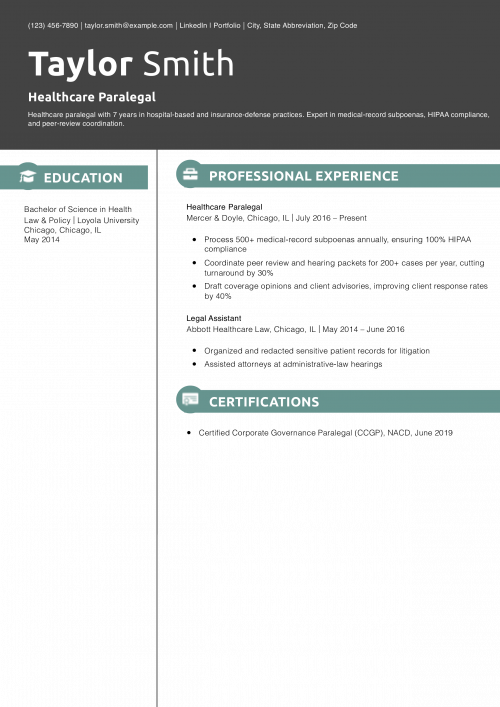
Taylor’s compliance record (“100% HIPAA”) and faster packet prep (“30% quicker”) emphasize both regulatory expertise and efficiency.
Emphasize compliance metrics and process‐speed improvements. For more on specialized law resumes, see What to Put on a Resume.
Using a resume template can help you write an effective paralegal resume. Your document should include these sections:
Provide your full name, phone number, email address, location, and a link to your online professional profile. Ensure your contact information is current so potential employers can contact you for an interview.
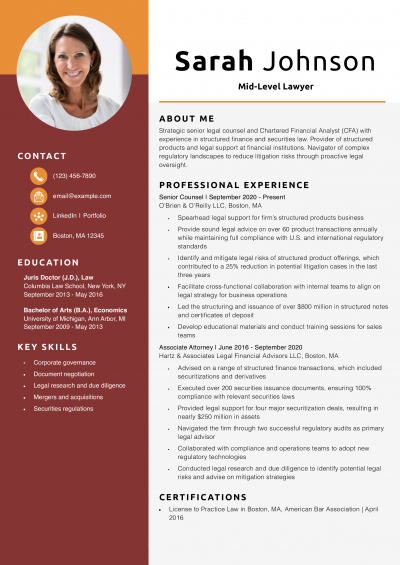
Sarah Johnson
(123) 456-7890
[email protected]
Boston, MA 12345
LinkedIn | Portfolio
After your contact information, capture the reader’s attention with a succinct but impactful profile. It should consist of about three sentences overviewing your job history, credentials, relevant skills, and accomplishments as a paralegal. Incorporate keywords from the job posting to demonstrate that your background aligns well with the opportunity you’re seeking.
Certified paralegal with more than 10 years of experience at top-shelf firms specializing in family law. Significant leadership experience as lead paralegal overseeing a team of legal assistants. Deep knowledge of custody legal challenges, trial document preparation, and legal research standards.
Attentive, organized paralegal with several years of experience in personal injury and malpractice law. Track record for helping attorneys build, maintain, and grow client relationships. Expeditious researcher and problem-solver with critical thinking skills.
The professional experience section of your resume should provide a history of your employment as a paralegal and any other relevant work. More importantly, it should create a narrative of how you’ve grown as a professional. For each role, include three to five bullets that showcase special achievements, the impact you’ve made, as well as key responsibilities.
Lead Paralegal, Squires & Smith LLC, Nashville, TN
May 2018 – present
Paralegal, Scranton and Sons LLC, San Diego, CA
June 2021 – present
Use numbers and metrics to show the results you achieved in previous legal roles. Provide context to your work history and give recruiters a better understanding of your scope and impact. You can demonstrate your value and potential as a paralegal by detailing how you expedite time to trial and improve organizational systems to facilitate more efficient case management.
Creating a paralegal resume if you haven’t yet worked in the field can be a challenge. However, everyone has to start somewhere, and employers can still determine if you have the skills and knowledge needed based on what you include on your resume. For paralegals, your education, certifications, and training are essential as they show you have the competencies needed for the role. Also, highlight relevant coursework or internships.
You can also include past jobs even outside of the legal field, focusing on your ability to adapt, work in teams, meet deadlines, and conduct research. These traits are all valuable assets to a legal team.
Include your educational background and certifications from recognized paralegal associations like NALA to prove you have the required credentials to work as a paralegal. Include the titles of your degrees and certificates, along with each institution’s name and the completion date.
Template:
[Degree Name]
[School Name], [City, State Abbreviation] | [Graduation Year]
Example:
Bachelor of Arts (B.A.), Legal Studies, May 2014
University of Tennessee, Knoxville, TN
Associate of Applied Science (AAS), Paralegal Studies, June 2012
Nashville State Community College, Nashville, TN
Template:
[Certification Name], [Awarding Organization], [Completion Year]
Example:
Most organizations rely on some form of ATS to identify qualified candidates for job openings. To get your resume through the initial screening process and into the hiring manager’s hands, incorporate keywords from the job description directly into your profile, professional experience, and skills section. Below are key terms and skills you may encounter while applying for paralegal positions:
| Key Skills and Proficiencies | |
|---|---|
| Case management | Client service and communications |
| Contract management | Court procedures |
| Deadline management | Document drafting and preparation |
| e-Discovery and document management | Filing and retrieval systems |
| Legal ethics and confidentiality | Legal file digitization |
| Legal research and analysis | Legal terminology and procedures |
| LexisNexis | Microsoft Office Suite |
| Process streamlining and improvement | Task prioritization |
| Team collaboration | Trial preparation and support |
| Westlaw | Writing, editing, and proofreading |
Take a strategic approach with the words you use on your paralegal resume. In the professional experience section of your resume, incorporate action verbs to communicate your job duties and accomplishments. Instead of listing responsibilities, start each bullet with an engaging verb that shows how you executed critical paralegal tasks. Avoid using first-person language such as, “I was responsible for…” Following are some action verbs you can use to liven up your paralegal resume.
| Action Verbs | |
|---|---|
| Analyzed | Assisted |
| Discussed | Drafted |
| Enhanced | Exhibited |
| Expedited | Facilitated |
| Filed | Garnered |
| Generated | Interviewed |
| Investigated | Maintained |
| Managed | Met with |
| Negotiated | Organized |
| Prepared | Prevented |
| Processed | Ranked |
| Researched | Reviewed |
| Streamlined | Summarized |
| Supported | Uncovered |
| Updated | Verified |
When selecting your paralegal resume template, prioritize structure and readability over visual appeal. Avoid loud graphics and overbearing colors, and focus on a clean design that showcases your content in an organized way. Keep in mind hiring managers will always be more interested in your achievements and qualifications than the style of your template.
According to the Bureau of Labor Statistics, jobs for paralegals are projected to grow by 4% from 2022 to 2032, about as fast as other occupations. Because many large corporations are increasing their in-house legal departments to cut costs, there will be an increase in demand for paralegals and legal assistants in various settings.
Although these projections are optimistic, you must align your resume with the job description to secure interviews for the most lucrative opportunities. By tailoring your document to individual paralegal job postings, you will increase your chances of landing your next job opportunity.
For example, suppose a company is looking for a paralegal who specializes in family court and custody cases. In this case, highlight your knowledge of family law and research skills to assist with divorce cases.
Reverse chronological format is ideal for most resumes, including those for paralegals. This approach ensures your most recent and relevant experience is featured at the top of your document. Even at the entry level, avoid functional resume formats. If you lack hands-on experience, your resume will still be more effective if you highlight academic projects rather than only listing technical skills.
A well-rounded Paralegal CV should include the following sections: a profile summary that highlights your experience and strengths, a skills section that aligns with the job description, a professional experience section that outlines key roles and responsibilities, and education and certifications. Adding a section for key achievements or quantifiable results can also give your CV a competitive edge.
Your paralegal resume should demonstrate your strong communication skills, organizational skills, decision-making and solution-finding capabilities, and research and analytics skills. Also, display an understanding of tools such as LexisNexis and document digitization systems, and any areas of expertise like benefits planning or strategic recruiting. Include hard and soft skills that show you are a well-rounded paralegal professional candidate.
Make your paralegal resume stand out by highlighting achievements, demonstrating the value you bring to companies by incorporating numbers and data, and using keywords that align with the job description. Begin with a compelling profile summary, detail your accomplishments in the professional experience section, list relevant skills, and include your education and certifications.
Executive Resume Writer and Career Coach
Andrew Stoner is an executive career coach and resume writer with 17 years of experience as a hiring manager and operations leader at two Fortune 500 Financial Services companies, and as the career services director at two major university business schools.
Resume Templates offers free, HR approved resume templates to help you create a professional resume in minutes. Choose from several template options and even pre-populate a resume from your profile.