
21 Best Medical Assistant Resume Examples and Templates for 2025



The first step in pursuing a career within the medical field is creating a results-driven resume that captures the most substantial aspects of your professional background. Convey your passion for patient care and dedication to improving clinical outcomes. Demonstrate your experience working in fast-paced clinical environments and collaborating effectively with multidisciplinary teams. This guide will help you tell your unique story within the medical field and propel your career forward.
Key takeaways:
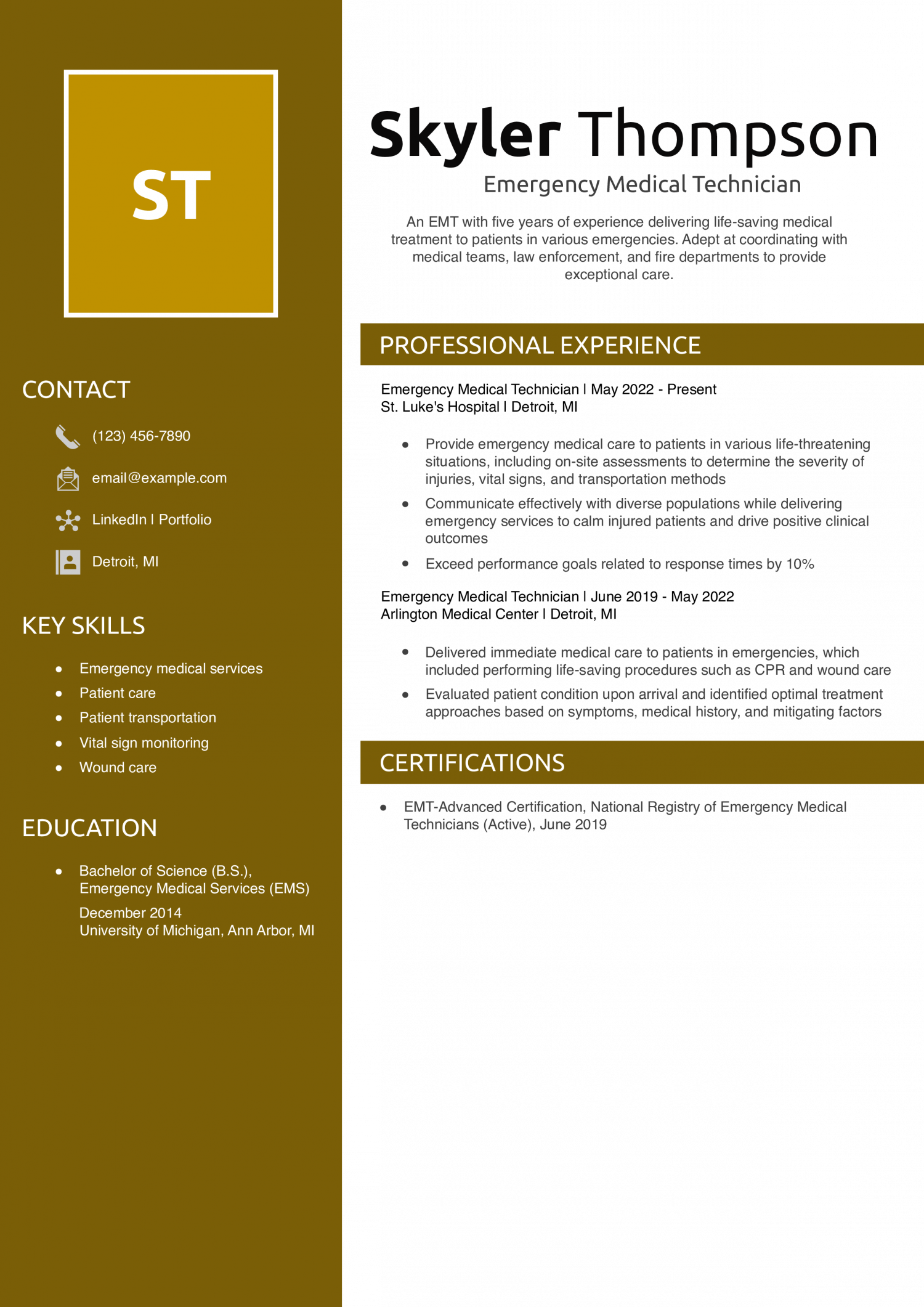
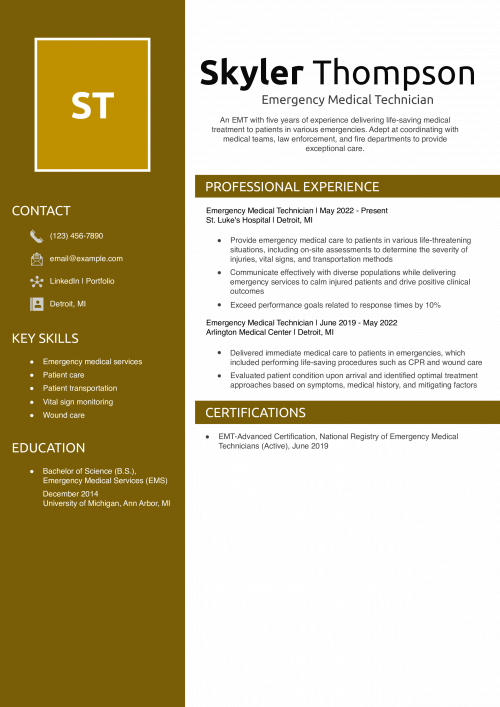
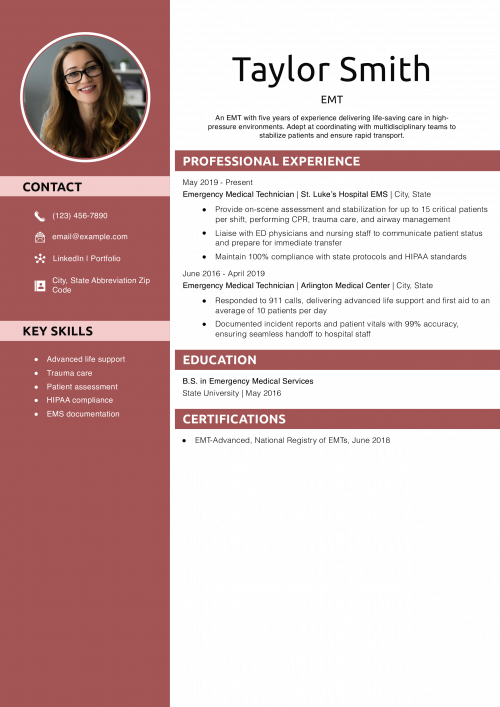
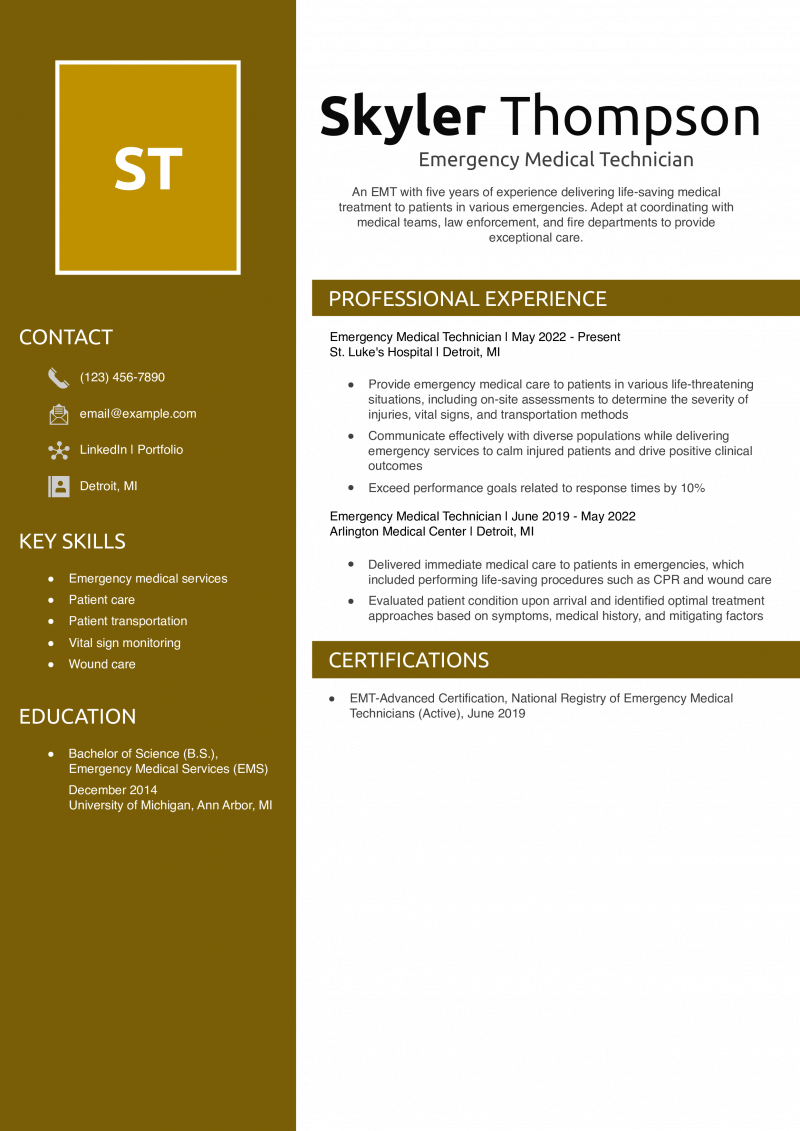
This medical resume does an excellent job of capturing the candidate’s background as an EMT. The summary is concise yet engaging, and the bullet points emphasize the EMT’s ability to deliver exceptional care during high-pressure situations.
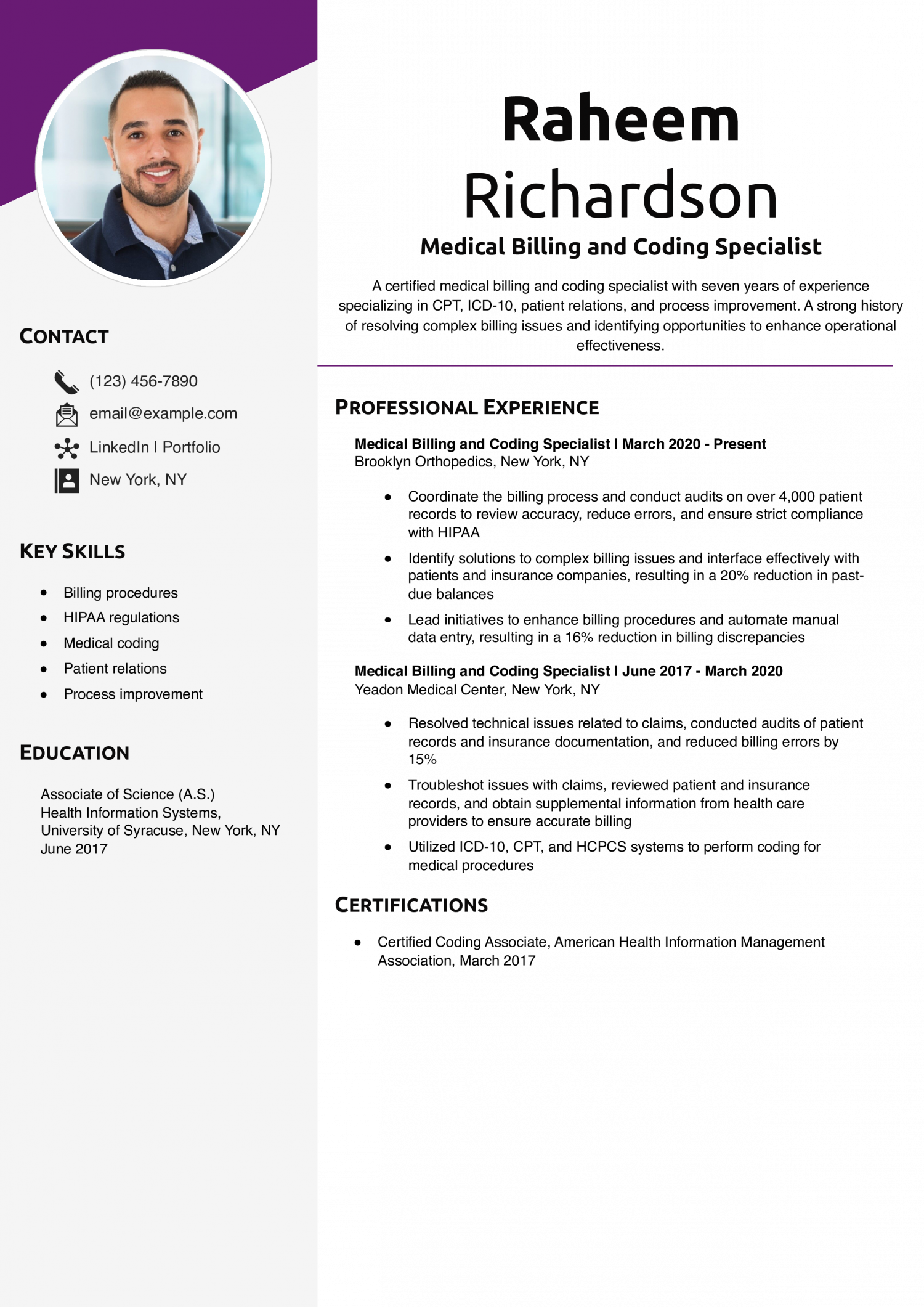
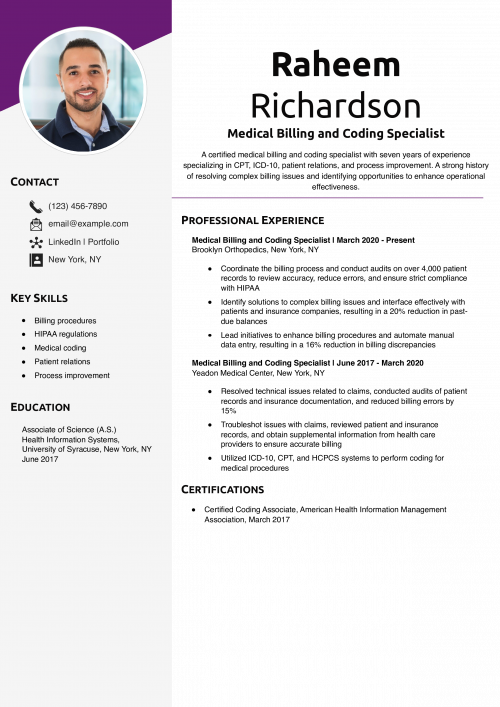
This medical resume demonstrates how candidates utilize their medical and technical knowledge to improve internal processes. They also substantiate their achievements with impactful numbers, illustrating the value they can bring to future employers.
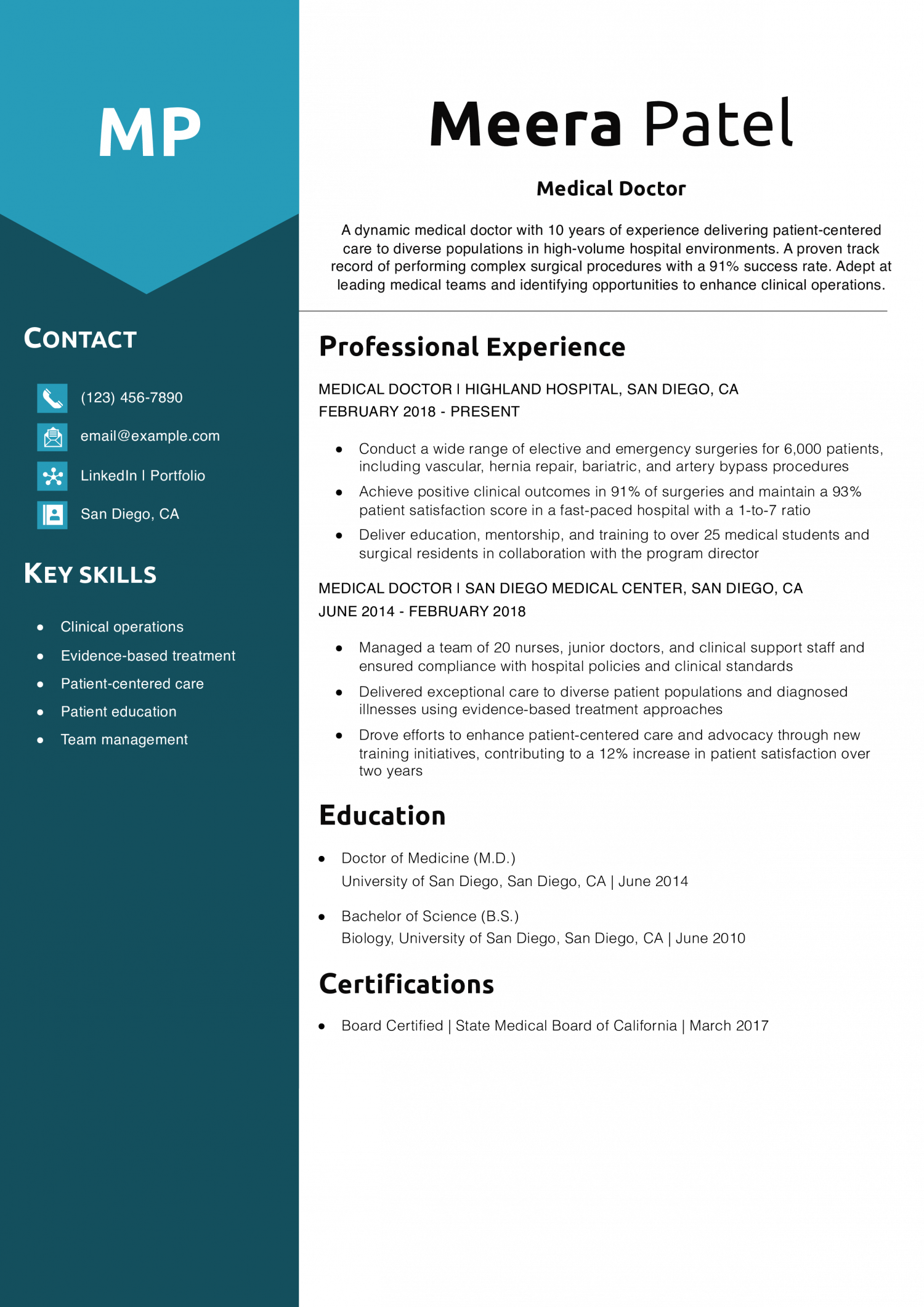
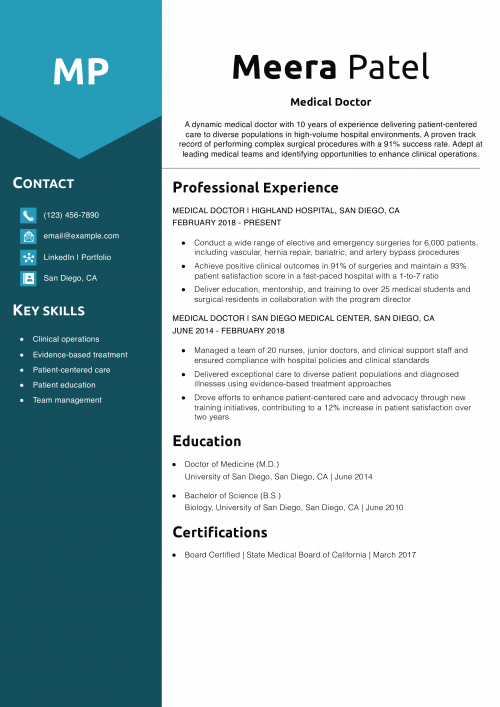
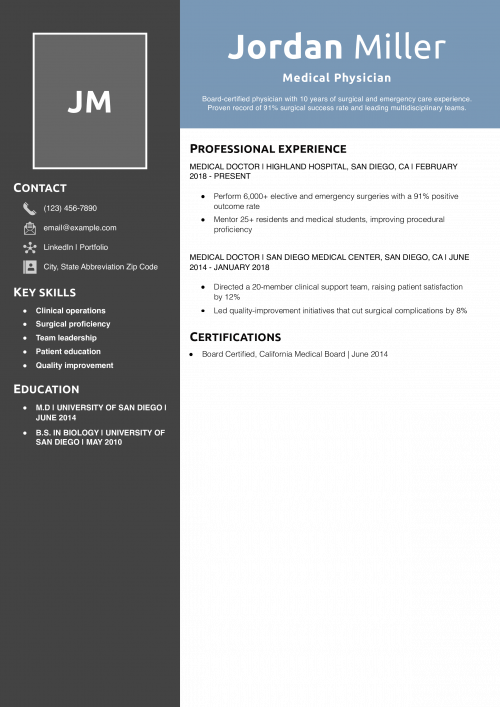
This medical resume is a great example of how to structure your content as a physician. In addition to featuring compelling metrics and clinical data, the candidate emphasizes their leadership experience managing clinical teams and mentoring junior residents.
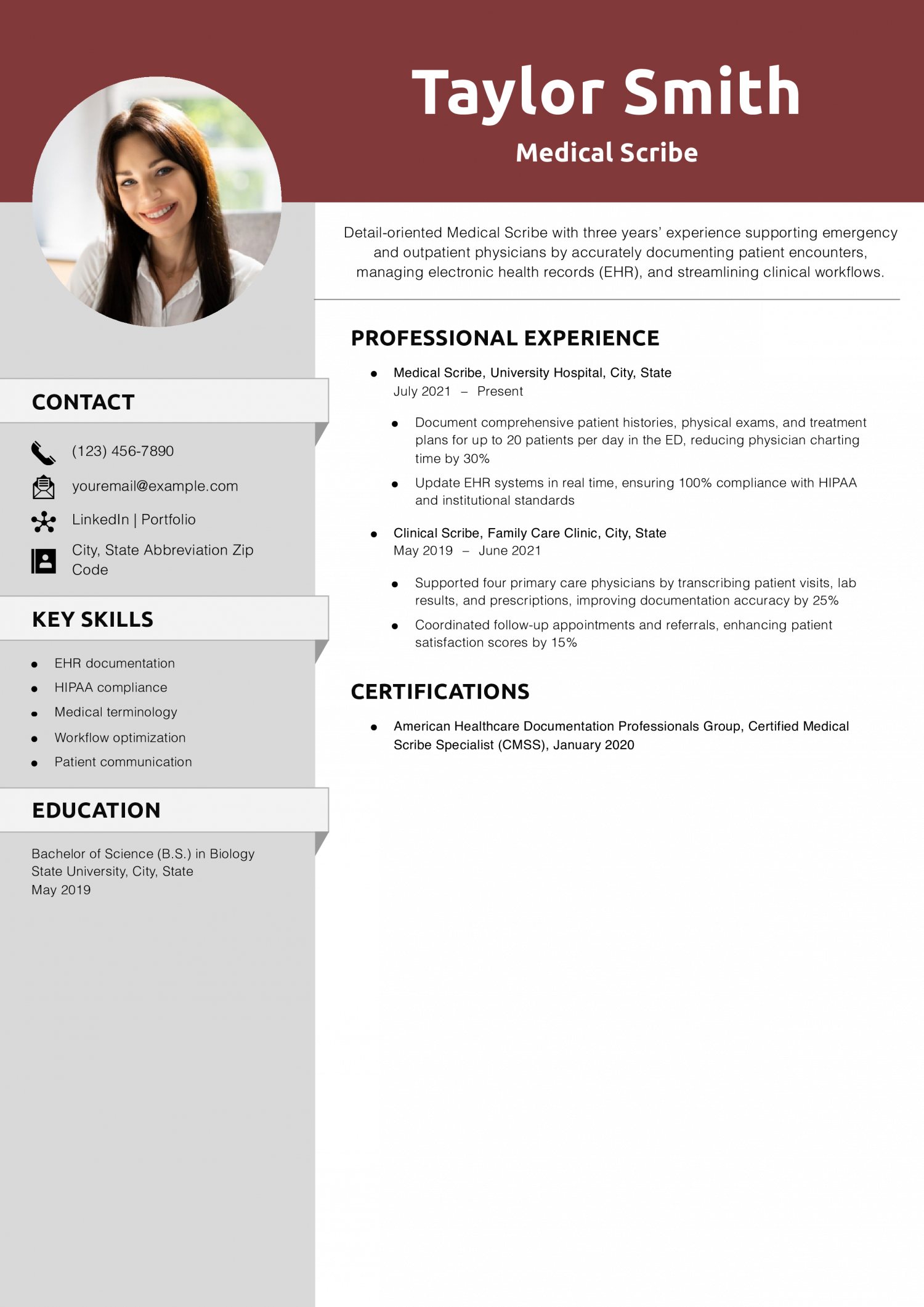
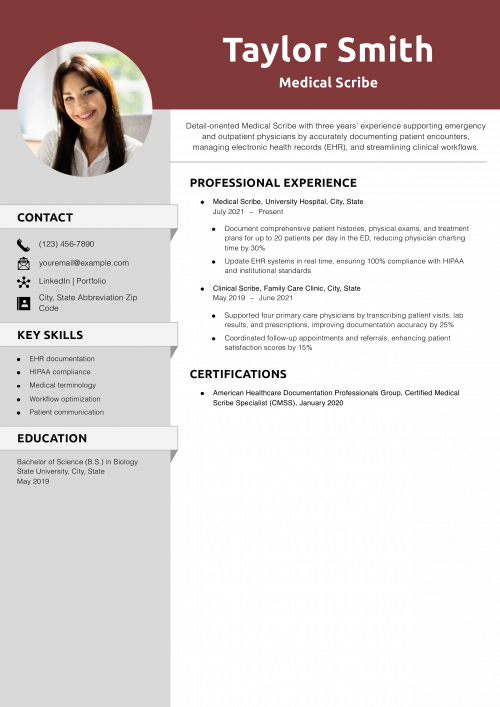
Taylor’s resume showcases their ability to reduce physician administrative burden through precise EHR documentation and real-time charting support, skills essential for a Medical Scribe. The structure is concise, allowing hiring managers to quickly assess clinical and technical competencies.
Highlight your impact on clinical efficiency to demonstrate value. For guidance on crafting concise summaries, see How to Write a Resume Summary.
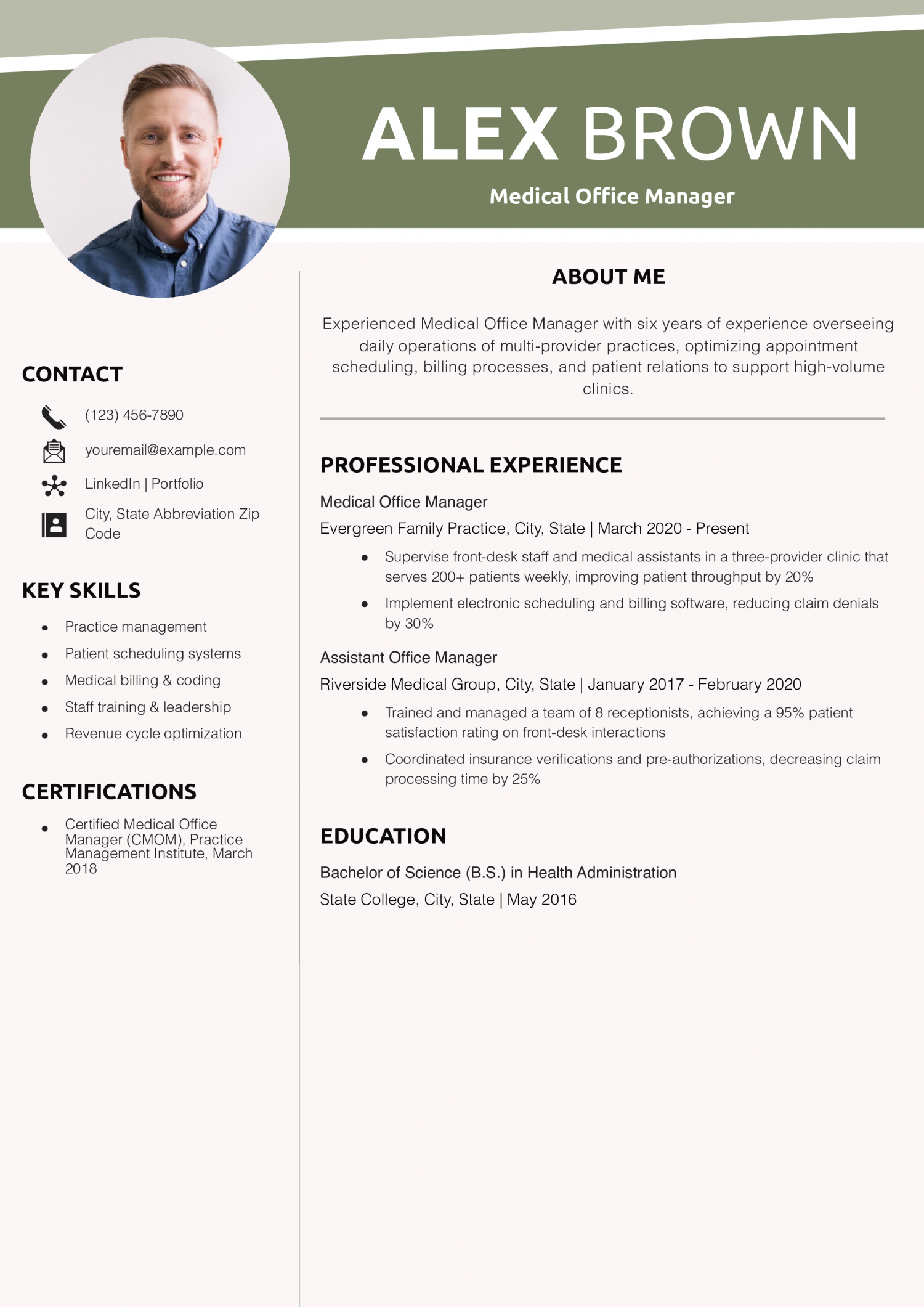
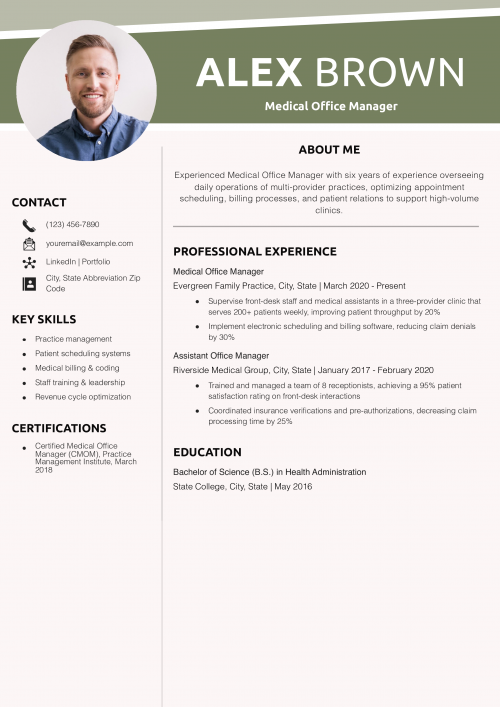
Alex’s resume clearly demonstrates leadership in practice operations and measurable improvements in scheduling and billing accuracy, crucial for a Medical Office Manager. The bullet points pair responsibilities with concrete results to highlight operational impact.
Use metrics to quantify process improvements and patient satisfaction gains. For more on showcasing leadership skills, see Leadership Skills for Resumes with Examples.
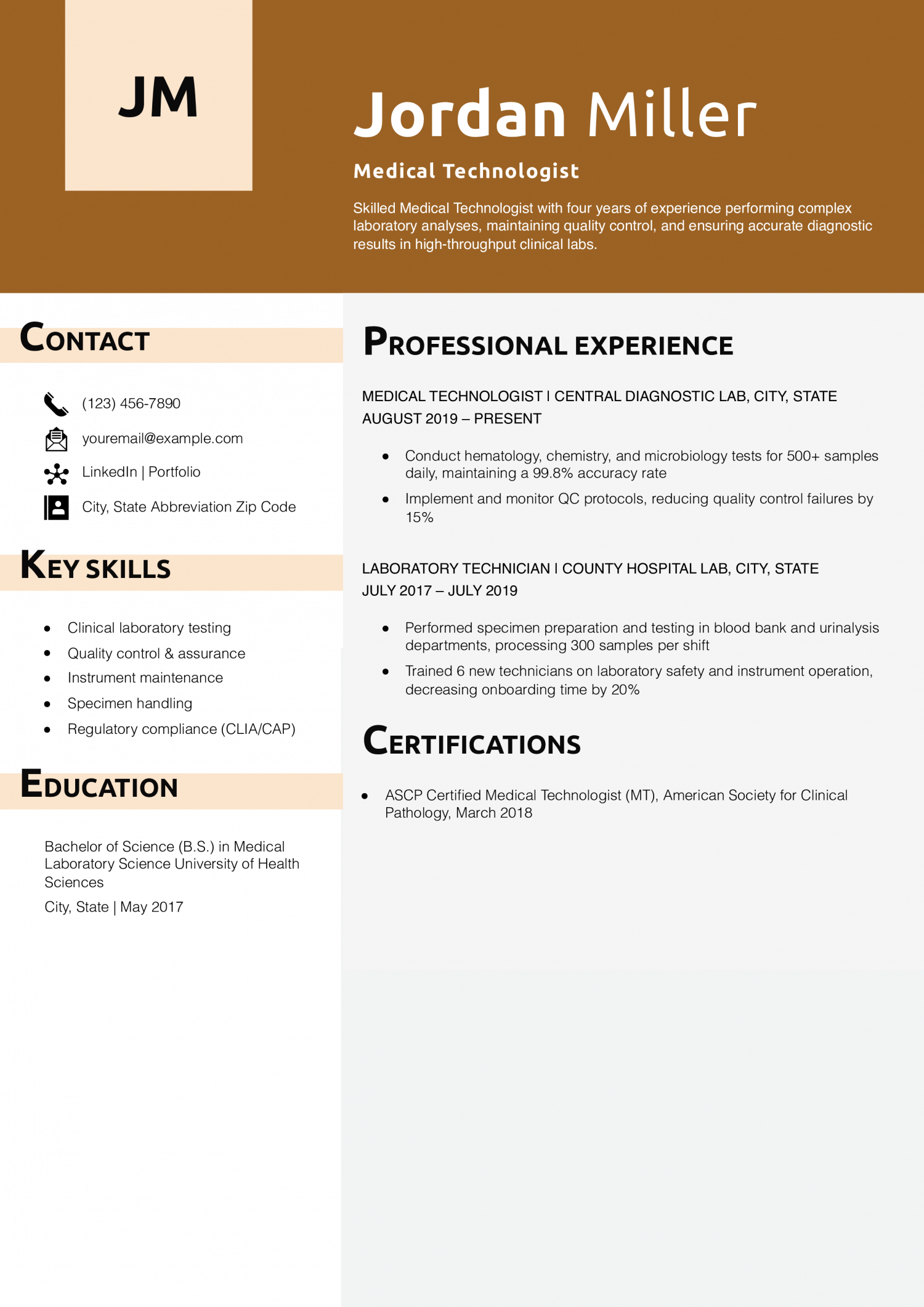
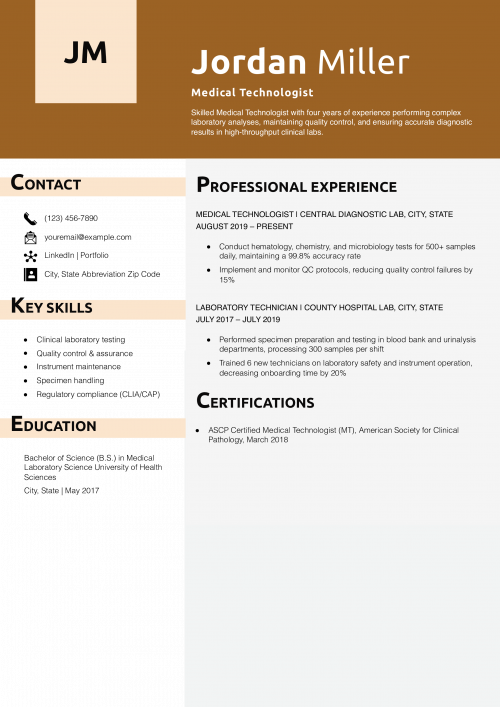
Jordan’s resume emphasizes both technical proficiency and quality control achievements, key for Medical Technologists. The clear structure and quantifiable results make their impact immediately evident.
Pair technical processes with outcome metrics to highlight reliability. For advice on listing technical skills, see Technical Skills in an IT Resume.
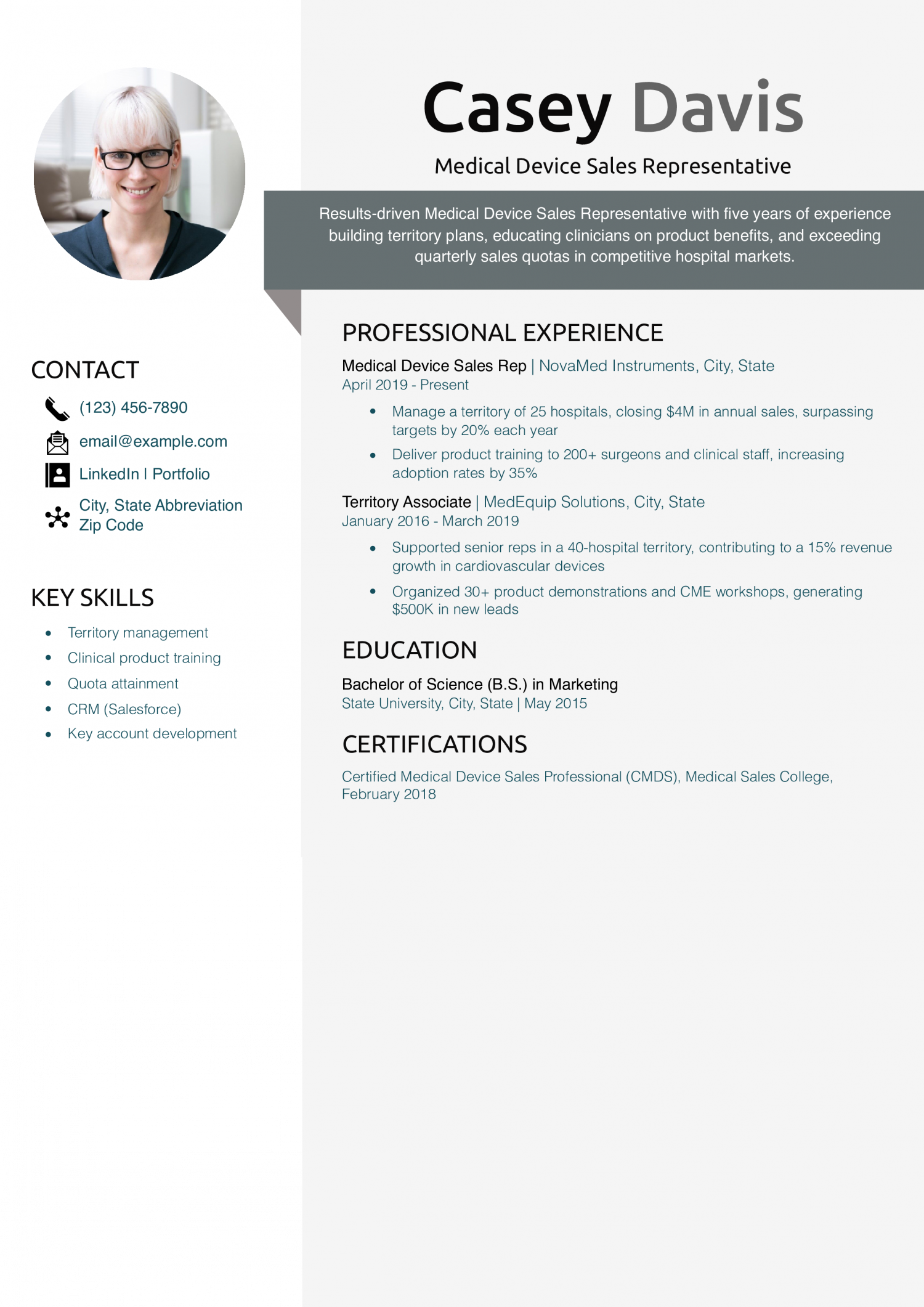
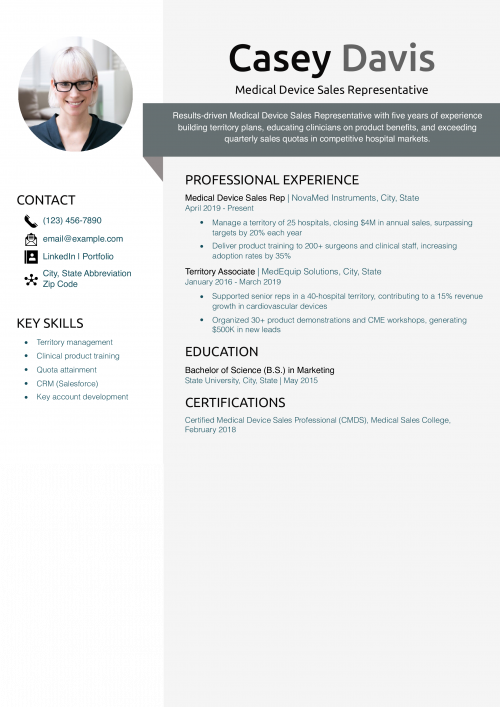
Casey’s resume highlights measurable sales achievements and clinician-training initiatives, key for a Medical Device Sales role. The bullet points pair responsibilities with revenue impacts, demonstrating clear business value.
Lead with your top sales metrics to capture recruiters’ attention. For ideas on quantifying achievements, see How to Make a Resume.
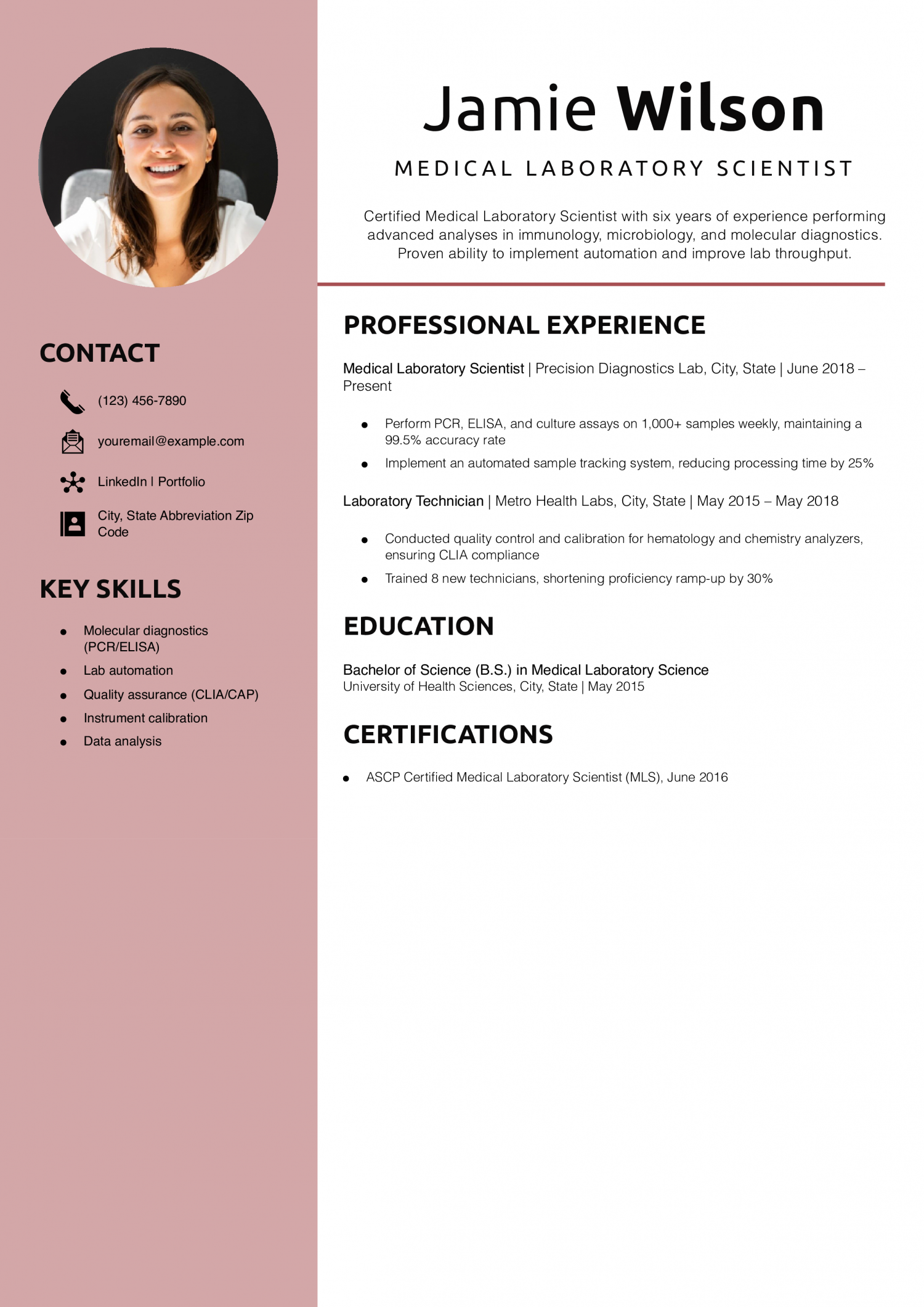
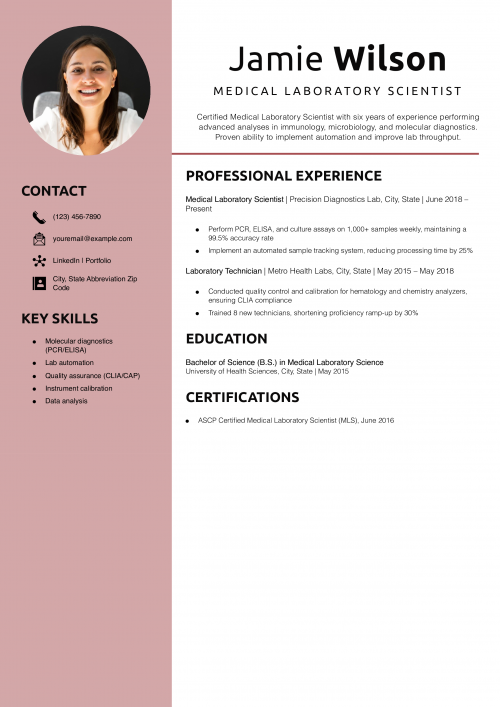
Jamie’s resume emphasizes both technical testing expertise and process improvements that enhance lab efficiency. Specific throughput metrics and automation initiatives clearly showcase their impact.
Showcase improvements in accuracy and throughput to highlight technical proficiency. For guidance on showcasing lab achievements, see Best Resume Formats.
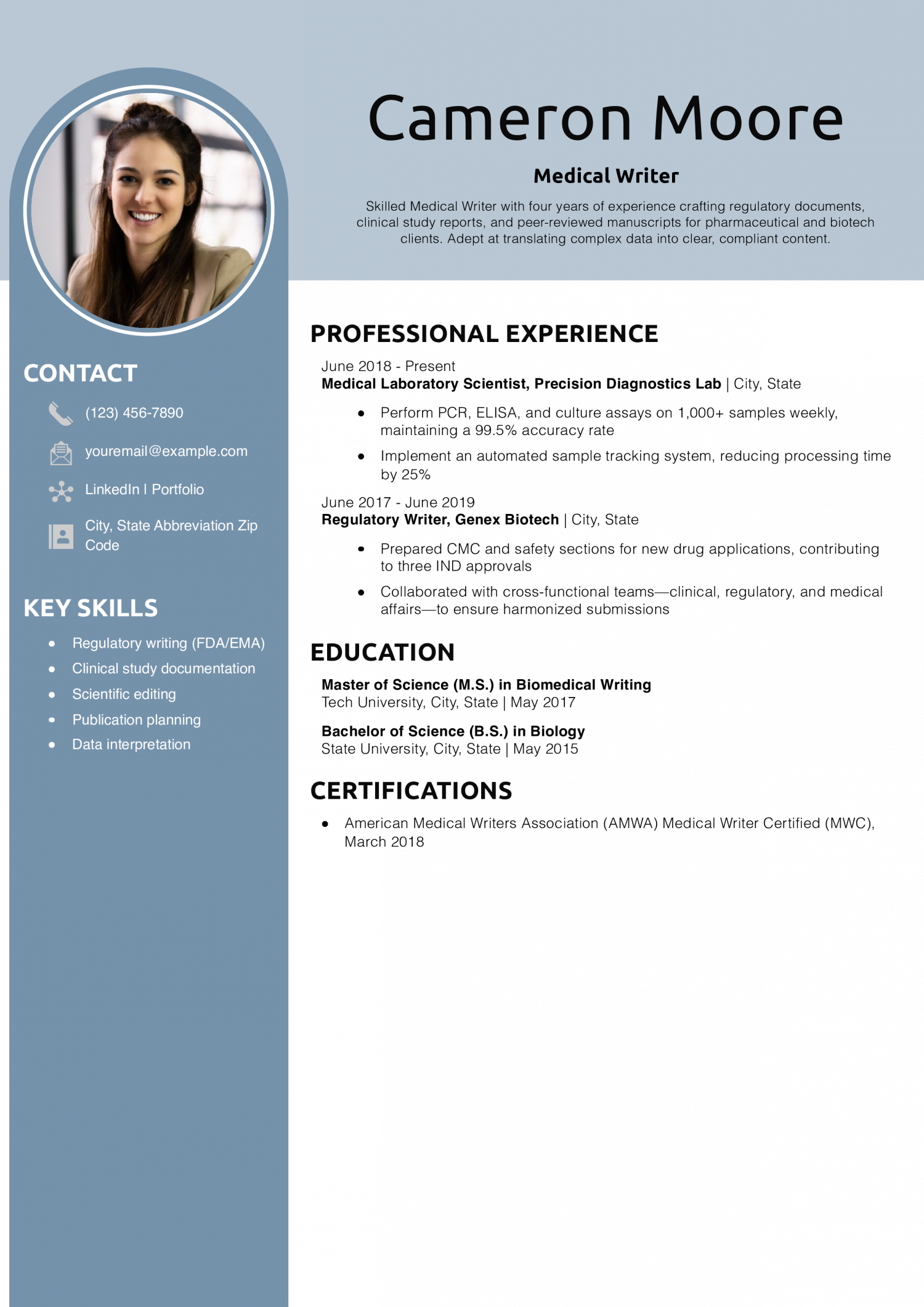
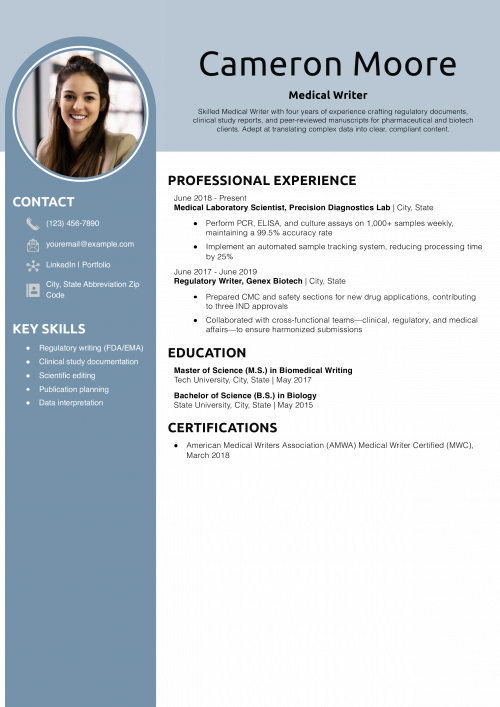
Cameron’s resume balances technical regulatory achievements with publication metrics, showcasing depth in both compliance and scientific communication. The concise bullets clearly map to key writing competencies.
Pair document types with outcomes, ike FDA approvals or publications, to highlight writing impact. For tips on structuring your profile, see Resume Objective Examples.
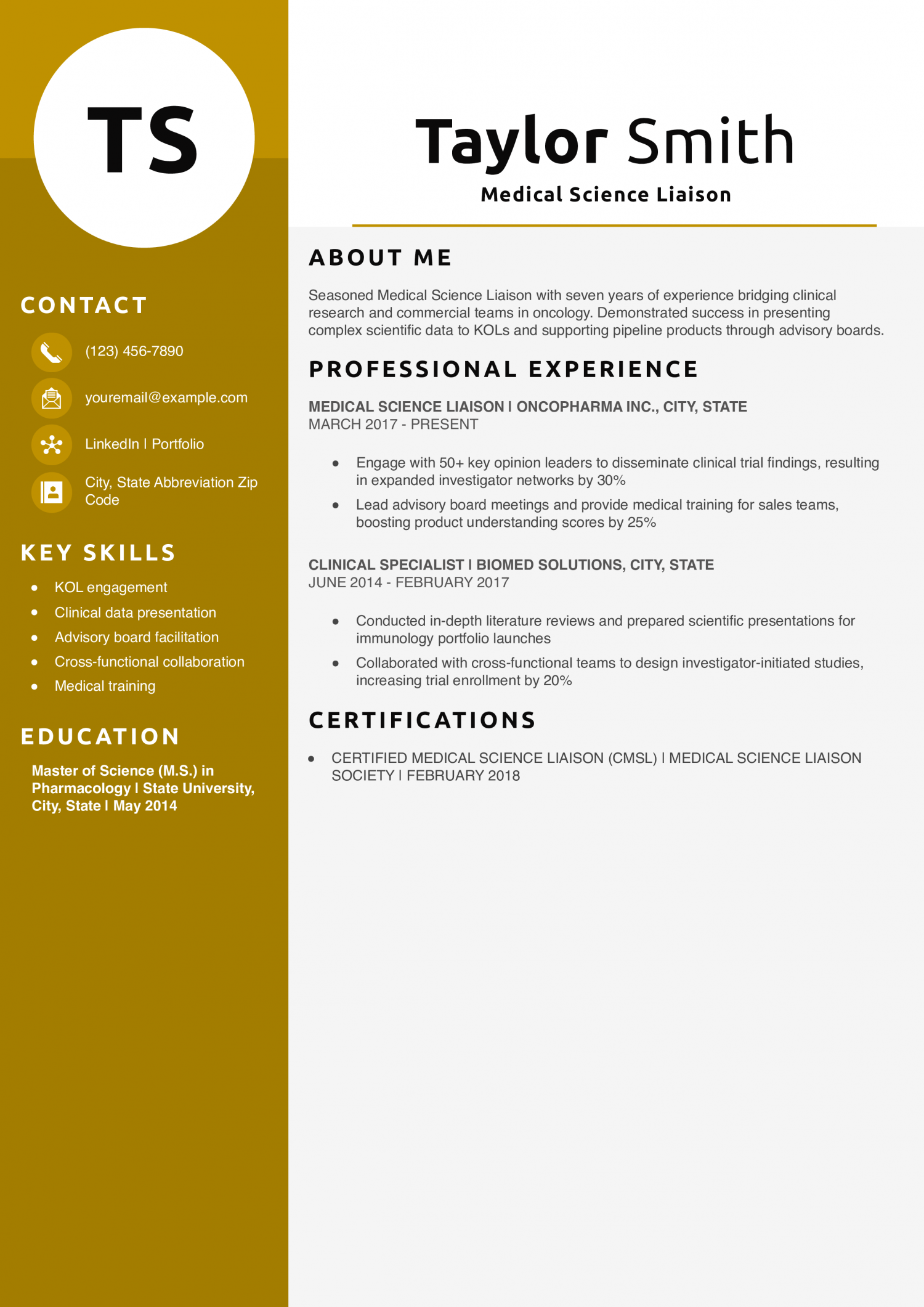
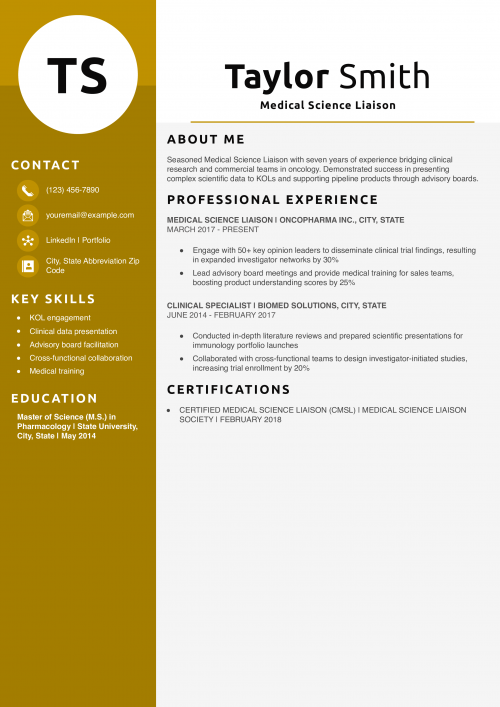
Taylor’s resume clearly demonstrates the MSL’s impact on KOL relationships and study enrollment with quantifiable outcomes. The combination of scientific expertise and cross-functional achievements makes this resume compelling.
Emphasize your scientific communication successes with specific audience and outcome details. For guidance on crafting an effective summary, see How to Write a Resume Summary.
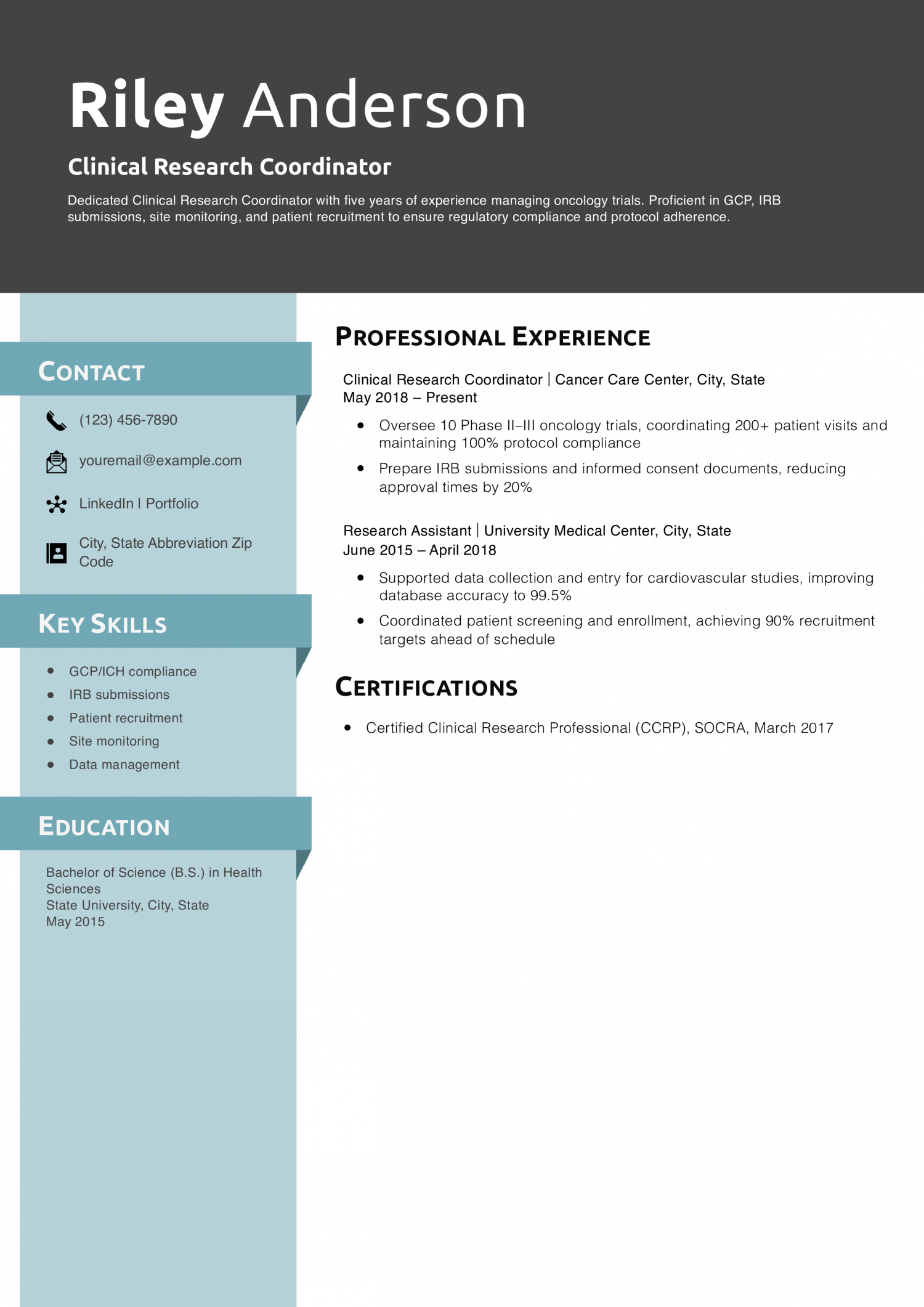
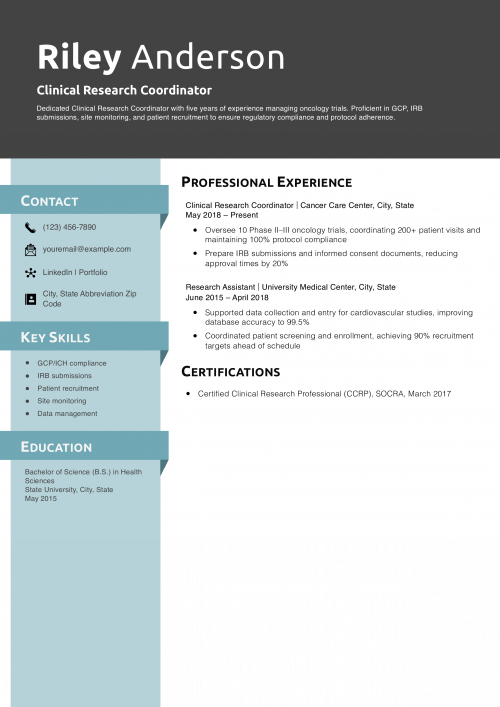
Riley’s resume combines regulatory achievements with patient-centric metrics that drive trial success. The IRB and recruitment improvements highlight operational excellence.
Focus on compliance and recruitment percentages to demonstrate trial management expertise. For more on tailoring clinical roles, see Resume Personal Statement Examples.

Morgan’s resume balances high-volume dispensing proficiency with critical safety and compliance achievements, demonstrating both speed and accuracy. The zero-contamination and reduced shortage metrics underscore operational excellence.
Emphasize error rates and safety outcomes to stand out in pharmacy roles. For more on structuring your skills section, check Skills to Put on Resume.
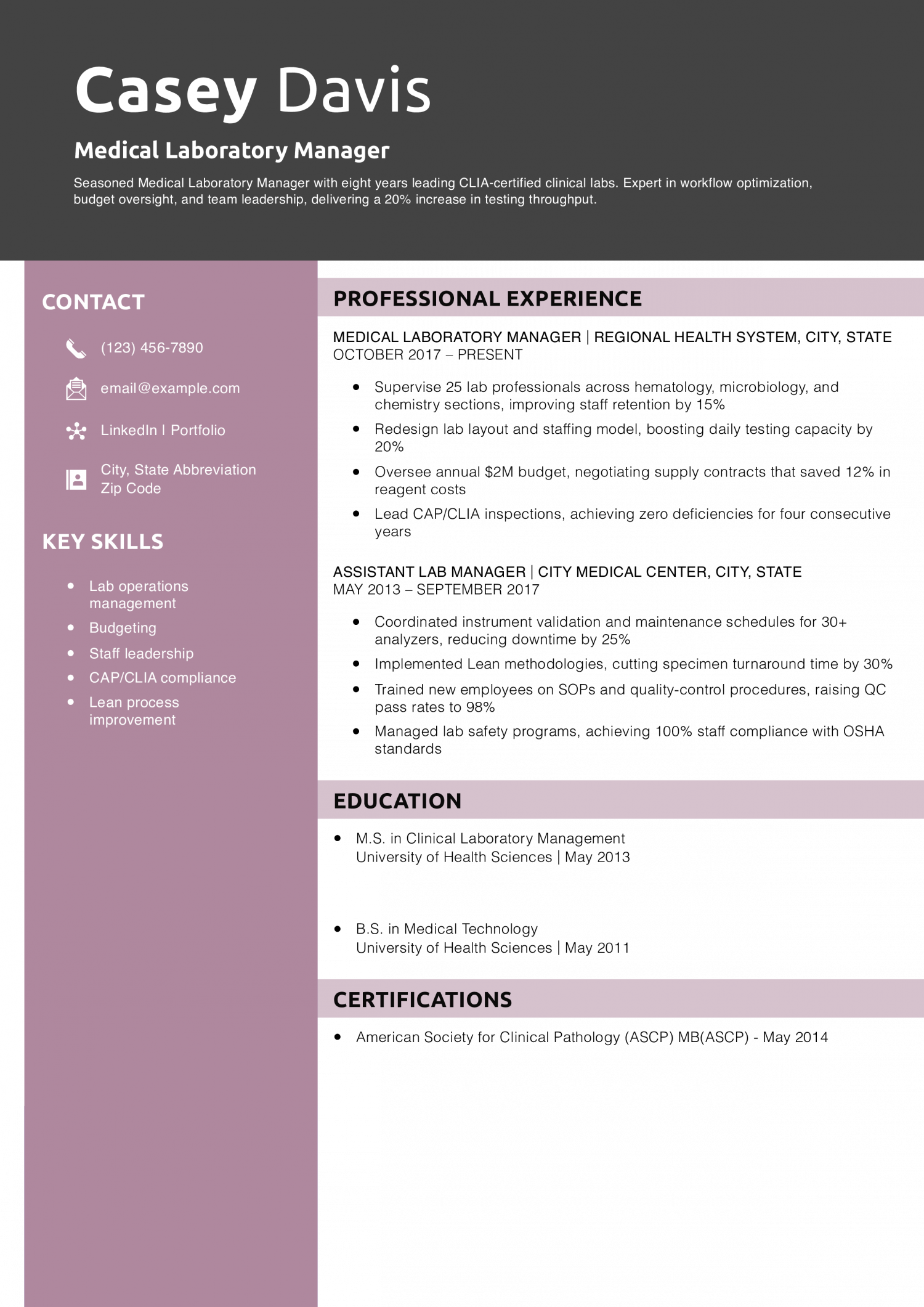
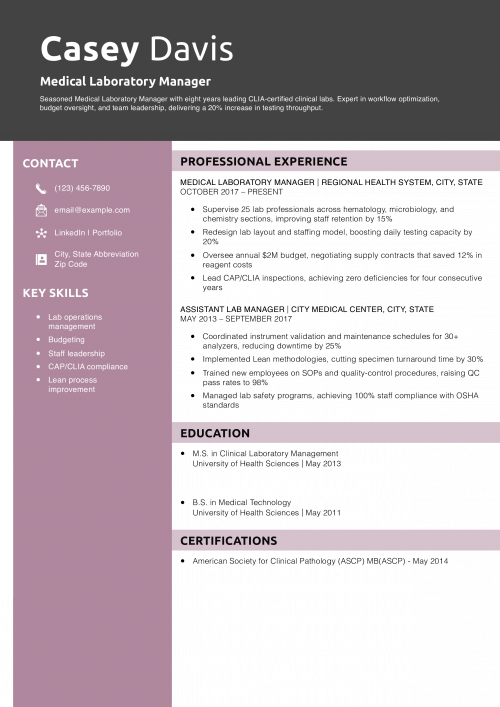
Casey’s resume highlights both leadership scope—managing twenty-five staff—and measurable improvements in throughput and cost savings, demonstrating strategic impact. The spotless inspection history reinforces a commitment to quality.
Show both people-management and operational metrics to illustrate full managerial capability. For ideas on formatting multi-role leadership resumes, see Best Resume Formats.
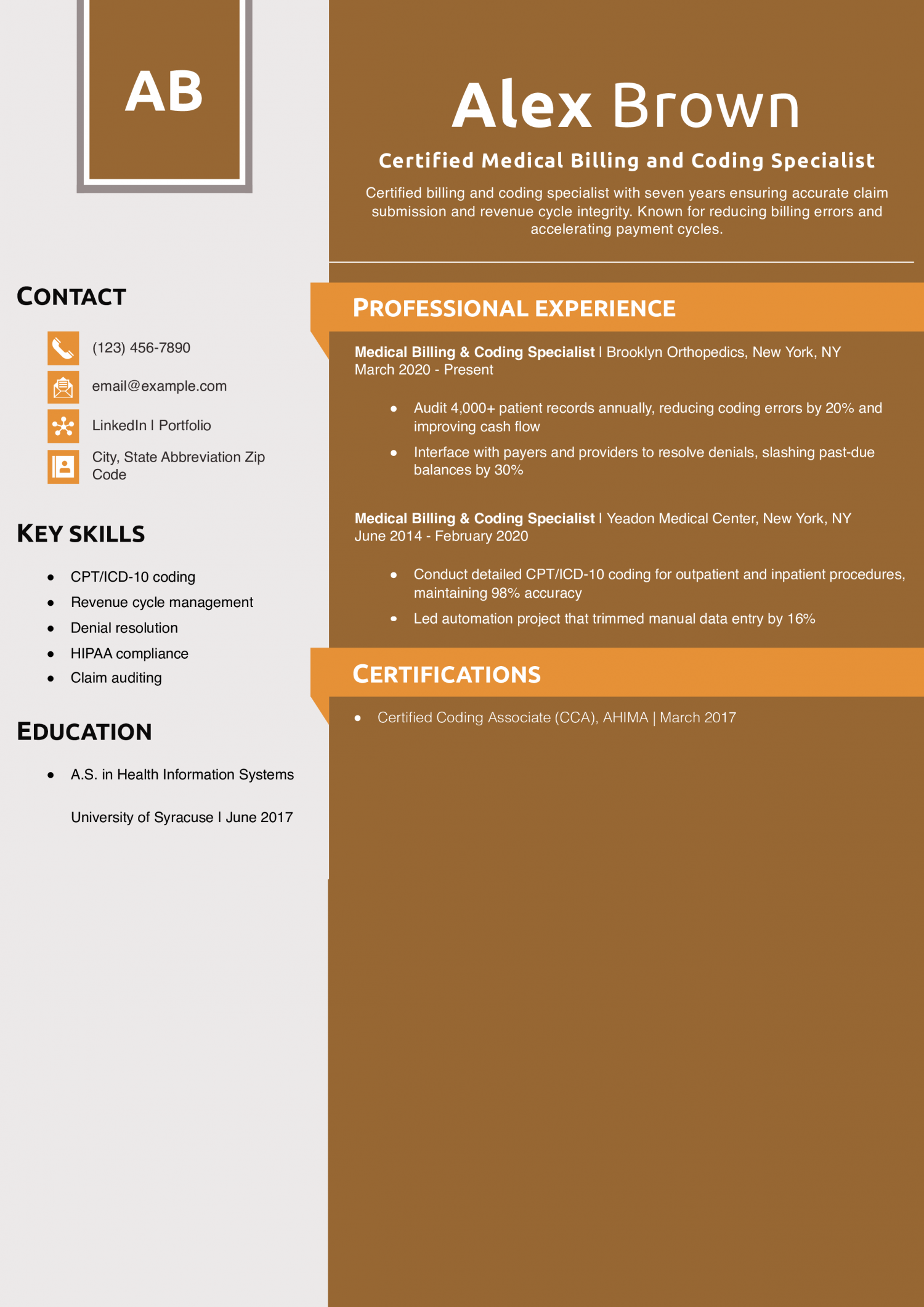
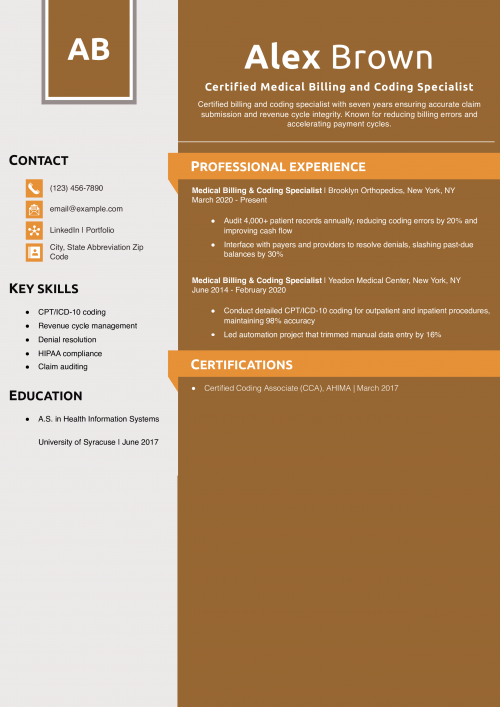
Alex’s resume quantifies error-reduction and cash-flow improvements—core metrics for coding roles. The dual-facility experience highlights adaptability in varied clinical settings.
Highlight error-rate reductions and audit volumes to showcase precision. For tips on emphasizing reimbursement achievements, see What to Put on a Resume.
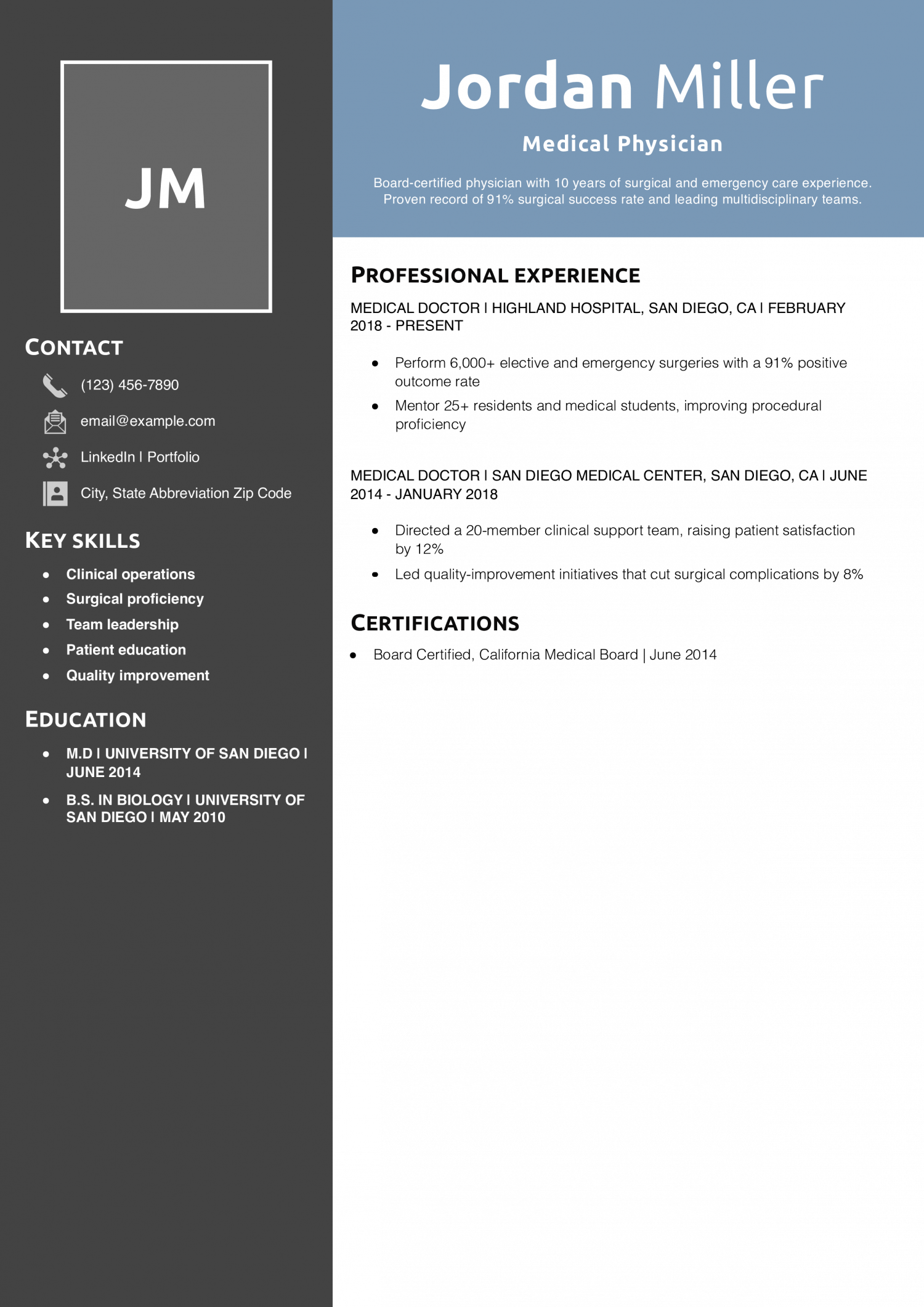
Jordan’s resume combines high surgical volume with measurable success rates, showcasing clinical expertise. Leadership and mentoring bullets emphasize team impact.
Lead with outcome metrics and teaching roles to underscore clinical and leadership strengths. For help crafting summaries, see How to Write a Resume Summary.
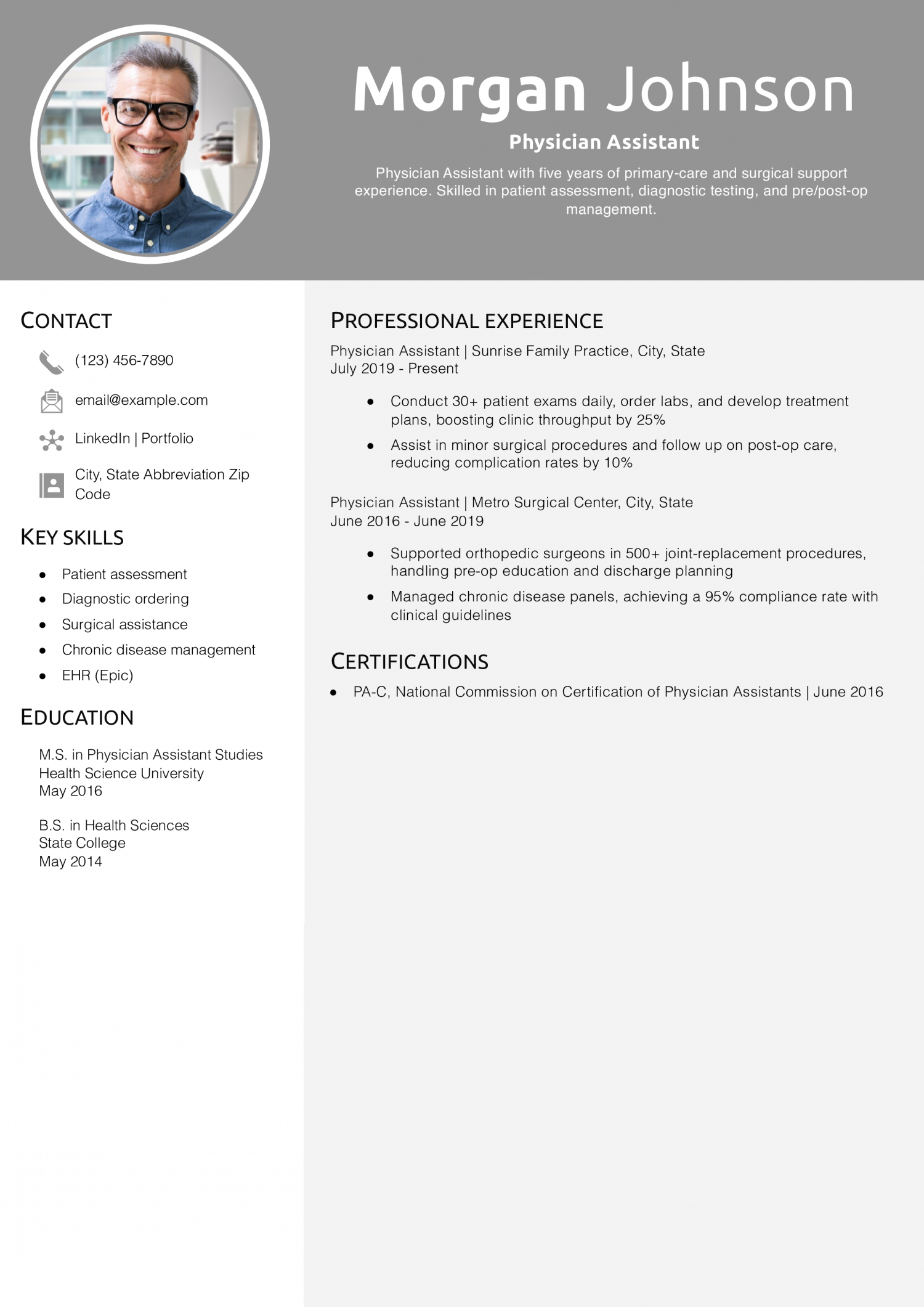
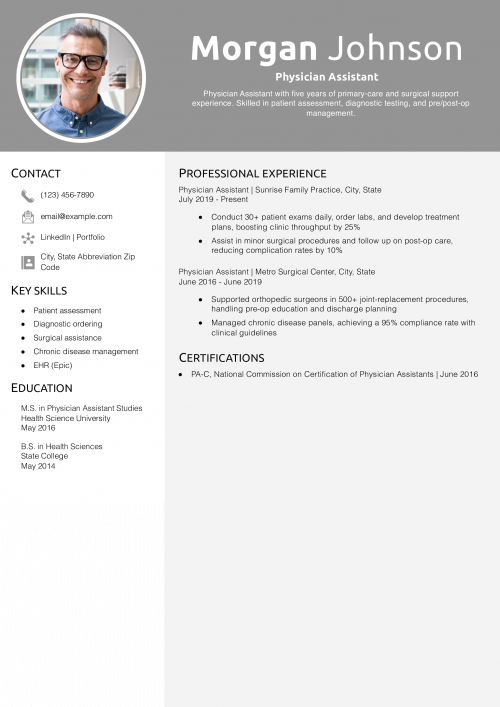
Morgan’s resume pairs patient-load metrics with complication-reduction outcomes—key for PA roles. Surgical and chronic-care experience demonstrate clinical versatility.
Quantify patient volume and clinical outcomes to highlight competence. For guidance on medical role formatting, see Server Job Description for Resume.
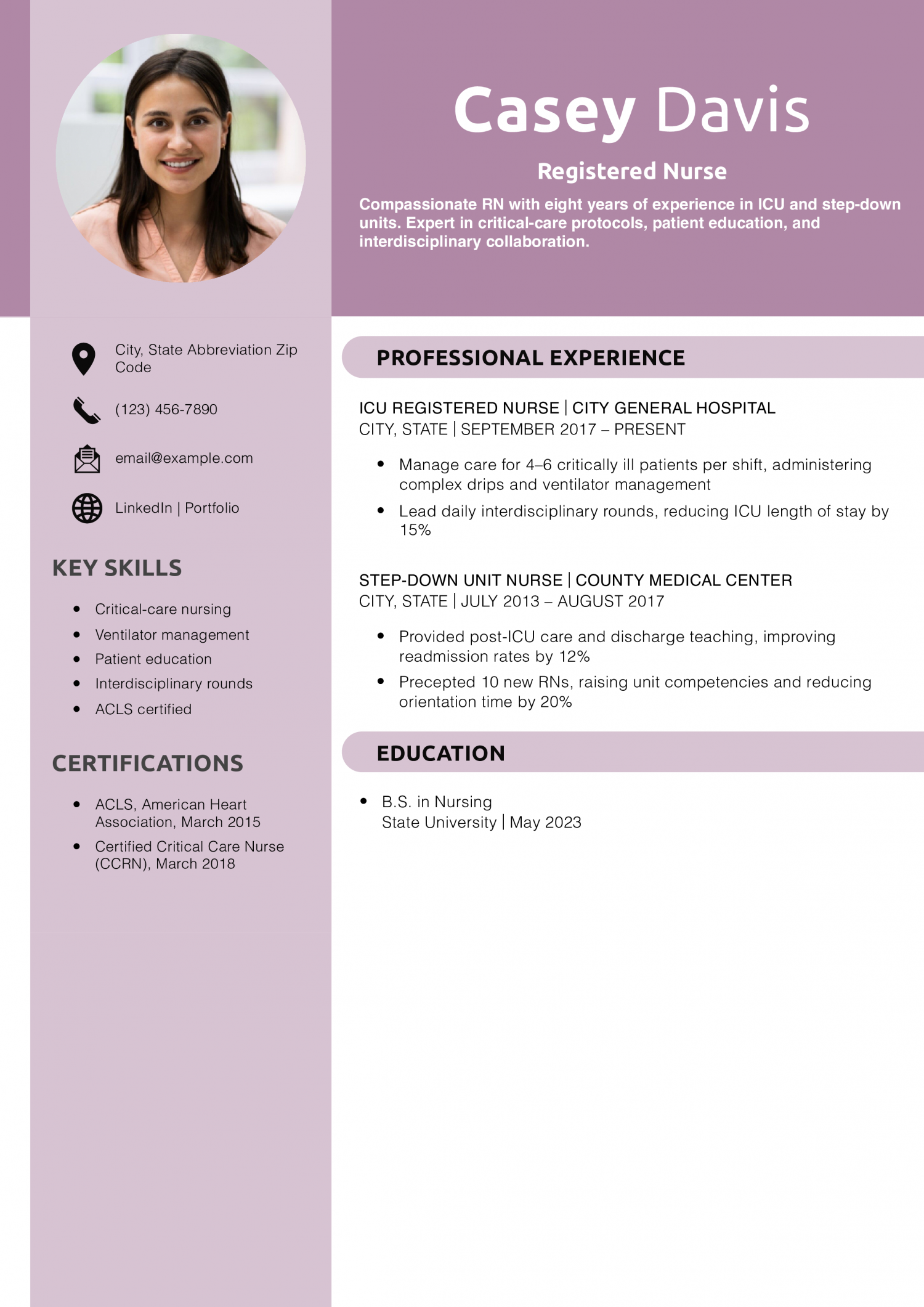
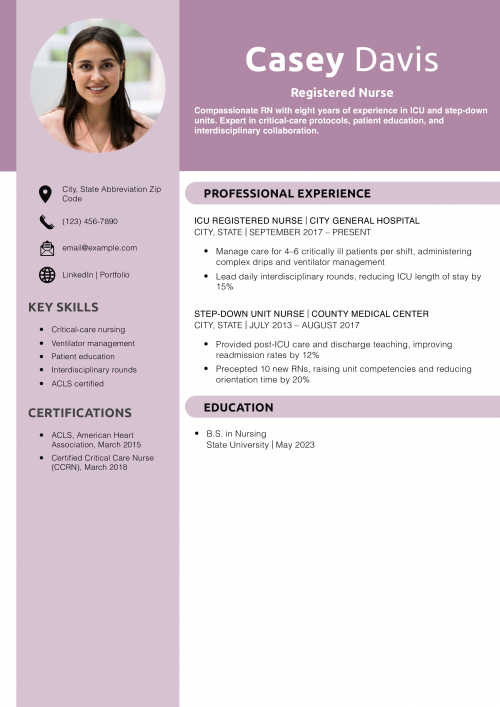
Casey’s resume highlights critical-care caseload and measurable readmission improvements, vital for ICU roles. Precepting achievements demonstrate leadership in nursing education.
Emphasize patient ratios and outcome metrics to showcase clinical impact. For tips on nursing-specific bullet points, see Nursing Skills for Resume.
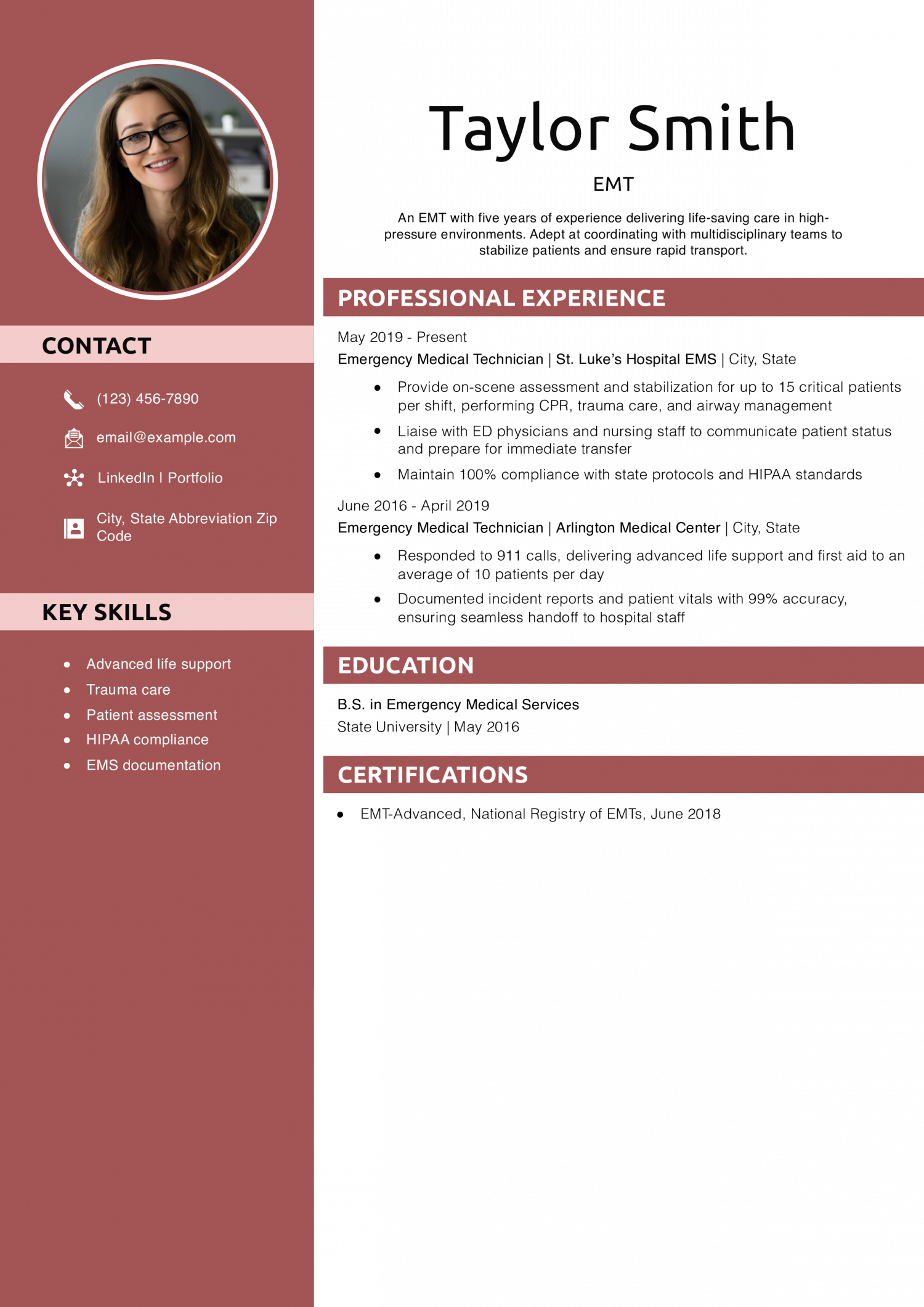
Taylor’s resume emphasizes critical, quantifiable patient-care metrics—essential for EMT roles. The clear timeline and compliance highlights reassure hiring managers of reliability under pressure.
Stress your patient-load capacity and compliance record to demonstrate dependability. For insights on structuring emergency-response achievements, see Best Resume Formats.
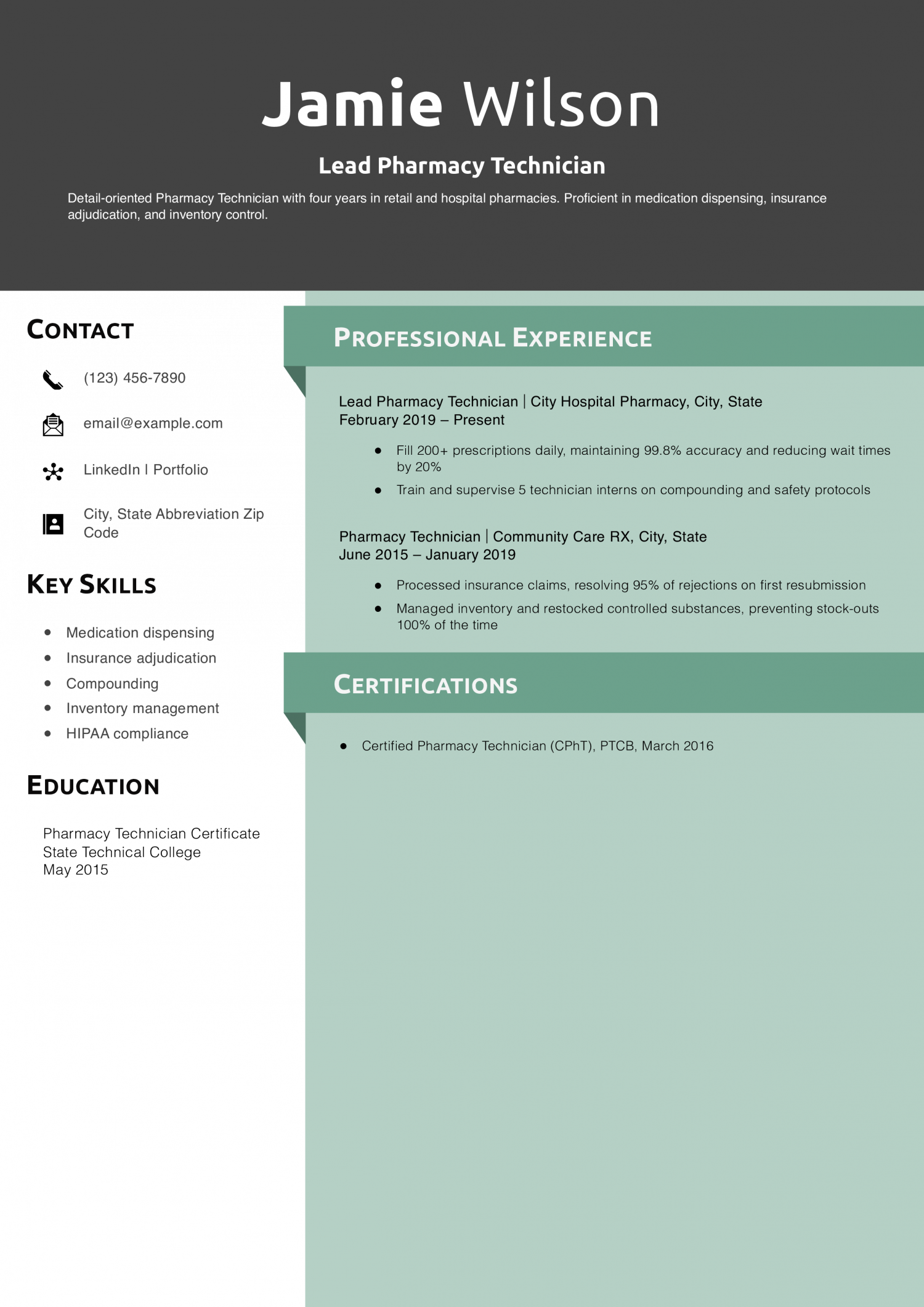
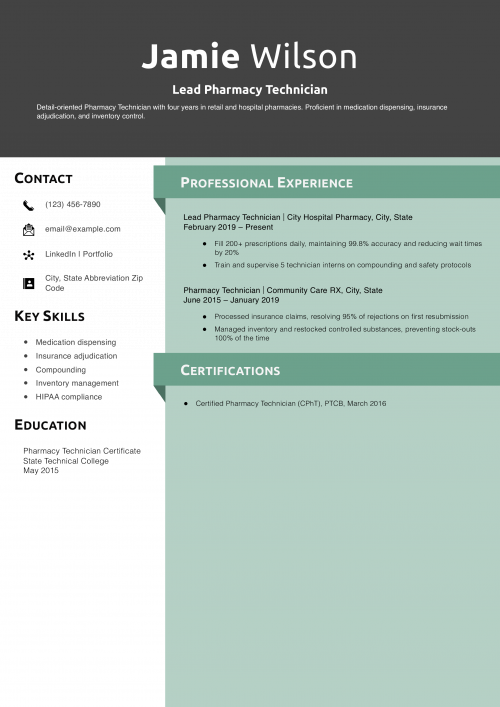
Jamie’s resume focuses on prescription volume and accuracy—core metrics for technicians. Supervisory and insurance-resolution successes demonstrate reliability and leadership.
Highlight accuracy rates and training roles to underscore trustworthiness. For guidance on entry-level to senior transitions, see How to Write a Resume With No Experience.
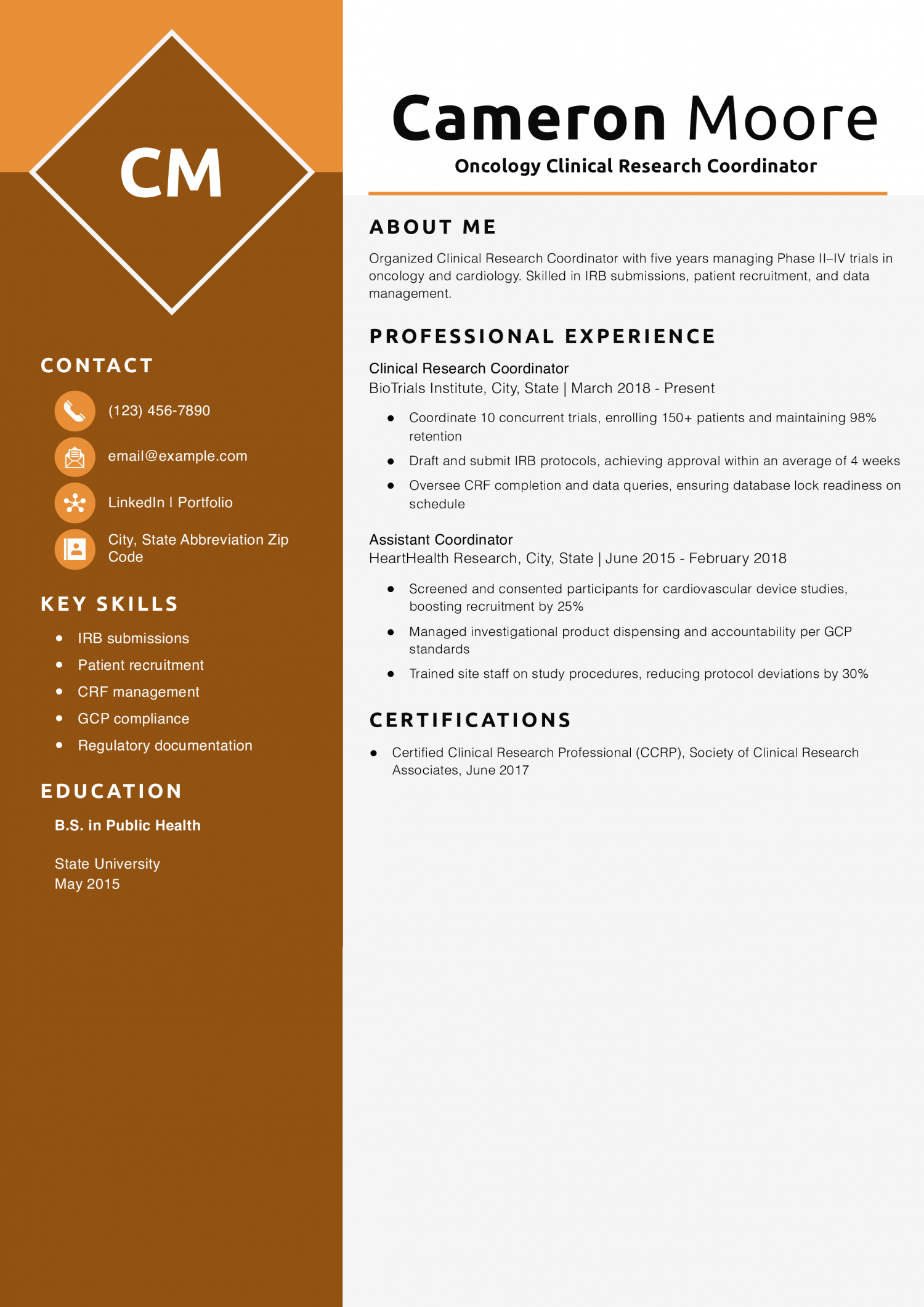
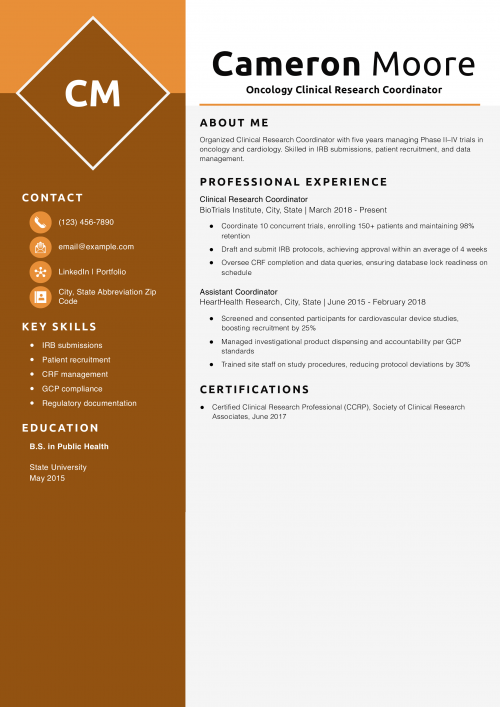
Cameron’s resume combines enrollment and retention statistics with rapid IRB-approval metrics—crucial for CRC roles. Protocol-deviation reductions illustrate process-improvement impact.
Quantify recruitment and retention to showcase study-management expertise. For more on highlighting research skills, see Work Experience on a Resume.
To help you organize your content effectively, use a professional template. Your medical assistant resume should include the following sections:
Provide your full name, phone number, email address, location, and a link to your online professional profile. Carefully review your contact information for accuracy to ensure potential employers can quickly contact you for an interview.
To grab the hiring manager’s attention quickly, you need an eye-catching professional summary that sets the tone for your medical resume. Start by detailing your job title, years of work experience, and three to four clinical specializations that match the role you’re interested in. Emphasize unique aspects of your journey within the medical field and your genuine passion for patient-centered care.
A dynamic medical doctor with 10 years of experience delivering patient-centered care to diverse populations in high-volume hospital environments. A proven track record of performing complex surgical procedures with a 91% success rate. Adept at leading medical teams and identifying opportunities to enhance clinical operations.
An emergency medical technician (EMT) with five years of experience delivering life-saving medical treatment to patients in various emergencies. Adept at coordinating with medical teams, law enforcement, and fire departments to provide exceptional care.
Illustrate your most impressive clinical achievements in the professional experience section of your medical resume. Craft impactful bullet points that convey the full breadth of your accomplishments and impact on patient lives. Highlight your ability to collaborate effectively with multi-disciplinary teams and deliver exceptional care to diverse patient populations.
Medical Doctor, Highland Hospital, San Diego, CA | February 2018 – present
Medical Billing and Coding Specialist, Brooklyn Orthopedics, New York, NY | March 2020 – present
Feature eye-catching numbers and clinical data to draw the reader’s eye and raise the effectiveness of your bullet points. Incorporate compelling metrics to give the hiring manager a better understanding of how your contributions impacted patients and medical organizations. For example, if you were a medical doctor, you might note the number of procedures you’ve performed or draw attention to a noticeably high success rate. If you worked in an administrative role, you could provide examples of you improving or automating internal processes.
Constantly adjust your medical resume to each job application. Pay attention to critical terms the organization seeks and integrate them into your skills section and bullet points. For instance, if a hospital mentions its commitment to patient-centered care, feature your experience as a patient advocate throughout the treatment process.
Even if you lack hands-on clinical experience, you can still build an effective medical resume to secure an entry-level position. In this situation, it’s best to prominently feature your education, medical certifications, and clinical skills to show potential employers that you have the qualifications to succeed in the role.
Education, industry certifications, and licenses are essential for most medical roles, so showcasing them effectively on your resume is important. Include your degrees, academic institution, and graduation dates. At the entry level, consider featuring academic awards and your GPA in this section. Certifications and licensure should be featured separately, and will vary greatly depending on your state and the type of medical position you’re pursuing. For example, a physician’s education and license requirements will differ significantly from those of an EMT or medical assistant.
Template:
[Degree Name and Major] | [Graduation Date]
[School Name] | [City, S.T.]
Example:
Associate of Science (A.S.), Health Information Systems | June 2017
University of Syracuse, New York, NY
Template:
[Certification Name] | [Awarding Organization] | [Completion Date]
Examples:
EMT-Advanced Certification | National Registry of Emergency Medical Technicians (Active), June 2019
Certified Coding Associate, American Health Information Management Association | 2017
In today’s job market, most health care organizations use ATS during the hiring process. To pass the initial screening, your resume must feature appropriate keywords and skills from the job posting. In addition to listing your skill sets, provide examples of applying them in clinical settings. This shows the hiring manager you have the medical knowledge and hands-on experience the organization seeks.
| Key Skills and Proficiencies | |
|---|---|
| Activities of daily living (ADLs) | Acute care |
| Clinical operations | Communication |
| Electronic health records (EHR) | Evidence-based treatment |
| HIPAA | Medication administration |
| Oncology | Patient advocacy |
| Patient education | Patient relations |
| Patient-centered care | Pediatric care |
| Prescription management | Wound care |
Incorporating strong action verbs is a great way to infuse proactive language into your resume. That said, diversify your word choice to keep your bullet points fresh and distinct from one another. We’ve compiled a list of action verbs you can use to craft the professional experience section of your medical resume.
| Action Verbs | |
|---|---|
| Administered | Conducted |
| Coordinated | Created |
| Delivered | Educated |
| Evaluated | Improved |
| Led | Managed |
| Monitored | Oversaw |
| Performed | Provided |
| Supervised | Supported |
| Trained | Treated |
Given the various options and styles available, selecting a suitable template for your medical resume can be confusing. The most important things to consider are how the template is organized and whether or not hiring managers can easily navigate your content. Also, be conservative regarding visual elements to avoid distracting the reader with flashy colors and graphics.
According to the Bureau of Labor Statistics, occupations within the health care field are expected to grow steadily, with over 1.8 million new openings yearly. Despite the need for skilled medical professionals, you must align your resume with the job description to capitalize on the most lucrative opportunities.
For example, if a hospital is looking for a medical doctor with experience performing bariatric surgeries, mention this aspect of your experience directly in your profile. If an organization is looking for a coding specialist with advanced CBT and ICD-10 systems knowledge, incorporate these skills into a bullet point.
Creating a Medical resume example that stands out involves focusing on your unique contributions. Whether you've worked in leadership, handled large budgets, or managed complex projects, showcase your experience with measurable results. Include your proficiency in relevant tools and technologies, and make sure your resume reflects your career trajectory in a clear and concise manner.
In most cases, reverse chronological is the ideal format for a medical resume. This approach makes your most recent work history the focal point of the document. Consider using a combination format at the entry-level or during a career transition, as this layout places your skills, certifications, and education further on the page.
Pair your medical resume with a powerful cover letter to make a lasting impression on the hiring manager. Communicate why you’re interested in this organization and how your background and values align with the hospital’s mission. Incorporate unique details about you as a health care professional that you wouldn’t normally feature on a resume.
Executive Resume Writer and Career Coach
Andrew Stoner is an executive career coach and resume writer with 17 years of experience as a hiring manager and operations leader at two Fortune 500 Financial Services companies, and as the career services director at two major university business schools.
Resume Templates offers free, HR approved resume templates to help you create a professional resume in minutes. Choose from several template options and even pre-populate a resume from your profile.